
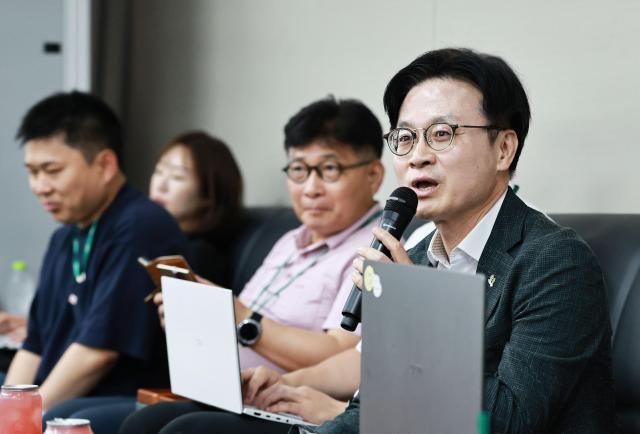
On June 23, the Ministry of Trade, Industry and Energy held the first meeting of the Korea-U.S. Strategic Investment Project Management Committee, chaired by Minister Kim Jeong-kwan. The committee consists of 20 members, including nine ex-officio members and 11 representatives from policy finance institutions and the private sector.
The committee was established under the U.S. Investment Special Act, which took effect on June 18. Prior to the act's implementation, the government operated a temporary management system. With the special act now in effect, the temporary system has been terminated, and the committee will officially oversee the review of strategic investments in the U.S.
The committee, established under the Ministry of Trade, Industry and Energy, serves as the first gateway in the domestic process for deciding on U.S. investments. It will evaluate the commercial viability of candidate projects, along with strategic and legal considerations, the participation of domestic companies, and support from the U.S. government.
However, the committee will not make final investment decisions. After the committee reviews candidate projects, the operational committee under the Korea-U.S. Strategic Investment Corporation will deliberate and decide on project execution, funding management, and remittances. Following this, reports or approvals will be submitted to the National Assembly, leading to negotiations with the U.S. The committee acts more as a filter to assess whether the projects possess the economic and strategic merits necessary for advancement.
During the first meeting, members discussed the review framework and basic operational plans of the committee, as well as strategies for transferring responsibilities from the temporary management system to ensure continuity of operations. They agreed on the importance of smoothly transitioning the work previously reviewed by the temporary system to the committee, emphasizing the need to quickly identify and evaluate new U.S. investment projects.
The status of candidate projects for U.S. investment and subsequent review strategies were also on the agenda. Members concurred on the necessity of thoroughly verifying the primary criterion of commercial viability for candidate projects. They also agreed to comprehensively consider strategic benefits, such as expanding the entry of domestic companies into the U.S. market.
Minister Kim Jeong-kwan remarked the previous day regarding the first U.S. investment project, stating, "We will assess whether it will be the first project or if several will emerge together as we monitor the situation. With the establishment of the U.S. Investment Corporation, we are following the necessary procedures."
At the meeting, Minister Kim emphasized that the committee has been entrusted with the significant role of objectively and transparently verifying the core principle of commercial viability in U.S. investments. He urged members to focus their efforts on generating diverse benefits for various domestic companies and industries through these investments.
* This article has been translated by AI.
Copyright ⓒ Aju Press All rights reserved.