
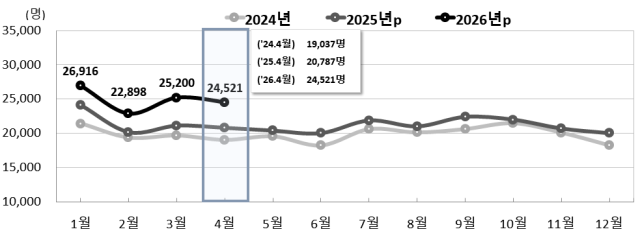
In April 2026, the number of births increased by 3,734, or 18.0%, compared to the same month last year, totaling 24,521. This marks the 22nd consecutive month of rising birth rates since July 2024.
The total fertility rate, which represents the average number of children a woman is expected to have in her lifetime, rose to 0.93, an increase of 0.13 from the previous year. Births increased across all regions for three consecutive months.
The composition of births by order showed that the percentage of first and second children increased by 0.3 percentage points each compared to last year, while the share of third children and beyond decreased by 0.7 percentage points.
In April, the number of deaths was recorded at 28,405, a decrease of 386, or 1.3%, from April of the previous year. While deaths increased in four regions, including Busan and Incheon, they decreased in 12 regions, including Seoul and Daegu, with Gyeongnam remaining stable.
The overall population, after accounting for deaths, saw a natural decline of 3,884. This marks the 78th consecutive month of natural population decline since November 2019.
During this period, the number of marriages increased by 1,703, or 9.0%, to 20,622 compared to the same month last year. In the same month, divorces totaled 7,829, an increase of 531, or 7.3%.
Last month, the number of movers was 466,000, a decrease of 7,000, or 1.5%, from the previous year. Among the total movers, 65.0% relocated within the same region, while 35.0% moved between regions.
The population mobility rate, which indicates the number of movers per 100 people, was 10.8%, down 0.2 percentage points from May of last year.
Net migration varied by region, with Gyeonggi (2,433), Chungnam (1,284), and Incheon (1,237) experiencing net inflows, while Seoul (-4,221), Gyeongbuk (-663), and Ulsan (-646) faced net outflows.
* This article has been translated by AI.
Copyright ⓒ Aju Press All rights reserved.