
[Source: Rural Development Administration]
Feeding Korean cattle with self-mixed total mixed ration (TMR) has resulted in an 11.3% reduction in feed costs and a two-month decrease in the age at which cattle are ready for market.
On June 24, the Rural Development Administration (RDA) announced these findings at a press conference in Sejong City, detailing the achievements of TMR technology and its dissemination model. TMR feed allows farmers to create customized feed by mixing agricultural byproducts such as spent grain, soy milk residue, and mushroom waste, moving away from purchasing pre-made feed from factories. This approach is gaining attention as a way to reduce reliance on imported feed ingredients and lower production costs.
Since 2018, the RDA has conducted pilot projects in 42 farms across 16 cities and counties to verify the effectiveness of TMR technology in real-world applications.
According to the RDA, the pilot projects demonstrated both cost savings and improved productivity. The age at which cattle are ready for market decreased from 30.9 months to 28.5 months, while feed costs were reduced by 11.3%. Additionally, the rate of cattle achieving a quality grade of 1+ or higher increased from 65.6% to 72.4%. Farmers' incomes also rose by 41.6% compared to before implementing TMR.
Jo Yong-min, head of the RDA's National Institute of Animal Science, stated, "This research confirms that nutritional management of pregnant cows can impact the growth and meat quality of calves. It presents a new direction for managing breeding cattle and producing high-quality meat."
However, high initial investment costs and the complexity of manufacturing techniques remain obstacles to wider adoption of TMR. To address this, the RDA is collaborating with the National Korean Cattle Association and the Korean Cattle Promotion Fund to provide technical training and on-site consulting. The RDA plans to expand TMR facilities to 18 locations by 2027.
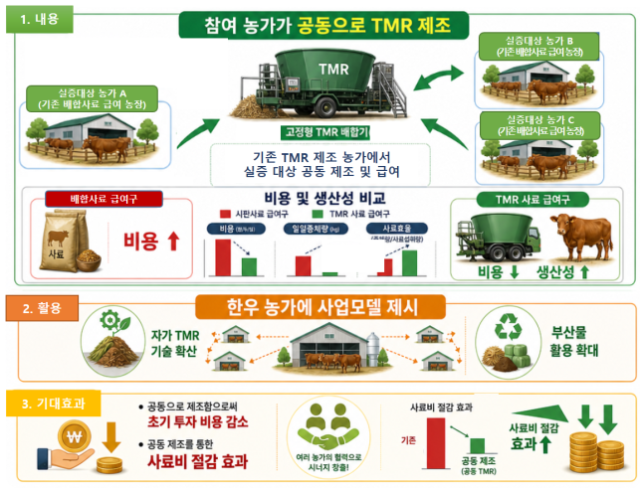
Additionally, the RDA is exploring a cooperative manufacturing model to alleviate the initial investment burden on farmers. This model would allow multiple farms to share resources for securing raw materials and manufacturing facilities, thereby reducing individual costs.
Jo emphasized, "Based on the verified results, we will expand support for cooperative manufacturing models that can reduce farmers' adoption burdens and continue to develop and disseminate technology tailored to various farming conditions."
On June 24, the Rural Development Administration (RDA) announced these findings at a press conference in Sejong City, detailing the achievements of TMR technology and its dissemination model. TMR feed allows farmers to create customized feed by mixing agricultural byproducts such as spent grain, soy milk residue, and mushroom waste, moving away from purchasing pre-made feed from factories. This approach is gaining attention as a way to reduce reliance on imported feed ingredients and lower production costs.
Since 2018, the RDA has conducted pilot projects in 42 farms across 16 cities and counties to verify the effectiveness of TMR technology in real-world applications.
According to the RDA, the pilot projects demonstrated both cost savings and improved productivity. The age at which cattle are ready for market decreased from 30.9 months to 28.5 months, while feed costs were reduced by 11.3%. Additionally, the rate of cattle achieving a quality grade of 1+ or higher increased from 65.6% to 72.4%. Farmers' incomes also rose by 41.6% compared to before implementing TMR.
Jo Yong-min, head of the RDA's National Institute of Animal Science, stated, "This research confirms that nutritional management of pregnant cows can impact the growth and meat quality of calves. It presents a new direction for managing breeding cattle and producing high-quality meat."
However, high initial investment costs and the complexity of manufacturing techniques remain obstacles to wider adoption of TMR. To address this, the RDA is collaborating with the National Korean Cattle Association and the Korean Cattle Promotion Fund to provide technical training and on-site consulting. The RDA plans to expand TMR facilities to 18 locations by 2027.
Additionally, the RDA is exploring a cooperative manufacturing model to alleviate the initial investment burden on farmers. This model would allow multiple farms to share resources for securing raw materials and manufacturing facilities, thereby reducing individual costs.
Jo emphasized, "Based on the verified results, we will expand support for cooperative manufacturing models that can reduce farmers' adoption burdens and continue to develop and disseminate technology tailored to various farming conditions."
* This article has been translated by AI.
Copyright ⓒ Aju Press All rights reserved.