
SEOUL, June 24 (AJP) - Gambling used to be a taboo word in South Korea. Real-money betting is prohibited in online games, as are casinos, bingo and lotteries for most citizens.
But illegally, online gambling is proliferating — and increasingly invading classrooms.
The episode in Netflix's hit drama "Teach You a Lesson," in which an ordinary high school student becomes addicted to gambling, destroys his family life and is eventually pulled into a criminal ring to repay debts, is hardly an exaggeration.
In reality, the touts are no longer human.
They are AI-driven advertisements, proxy sites and incessant pop-up attacks that relentlessly target teenagers' smartphones.
"Teenagers are easily attracted by lotteries and dreams of sudden wealth," said Jeong You-seon, a counselor who has worked at both middle and high schools in Seoul.
Apparently harmless fruit-matching game often serves as the gateway.
In academically competitive districts, gambling may remain confined to a smaller group of students. In some vocational schools, however, it can spread much more widely.
"People watch these stories on television dramas and think they are fictional," Jeong said.
"They are not. They are based on reality."
One former student she counseled became so consumed by online gambling that he began directing other students to earn points and money for him. He borrowed cash from friends and stole money from home to continue betting.
His case is hardly unusual.
In a recent self-reporting campaign run by the National Police Agency, nearly 300 teenagers came forward in just one month.
One high school in Gangwon Province recorded 48 self-reported cases, while another in the same province reported 20. Gangwon is home to the country's only casino open to Korean nationals.
Among the students was a 15-year-old boy in Incheon who told authorities he had accumulated about 30 million won ($19,500) in gambling debt. He assaulted his mother after she refused to repay 4 million won and later attempted suicide.
In another extreme case, a 17-year-old school dropout in North Jeolla Province repeatedly ran away from home and broke into vehicles to finance his gambling habit. Over 14 months, he deposited about 16 million won into online gambling sites.
The cases offer a glimpse into what experts increasingly describe as one of the most underrecognized threats facing South Korean adolescents: the rapid spread of online gambling through smartphones, social media and gaming platforms.
Police data show the average teenage self-reporter had gambled for about a year and wagered roughly 3 million won. The highest reported amount reached 60 million won.
Boys accounted for 93 percent of those who came forward.
The problem extends well beyond high schools. Four in 10 self-reporters were middle school students.
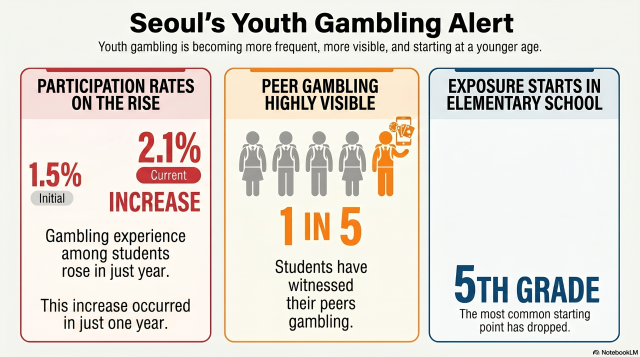
A survey by the Seoul Metropolitan Police Agency last year of nearly 35,000 students found that 2.1 percent had gambling experience, up from 1.5 percent a year earlier. More strikingly, one in five students said they had witnessed gambling among their peers.
The age of first exposure is also falling.
Fifth grade in elementary school emerged as the most common starting point, replacing the first year of middle school in the previous survey.
Most gambling now takes place online. Students reported participating in esports betting, online instant-win games and illegal internet casinos, with nearly two-thirds using smartphones as their primary device.
For Bhang Soo-young, a psychiatrist at Nowon Eulji University Hospital and director of the Nowon District Comprehensive Addiction Management Center, the statistics merely confirm what she already sees in her clinic.
"The problem is much bigger than most people realize," Bhang said.
"Many teenagers believe everyone around them is gambling. Once they think all their friends are doing it, gambling starts to feel normal."
She said adolescents are particularly vulnerable because they are drawn to the promise of easy money without the effort associated with part-time work or traditional employment.
Some of the teenagers she treats have accumulated debts that would overwhelm many adults.
"I have seen cases where debts reached 150 million won," she said.
"Families initially try to repay the money, but eventually they can no longer keep up."
As debts mount, gambling often spills into other forms of delinquency and crime.
Teenagers may begin extorting classmates, stealing or carrying out online scams in an attempt to recoup losses, Bhang said. In many cases, authorities first discover gambling only while investigating another crime.
"Students are often not caught because of gambling itself," she said. "They are caught because they committed another offense, and gambling turns out to be the reason."
Researchers and counselors warn that gambling addiction may be particularly damaging during adolescence, when the brain is still developing.
Bhang compared the neurological effects of severe gambling addiction to those observed in drug addiction, citing impaired impulse control, attention and decision-making.
"The attraction can be as powerful as what drug addicts describe," she said.

Police investigators say the typical adolescent gambler falls between the ages of 14 and 18.
"We are currently investigating cases involving a high school student who gambled more than 10 million won and a middle school student who gambled more than 1 million won," said a Seoul police officer who handles juvenile gambling cases.
The consequences often extend far beyond financial losses.
According to the Seoul police survey, some students funded gambling through extortion, fraud and school violence. Others relied on unauthorized microloans known as "proxy loans," an illegal lending practice widely advertised on social media.
The arrangements often involve less than $100 but carry exorbitant fees and penalties that can exceed legal interest-rate limits many times over.
Because many teenagers lack financial literacy and are reluctant to seek help from parents or authorities, they become easy targets for exploitation.
Police extended the voluntary reporting program through the end of August and are encouraging teenagers and parents to come forward without fear of punishment.
The battle won't likely be an easy one as the danger will always be literally at hand.
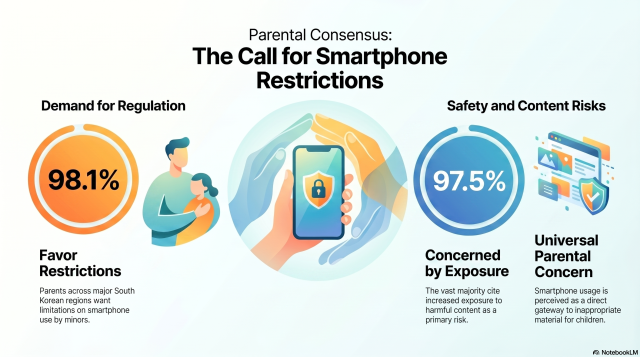
A survey released Tuesday by Democratic Party lawmaker Kim Young-ho, 98.1 percent of parents across Seoul, Incheon and South Gyeongsang Province wanted some restrictions on smartphone use by minors. The majority also cited smartphones increase children's exposure to harmful content (97.5 percent).
For a generation raised on games, the line between play and betting is disappearing — and by the time parents, schools, and society notice, the addiction may already be entrenched.
Copyright ⓒ Aju Press All rights reserved.