
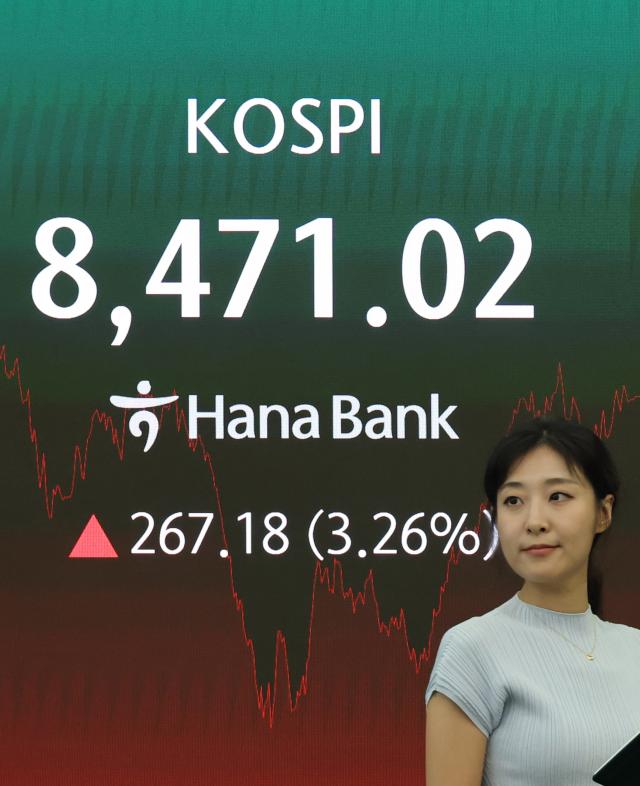
Concerns over foreign net selling and the rebalancing of the National Pension Service (NPS) are increasing uncertainty in the domestic stock market. Online communities are buzzing with claims that the pension fund will dump over 50 trillion won in assets all at once, which is dampening investor sentiment. However, analysts believe the actual impact on the market will not be as severe as feared.
On June 24, the Korea Exchange reported that the KOSPI closed at 8,471.02, up 3.26% from the previous trading day, as individual investors took advantage of lower prices following a 9.9% drop. However, foreign investors continued their selling spree, offloading 4.6 trillion won in stocks. The KOSPI 200 Volatility Index (VKOSPI), often referred to as Korea's fear index, surged to 95.45 during the day, marking its highest level of the year.
This anxiety is also reflected in online discussions. Posts on the workplace community Blind include statements like, "July, when the pension fund rebalances, will mark the beginning of a major crash," and "The sell-off is imminent, and the pension fund will soon realize profits."
Despite these fears, analysts suggest that even if the NPS adjusts its asset allocation, the likelihood of a massive sell-off occurring all at once is low. The recent surge in the KOSPI has pushed the NPS's domestic stock holdings above its target, necessitating a rebalancing. However, releasing tens of trillions of won in assets at once could shock the market and harm the fund's returns.
Lee Jong-hyung, head of Kiwoom Securities, stated, "The scenario of a 50 to 60 trillion won sell-off happening all at once starting in July is unrealistic. It is more likely that they will manage daily selling volumes and distribute sales over an extended period, limiting the potential shock to the KOSPI's upward trend."
Similarly, Lee Kyung-min, a researcher at Daishin Securities, expressed a similar view. He noted, "If the Korean pension funds needed to sell over 50 trillion won for rebalancing by the end of June, we would have seen significant selling activity earlier this month. Given the limited selling volume throughout June, the chances of a sudden sell-off at the end of the month are low." He added, "While there may be potential selling pressure, it is likely to be executed in a way that minimizes market disruption."
Experts also predict that the recent foreign selling will have a limited impact on the domestic market. They argue that the net selling by foreign investors is not due to a decline in the value of the Korean stock market.
Lee emphasized, "Recent foreign selling is more about profit-taking and rebalancing in global asset allocation rather than aggressive position reduction. If the won-dollar exchange rate stabilizes and the earnings outlook for semiconductors improves following Micron's results and Samsung Electronics' preliminary earnings announcement, foreign selling may gradually ease."
* This article has been translated by AI.
Copyright ⓒ Aju Press All rights reserved.