
Until just a few years ago, when the world thought of South Korea, it primarily associated the country with semiconductors, automobiles, and K-pop. However, interest has now expanded to include Korea's history, culture, and spirituality. The Korean Wave, or Hallyu, no longer solely represents pop music and dramas. A new era has emerged where the spiritual world and symbolic systems of Koreans, developed over thousands of years, are being introduced to global audiences through films, animations, games, and performing arts.
One prominent example is 'K-Pop Demon Hunters.' This work is not merely an action fantasy; it is a cultural content that modernly reinterprets Korean shamanism, folklore, and traditional symbols atop the contemporary culture of K-pop. While various elements in the work are creatively imagined, they are rooted in the worldview derived from Korean shamanism and traditional beliefs, which is why they resonate so fresh with global audiences.
Korean shamanism has long viewed the visible and invisible worlds as interconnected rather than completely separate. People live within nature, ancestors and descendants are linked through memory, and life and death exist within a larger cycle. Shamans serve as the bridge between these realms, and the 'gut' (shamanic ritual) is a ceremony aimed at restoring that connection. 'K-Pop Demon Hunters' translates this traditional worldview into a modern narrative structure.
The tiger, which appears repeatedly in the work, is not merely a fierce beast in Korean culture. It symbolizes a guardian spirit that protects the mountains and wards off evil spirits. In folk paintings, tigers are depicted as both majestic and comical, always serving as a link between humans and nature. This is why tigers often accompany mountain deities in Korean mythology. Koreans view the tiger as both an object of fear and a symbol of justice and courage. Such symbolism continues to thrive in modern content.
The image of the grim reaper in the work is also distinctly Korean. While death is often portrayed as a source of fear in Western culture, the Korean grim reaper is not necessarily an evil entity. Instead, it guides the deceased along a predetermined path and symbolizes the order that judges human morality. Thus, the Korean grim reaper embodies both order and ethics rather than fear, which explains its frequent use in contemporary dramas, films, and animations.
Another significant aspect is the concept of ghosts. In Korean culture, ghosts are not merely monsters; they are often understood as souls burdened by unresolved grievances or unfulfilled love, embodying the concept of 'han' (a deep sorrow). Therefore, traditional narratives do not simply depict ghosts as adversaries but often involve listening to their stories and resolving their grievances, reflecting the spirit of 'haewon' (resolving grievances). In Korean shamanism, the gut serves as a ritual for this very purpose, helping to alleviate sorrow and reconcile the living and the dead.
This worldview of haewon is deeply embedded in Korean culture as a whole. Pansori (traditional narrative singing), folk songs, mask dances, and gut all express sorrow while ultimately refusing to abandon hope. The coexistence of tears and laughter in Korean art is connected to this shamanistic sentiment. The emotional depth that 'K-Pop Demon Hunters' brings to global audiences is not merely due to its action but also stems from this uniquely Korean sentiment.
The rituals, talismans, and symbolic patterns depicted in the work can also be seen as inspired by traditional shamanism. While modern content is a realm of creativity and does not replicate traditional rituals exactly, the overarching themes of the struggle between good and evil, the connection between the invisible and human worlds, and the rituals aimed at protecting the community resonate with the long-standing worldview of Korean shamanism. This creates a sense of both novelty and attraction for global audiences.
Today, K-pop has evolved beyond a mere music genre to become a platform that encapsulates Korean culture. Elements such as hanbok (traditional clothing), hanok (traditional houses), jangseung (wooden totem poles), sotdae (bamboo poles), tigers, mountain deities, grim reapers, and the philosophy of haewon are being introduced to the global stage. Culture serves as the strongest form of diplomacy, and spirituality is the root of the most enduring cultures. Korean shamanism is no longer a relic of the past; it is a living cultural heritage that is being reinterpreted and engaging with the world through modern content.
In this context, 'K-Pop Demon Hunters' holds significant meaning. The work does not consume Korean shamanism as mere superstition but attempts to translate the symbols, emotions, and communal consciousness of Koreans into a modern language. While not every scene reflects traditional shamanism directly, it is clear that Korea's ancient spirituality is gaining new life within global popular culture.
Korean shamanism has long shared in the joys and sorrows of people at the borders of mountains, fields, villages, and homes, as well as between life and death. Now, this spirituality is reconnecting with the world through the screens of the digital age. While traditional gut ceremonies once united communities, today, cultural content connects people across borders. The times have changed, but the human desire for meaning and comfort remains unchanged. This is why Korean shamanism continues to thrive today and is fundamentally why K-culture resonates with people worldwide.
One of the deep roots of the Korean imagination that K-culture is introducing to the world is shamanism. However, the essence of shamanism is not merely calling upon spirits or predicting the future. It embodies the wisdom necessary for communities to coexist and a philosophy of life that seeks to understand nature and humanity, ancestors and descendants, life and death within a single order. Therefore, to understand Korean shamanism, one must view gut, mountain deities, the Seven Stars, Seonghwang, Seonang, and ancestor worship as an organic whole.
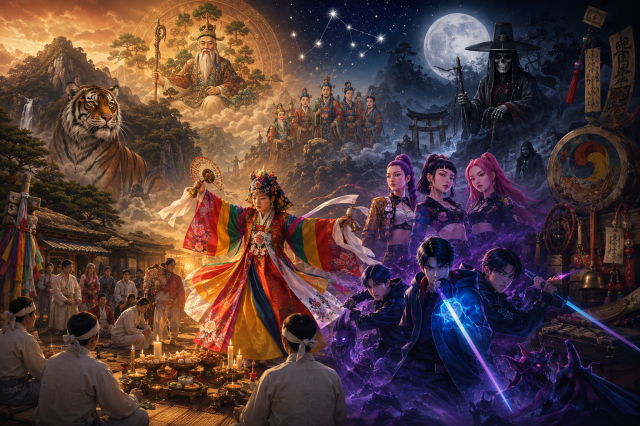
At the heart of shamanism is the gut. Today, when people hear the term gut, some may first think of superstition or sorcery, but historically, the gut has been a communal ritual. When drought struck a village, people gathered to pray for rain, and when epidemics occurred, villagers came together to pray for the passing of calamities. Gut ceremonies were also held to wish for a bountiful harvest, good fishing, family peace, and children's health. In other words, the gut was a social ritual where the community collectively affirmed hope and comforted one another.
During gut ceremonies, music, dance, and singing come together. Drums, gongs, and cymbals resonate as people clap along in participation. This is not merely a source of joy but a healing process where the community shares both sorrow and happiness. Modern psychology has also found numerous studies indicating the healing effects of music, dance, and group participation. In this regard, the gut can be viewed as a community healing culture that Koreans have practiced for a long time.
Another indispensable element of Korean shamanism is the mountain deity. South Korea is a country predominantly made up of mountains. Mountains create water, nurture forests, and harbor life. Thus, mountains are not just geographical features; they are the source of life. Mountain deities symbolize the order of that life. The presence of mountain deity shrines in ancient temples across the country reflects the harmony achieved between Buddhism and indigenous beliefs after Buddhism was introduced to Korea. Buddhism did not reject mountain deities but embraced them, and the spirituality of Koreans chose fusion over conflict.
The tiger, which often appears alongside mountain deities, is not merely decorative. It is a guardian of the mountains and a symbol of justice and courage. In folk paintings, tigers are depicted not as tormentors but sometimes in a humorous, human-like manner. This illustrates the Korean view of nature as a relationship of coexistence rather than opposition.
Next is the belief in the Seven Stars. The Big Dipper has symbolized life, longevity, and blessings since ancient times. When a child is born, families pray to the Seven Stars for health, and they also offer prayers for family peace. Even today, many old temples still have shrines dedicated to the Seven Stars. This is a representative example of how Buddhism harmonized with indigenous beliefs as it took root in Korea. Korean religion has developed in a way that embraces rather than completely displaces other beliefs.
Another important aspect is the beliefs surrounding Seonghwang and Seonang. The large trees and stone piles at the village entrances, as well as the Seonghwang and Seonang shrines, symbolize the village community. Villagers would gather annually to offer rituals wishing for bountiful harvests, peace, and the warding off of diseases. This was both a religious ceremony and a social event that united the community. Many of today's festivals and village events can trace their roots back to these traditions.
The deepest foundation of Korean spirituality lies in ancestor worship. Koreans do not view death as an end. Ancestors are not seen as departed beings but as guardians watching over their descendants. Thus, ancestral rites are not merely formalities but ceremonies of memory and gratitude. Filial piety is not only a virtue directed toward living parents but a cultural practice that spans generations. The belief that those who remember their ancestors do not forget their roots, and that those who know their roots cherish their community, is embedded within this practice.
This tradition continues to manifest in various forms today. The customs of Chuseok and Seollal rituals, visiting ancestral graves, and family gatherings to honor ancestors have evolved in form over time but remain alive in the lives of Koreans. This is not just a ritual but a cultural memory that connects generations.
A defining characteristic of Korean shamanism is its emphasis on fusion rather than exclusion. Mountain deities have been integrated into Buddhism, the Seven Stars have been enshrined within temples, and Confucian ancestral rites have merged with ancestor worship. Furthermore, modern cultural arts and popular culture are reinterpreting these traditions in new ways. This reflects the flexibility and inclusiveness inherent in Korean culture.
In today's AI-driven era, we are experiencing remarkable advancements in science and technology. However, technology does not resolve all human loneliness, sorrow, and feelings of loss. People still seek comfort, community, and meaning in life. Korean shamanism has responded to these fundamental human questions through the languages of community, nature, ancestors, and memory.
Thus, Korean shamanism is not a relic of the past. It is a living spirit within Korean culture and a spiritual asset that engages with the world through K-culture. The gut was a ritual for healing the community, mountain deities symbolize nature and life, the Seven Stars represent harmony between the universe and humanity, and ancestor worship embodies a culture of memory that connects generations. All of these elements have come together to shape contemporary Korea.
※ This article was generated using generative AI and has been reviewed by an editor.
* This article has been translated by AI.
Copyright ⓒ Aju Press All rights reserved.