
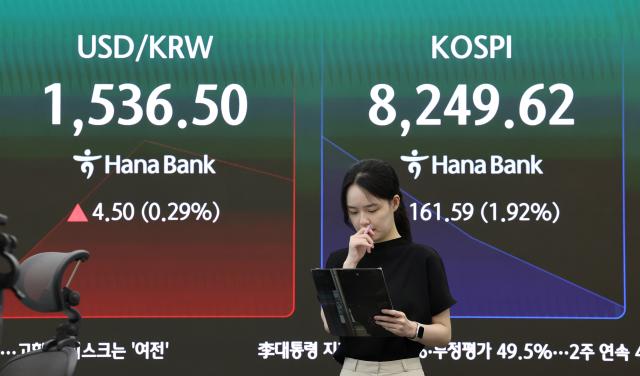
The won-dollar exchange rate opened higher as military tensions between the U.S. and Iran escalated.
As of 9:10 a.m. on June 29, the exchange rate in the Seoul foreign exchange market stood at 1,538.0 won per U.S. dollar, up 4.5 won from the previous session's opening of 1,536.5 won.
The renewed military tensions surrounding the Strait of Hormuz have heightened demand for safe-haven assets. Following Iran's attack on civilian vessels passing through the Strait on June 25, the U.S. has conducted retaliatory airstrikes, which have been met with Iranian counterattacks.
On June 27, U.S. Central Command issued a statement confirming airstrikes against Iran as a direct response to ongoing attacks on commercial vessels, stating that the strikes were carried out under the direction of military commanders.
Despite reports on June 28 from Axios that the U.S. and Iran had agreed to halt mutual attacks, market anxiety appears to persist.
The dollar index, which measures the value of the dollar against six major currencies, remained high at 101.35. The index has been on an upward trend since surpassing 100 on June 17.
International oil prices also showed signs of recovery. As of 8:03 a.m., Brent crude futures rose by 0.76% to $72.54 per barrel, while West Texas Intermediate (WTI) increased by 1.11% to $70.00 per barrel.
The exchange rate is expected to rise further. Min Kyung-won, an economist at Woori Bank, stated, "The outflow of foreign capital from the domestic stock market is likely to continue due to external uncertainties. This will lead to increased buying pressure from offshore investors, and demand for currency exchange related to import payments and overseas stock investments will contribute to a weaker won."
* This article has been translated by AI.
Copyright ⓒ Aju Press All rights reserved.