
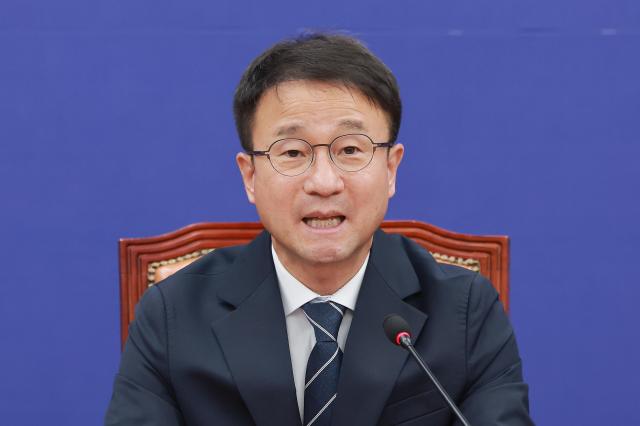
The Democratic Party of Korea on June 29 criticized the People Power Party for spreading falsehoods about the "Three Mega Projects for Korea's Great Leap Forward," calling their actions "malicious." Han Byung-do, the party's acting leader and floor leader, urged the opposition to cease their criticisms and collaborate instead.
During a Supreme Council meeting at the National Assembly, Han described the projects as "national initiatives that will redraw Korea's industrial map and are crucial for the fate of global conglomerates."
He accused the People Power Party of invoking outdated regionalism to undermine the project even before its announcement, stating, "They are distorting facts with provocative language."
Han also warned that "Representative Ahn Cheol-soo is spreading outrageous fake news. The Democratic Party will take legal action against these malicious falsehoods."
He emphasized the harsh reality that in global markets, including Europe, products cannot be manufactured and sold without meeting RE100 requirements. He stated that selecting optimal locations with renewable energy infrastructure and abundant water resources is a survival strategy.
Supreme Council member Hwang Myung-sun added that claims of reverse discrimination regarding semiconductor investments in the Honam region are merely political agitation, asserting that companies do not invest for political reasons.
Hwang pointed out that Gwangju and Jeonnam received top scores for advanced industry specialized zones under the Yoon Suk Yeol administration, which he claimed the government has since undermined, labeling this as blatant regional discrimination.
He countered criticisms that decisions to establish new semiconductor clusters in Honam, an advanced materials innovation hub in Chungcheong, and investments in AI manufacturing and bio-future industries in Yeongnam stem from regionalism.
* This article has been translated by AI.
Copyright ⓒ Aju Press All rights reserved.