Just a few years ago, when the world thought of South Korea, semiconductors, automobiles, and K-pop were the first things to come to mind. But now, interest has gone a step further, extending to Korean history, culture, and even spirituality. The Korean Wave no longer means only popular music and television dramas. An era has arrived in which the Korean people's inner world and symbolic vocabulary, accumulated over thousands of years, are being introduced to global audiences through film, animation, gaming, and the performing arts.
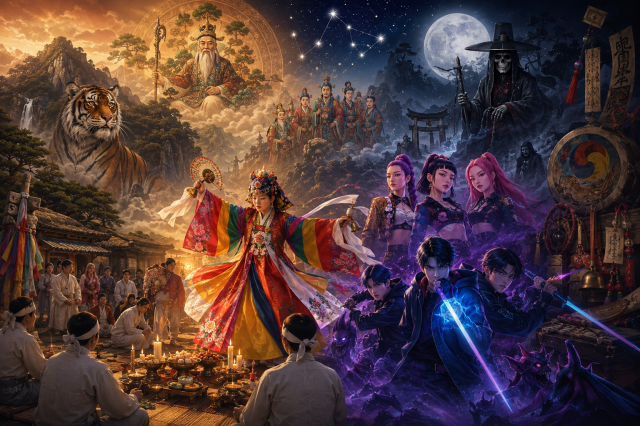
One of the most prominent examples of this is K-Pop Demon Hunters. The work is not a simple action fantasy. It is a cultural creation that reinterprets Korean shamanism, folk legends, and traditional symbols in a contemporary idiom, layered over the modern cultural platform of K-pop. Many of its elements carry the additions of creative imagination, but underlying them is a worldview that traces back to Korean shamanism and traditional belief. This is why the work has landed as something fresh for audiences around the world.
Korean shamanism has long held that the visible world and the invisible world are not entirely severed from each other. Human beings live within nature, ancestors and descendants remain connected through memory, and life and death are understood to exist within a single vast cycle. The shaman was the figure who bridged that boundary. The gut was the ritual that restored it. K-Pop Demon Hunters moves this traditional worldview into the structure of a contemporary story.
The tiger that appears repeatedly within the work is not merely a fierce predator in Korean culture. The tiger is a sacred creature that guards the mountains and a symbol of the protector who repels evil spirits. In folk paintings, the tiger is sometimes depicted with dignity and sometimes with humor, but always as a figure that connects the human and the natural world. This is why the tiger appears beside the mountain spirit in paintings of the sanshin. Koreans received the tiger as both an object of awe and a symbol of justice and courage. These symbolic meanings live on naturally within contemporary creative work.
The image of the jeosung saja, the messenger of the underworld, that appears in the work is also distinctly Korean. In Western culture, death is often portrayed as an object of fear, but the Korean jeosung saja is not necessarily an evil being. He is a figure who guides a person whose life has ended along a designated path, and he symbolizes the order that judges the goodness and wrongdoing of human beings. The Korean jeosung saja therefore carries a meaning closer to order and ethics than to terror. The fact that contemporary dramas, films, and animations make frequent use of this image is rooted in this cultural background.
Another important figure is the gwisin, the ghost. In Korean culture, a ghost is not simply a monster. In many cases it is understood as a soul carrying han, the distinctly Korean weight of unresolved sorrow, a being who could not have a grievance settled or a love fulfilled. This is why in traditional Korean narrative there are many stories not of simply driving the ghost away but of listening to its story and resolving its resentment. This is the spirit of haewon, the resolution of grievance. In Korean shamanism, the gut is itself a ritual of haewon. Releasing sorrow, soothing resentment, and helping both the living and the dead find their proper place were among the central meanings of the gut.
This worldview of haewon runs deep throughout Korean culture as a whole. Pansori and folk songs, mask dances and the gut all sing of sorrow while never abandoning hope in the end. The quality of Korean art in which tears and laughter exist together is connected precisely to this shamanic sensibility. That K-Pop Demon Hunters moved global audiences was not simply because of the action. It is because this distinctly Korean emotional register gave the work its depth.
The rituals, talismans, and symbolic patterns that appear within the work can also be seen as elements drawing inspiration from traditional shamanism. Contemporary creative work is, of course, a domain of artistic invention and does not recreate traditional ritual as it stands. But the broad framework, the opposition between good and evil, the connection between the invisible world and the human world, the ritual intended to protect the community, touches the long-standing worldview of Korean shamanism. For global audiences, this arrives as an imagination that is unfamiliar and yet compelling.
Today, K-pop is becoming more than a simple music genre. It is becoming a platform that carries Korean culture within it. Hanbok and hanok, jangseung and sotdae, tigers and mountain spirits, the jeosung saja and the philosophy of haewon are all being introduced to the world stage. Culture is the most powerful form of diplomacy, and spirituality is the deepest root of culture, the one that survives the longest. Korean shamanism is no longer a relic of the past but a living cultural heritage being reinterpreted through contemporary creative work and entering into dialogue with the world.
In this regard, K-Pop Demon Hunters carries real significance. The work merits attention because it does not consume Korean shamanism as mere superstition but attempts to translate Korean symbols, emotional sensibility, and communal consciousness into a contemporary language. Not every scene faithfully reflects traditional shamanism. But one fact is clear: the ancient spirituality of Korea is finding new life within global popular culture.
Korean shamanism has, across many centuries, accompanied the joys and sorrows of people at the boundaries of mountain and field, village and home, life and death. Now that spirituality is meeting the world again through the screens of the digital age. In the past, the gut held the community together as one. Today, cultural content is connecting people across national borders. The times have changed, but the human impulse to seek meaning and find consolation has not. This is why Korean shamanism continues to breathe today, and it is also the fundamental reason K-culture earns the empathy of people around the world.
One of the deep roots of the Korean imagination that K-culture is introducing to the world is shamanism. But the essence of shamanism was never in summoning spirits or divining the future. It was the wisdom by which a community learned to live together, a philosophy of daily life that sought to understand nature and humanity, ancestor and descendant, life and death, within a single order. To understand Korean shamanism, then, one must look at the gut, the mountain spirit, the seven stars, the village guardian shrines, and ancestor worship as a single organic world.
At the center of shamanism is the gut. Today, when some people hear the word gut they think first of superstition or sorcery, but historically the gut was a communal ritual. When drought struck a village, people gathered to pray for rain together. When disease spread, villagers assembled to pray that the disaster would pass. The gut was also the occasion for praying for a good harvest, for a rich catch from the sea, for peace in the household and health for children. In other words, the gut was a social ritual through which a community confirmed its hopes and comforted one another.
In the space of the gut, music and dance and song all come together. The janggu drum, the buk, the kkwaenggwari, and the jing ring out, and the people clap along and take part. This was not simple festivity but a process of healing through which the community shared sorrow and joy alike. Contemporary psychology has produced considerable research showing that music, dance, and collective participation carry therapeutic effects. In this sense, the gut can be understood as a practice of communal healing that Koreans cultivated long ago.
Among the presences that cannot be left out of Korean shamanism is the mountain spirit, the sanshin. South Korea is a country whose land is largely composed of mountains. Mountains produce water, grow forests, and hold life within them. The mountain was therefore not simply a geographical feature but the very source of life. The sanshin was the figure who symbolized that order of life. The reason that ancient temples across the country have a sanshin shrine is that after Buddhism arrived in Korea it came to harmonize with indigenous belief. Buddhism did not reject the mountain spirit but embraced it, and the spirituality of the Korean people chose integration over conflict.
The tiger that always appears alongside the mountain spirit in paintings is not mere decoration. The tiger is a guardian that protects the mountain and a symbol of justice and courage. In folk paintings, the tiger is not a creature that terrorizes the people but is depicted at times with humor and a human quality. This reveals a Korean understanding of nature in which human beings and the natural world are not in opposition but in coexistence.
Next is the faith of the seven stars, the chilseong. The Big Dipper has from ancient times symbolized life, longevity, and blessing. When a child was born, people prayed to the deity of the seven stars for health. When they sought peace for the household, offerings were made to the seven stars with devotion. Even today, old temples retain a seven-stars shrine, a prominent example of how Buddhism, as it took root in Korea, came to harmonize with indigenous belief. Korean religion has developed not by one tradition displacing another entirely but by each holding the other within itself.
Another important element is the faith surrounding the village guardian shrines, the seonghwangdang and the seonangdang. The large trees and stone mounds at the edge of a village, the shrines of the village guardian deity, were symbols of the village community. Each year the villagers gathered to hold rites together, praying for a good harvest, for peace, and for the warding off of illness. This was a religious observance and at the same time a social occasion that bound the community together as one. A substantial number of the roots of today's festivals and village events can be traced back to these traditions.
The deepest foundation of Korean spirituality is ancestor worship. Koreans did not regard death as an ending. The ancestor was not a being who had left the family but a being who continued to watch over the descendants. Ancestral rites were therefore not a mere formality but a ritual of memory and gratitude. Hyo, filial devotion, was not a virtue directed only toward living parents but a culture that carried the thread from one generation to the next. Embedded within it was the belief that a person who remembers the ancestors does not forget the roots of the self, and a person who knows the roots of the self holds the community dear.
These traditions continue in various forms today. The Lunar New Year and Chuseok ancestral rites, the culture of visiting and tending graves, the custom of families coming together to honor their ancestors have changed in form with the passing of time but remain alive in Korean life. This is not simple ritual but a cultural memory that carries the thread between generations.
The most defining characteristic of Korean shamanism is integration over rejection. The mountain spirit entered into Buddhism. The seven stars were enshrined within the temple. Confucian ritual culture merged with ancestor worship. Now contemporary art, culture, and popular entertainment are reinterpreting these traditions in new ways. This is the flexibility and openness that Korean culture possesses.
Today, living in the age of artificial intelligence, we experience dazzling advances in science and technology. Yet technology cannot resolve every human loneliness, every sorrow, every sense of loss. People still desire comfort, desire community, and seek the meaning of life. Korean shamanism has answered precisely these fundamental human questions with the language of community, nature, ancestor, and memory.
Korean shamanism is therefore not a relic of the past. It is a spirit alive within Korean culture and a spiritual asset that speaks to the world through K-culture. The gut was a ritual of communal healing. The mountain spirit was a symbol of nature and life. The seven stars signified the harmony between the cosmos and humanity. Ancestor worship was a culture of memory that carried the thread between generations. All of these, woven together, have made Korea what it is today.

Copyright ⓒ Aju Press All rights reserved.