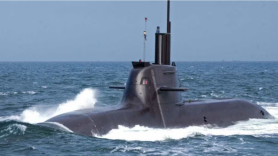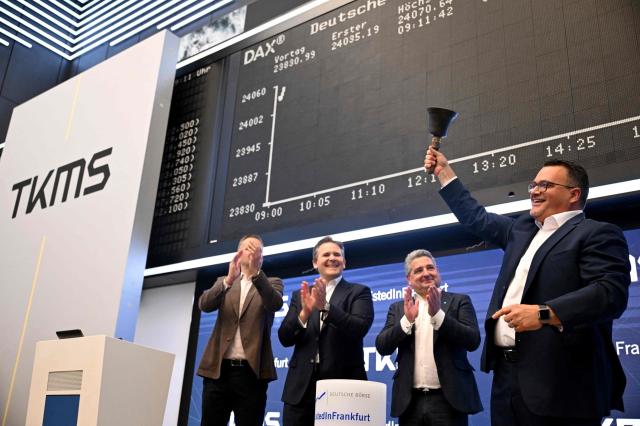
The latest twist came after a senior executive at Germany's ThyssenKrupp Marine Systems (TKMS) argued that Canada's long-term interests would be better served by joining the German-Norwegian 212CD program because it was designed from the outset as an English-language multinational partnership.
The exchange underscores how Canada's submarine competition has evolved into more than a procurement decision. As the technical gap between the rival bids narrows, both sides are increasingly promoting the industrial, operational and strategic ecosystems that would accompany their submarines over a service life expected to exceed four decades.
Philipp Schön, a senior sales executive at TKMS, urged Canada in a LinkedIn post to consider not only which submarine it would buy, but also which "cultural ecosystem" it would join if Ottawa chooses between the German-built 212CD and Hanwha Ocean's KSS-III Batch-II.
"Sometimes the most important interface in a submarine program is not man-machine. It's human-human," Schön wrote.
He argued that the 212CD program's working language is English and that its governance, engineering processes, documentation and industrial cooperation structures were designed from the beginning for multinational participation.
"Defense cooperation works best when partners can engage directly, not through translation," Schön wrote, adding that language influences everything from technical documentation and software development to crew training, maintenance, logistics and combat-system integration.
The comments quickly drew criticism for appearing to portray South Korea as culturally and linguistically less compatible with Canada.
Schön later clarified that the post was intended to promote discussion about interoperability in multinational defense programs and was "in no way meant to disparage any language, culture, or partner country."
He nevertheless maintained that the 212CD offers Canada a proven platform within an existing multinational NATO framework backed by long-term industrial and operational cooperation.
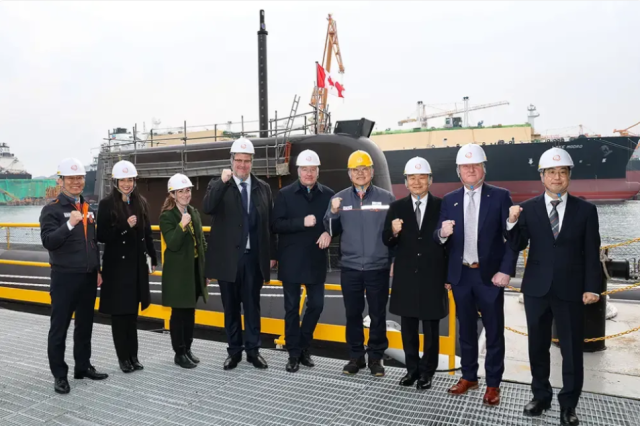
"There is fluency in English as well as team members who speak French, Japanese, Italian, Arabic and even German," Copeland said.
"Engineering and mathematics are the universal languages that deliver superb ships and submarines."
He also noted that the Republic of Korea Navy routinely operates alongside English-speaking forces, including during the U.S.-led Rim of the Pacific Exercise, demonstrating that language has never been an operational barrier.
The debate comes as alliance politics have also emerged as another competitive front.
British Ambassador to South Korea Colin Crooks told President Lee Jae Myung during a diplomatic corps dinner in Seoul on June 23 that London hopes to work alongside Hanwha on Canada's submarine program.
"The British government wants to be with Hanwha on the Canadian submarine program," Crooks said.
Lee smiled before replying, "Yes, it has to succeed."
Hanwha Ocean has already signed a memorandum of understanding and a teaming agreement with British defense company Babcock Canada.
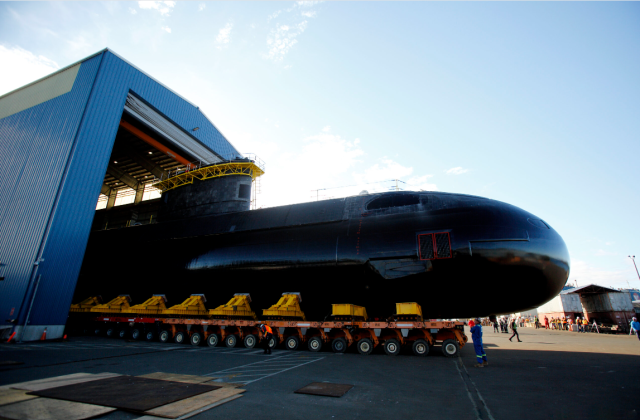
Babcock already supports the Royal Canadian Navy's Victoria-class submarines and possesses an established domestic workforce, maintenance infrastructure and supply chain.
Britain's participation could help address one of Hanwha's perceived disadvantages. Although South Korea is not a NATO member, Britain is one of Canada's closest military partners through both NATO and the Five Eyes intelligence-sharing alliance alongside the United States, Australia and New Zealand.
TKMS, meanwhile, continues to emphasize that the 212CD itself is a joint German-Norwegian program developed by two NATO allies, allowing the company to market not only a submarine but also an existing multinational operating framework.
The competition is therefore increasingly becoming a choice between ecosystems rather than simply competing submarine designs.
Hanwha has built its campaign around delivery speed, industrial participation and operational capability, offering to deliver the first four submarines by 2035 if selected.
Earlier this year, South Korea also deployed the Dosan Ahn Chang-ho—the lead vessel of the KSS-III class—to Canada's Pacific coast, demonstrating the submarine's long-range endurance and blue-water operational capability.
TKMS has instead highlighted alliance interoperability, multinational governance and lifecycle support under the 212CD program.
Moon Geun-sik, a submarine expert and special professor at Hanyang University, said the contest has entered a stage where neither proposal appears to enjoy a decisive advantage.
"As the competition enters its final stage, both sides are emphasizing their respective industrial and economic benefits," Moon said. "From Canada's perspective, however, the two proposals appear to be almost evenly matched."
Flavio Volpe, president of Canada's Automotive Parts Manufacturers' Association, which is working with Hanwha on a potential industrial partnership, also dismissed concerns about language.
After working with major South Korean companies for nearly two decades, Volpe told The Globe and Mail that "they have no problem with English."
"But in fairness," he added, "maybe he doesn't understand Canada well."
The exchange illustrates how modern defense procurement has become as much about long-term industrial alignment as military capability. For Canada, the decision is no longer simply which submarine offers the best performance underwater, but which industrial network, alliance structure and strategic partnership it wants to anchor itself to over the next 40 years.

Copyright ⓒ Aju Press All rights reserved.