
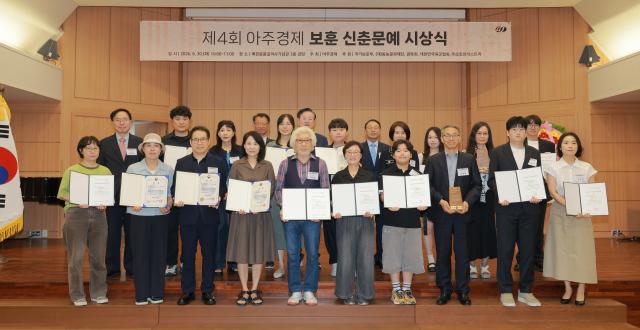
The Fourth Annual Aju Economic Literary Awards highlighted how ordinary days are built on the sacrifices of others. Rather than focusing on grand tales of heroism, the event emphasized the significance of patriotism through the lives of everyday people, extending the concept of remembrance from the past to the present.
The awards ceremony, held on June 30 at the Maehun Yoon Bong-gil Memorial Hall in Seocho-gu, Seoul, served as a reminder of the meaning of patriotism in today’s life.
This year, over 1,000 entries were submitted for the literary awards, leading to a restructuring of the award categories. The Minister of Veterans Affairs Award expanded from one to six top works across various categories, with a total of 18 pieces receiving honors.
The judging panel, led by Chairman Kim Kyung-sik and including writer Han Ji-soo, Professor Yang Kyung-mi, poet Jang Jae-seon, and writer Kim Jin, noted, "There were many outstanding works that successfully captured the essence of patriotism in a literary form, making the selection process quite challenging." They particularly praised the quality of submissions in the fiction and poetry categories. The judges remarked, "We encountered works that beautifully depicted the dedication of those who have sacrificed for community values. While the theme should not be overly explicit, it also should not be too vague. The joy of finding works that struck this balance was significant."
The panel expressed delight at discovering worthy entries in the children’s literature category. They also highlighted a screenplay by a youth participant that garnered special attention. The judges emphasized, "The literary awards for patriotism are gaining interest across generations. This is a truly meaningful literary competition," adding that the award-winning works could help redefine the meaning of patriotism.
Family and friends of the winners expressed their joy at the event. Seo Hyun-dong, father of Seo Yoon-joo, who received an excellence award in the screenplay category, said, "I am so proud that my high school son has succeeded in a competition while studying." Yu Ha-neul, a 13-year-old child of Kim Yoo-young, who won the Minister of Veterans Affairs Award in the children’s literature category, shared, "I felt sad that my mom didn’t talk to me when she was writing, but now that she has won this award, I feel happy."
Sung Baek-gwang’s short story, "The Light of the Old Medal," which won the Minister of Veterans Affairs Award, delicately portrays a daughter’s lifelong sense of loss and pride after losing her father in war. It expands the concept of patriotism from past sacrifices to the strength of living in the present as a family member of a national hero.
Lim Hyo-sun’s screenplay, "Grandma Who Dislikes Exercise" (Minister of Veterans Affairs Award), resonates with the pain of a national hero’s family through the grandmother’s troubled past associated with the word "exercise." Kim Yoo-young’s children’s story, "100-Year School" (Minister of Veterans Affairs Award), takes readers on a time-travel journey to 1919, illustrating how today’s lives rest on the sacrifices of those who participated in the March 1st Movement. Lee Kyung-hee’s essay, "The Day We Moved to the National Cemetery" (Minister of Veterans Affairs Award), reflects on the sacrifices of national heroes and their families through a letter to her father, who died in the Vietnam War, and her mother, who raised the family alone.
Kim Yul-gok’s book report, "In a World Where the Long-Handled Spoon Doesn’t Look Like a Gun" (Minister of Veterans Affairs Award), depicts the scars of war through a child’s perspective, illustrating a veteran mistaking a spoon for a weapon.
This year’s award-winning works viewed patriotism not as a relic of the past but as a continuing aspect of life today. The winners expressed their desire to honor all the unnamed martyrs in their poetry, showing gratitude to the unsung heroes.
Additionally, the best short story award (Korean Liberation Association President Award) went to Jin Hwan-joo for "Happy Birthday, Anarchist in the Corner," while the excellence award was given to Kim Ah-won for "The Person Who Cries Instead." In the screenplay category, the best award (Korean Liberation Association President Award) was awarded to Lee So-ri for "To Your Name," and the excellence award went to Seo Yoon-joo for "A Beautiful Word for Each Star."
In the poetry category, the best award (Dongnong Cultural Foundation Chairman Award) was won by Jo Sook-ja for "The Ring of My Father from the Grave," while the excellence award went to Heo Kyung-ho for "Compass." In the children’s literature category, the best award (Dongnong Cultural Foundation Chairman Award) was awarded to Kim Yeon-soo for "Running Train," and the excellence award went to Lee Kwang-ho for "Ahn Jung-geun and Chiba Toshichi."
In the essay category, the best award (Republic of Korea Army Association Chairman Award) went to Sung Hyun-kyung for "Ode for the Forgotten Names," and the excellence award was given to Kim Young-bong for "A Familiar Fight."
In the book report category, the best award (Aju Economic President Award) was awarded to Kim Ga-bin for "The Names That Could Not Be Called for Attendance," and the excellence award went to Kim Yoon-ho for "The Flame of Choi Pechika."
* This article has been translated by AI.
Copyright ⓒ Aju Press All rights reserved.