
A new milestone in South Korea's industrial policy has been announced. The government and private sector unveiled a plan for three mega projects worth 4,755 trillion won, aimed at integrating semiconductors, artificial intelligence (AI) data centers, and physical AI into a cohesive national strategy to redesign the industrial structure. Political disputes over funding and feasibility continue, but these projects, critical to the nation's economic future, should not be hindered by partisan politics.
The scale and direction of this initiative are noteworthy. Over the past half-century, South Korea's industry has primarily grown around the capital region. In response to the AI era, the government has proposed a new growth model that connects the capital and regional areas into a single advanced industrial ecosystem. Rather than developing semiconductors, AI, and robotics separately, the plan aims to unify them into one industrial chain, aligning with national strategies of major countries like the United States, China, and Japan.
Samsung's investment plans are particularly significant. The company aims to develop semiconductor clusters in Pyeongtaek and Yongin into the world's largest production bases while establishing AI semiconductor and advanced manufacturing hubs in the Honam region, including Gwangju. The Chungcheong region is set to focus on HBM packaging and post-processing, while the Yeongnam region will become an innovation center centered on materials, components, and equipment. This strategy seeks to connect the entire nation into a single semiconductor production network rather than merely adding another factory.
SK's plans are equally ambitious. The company intends to invest 2,100 trillion won to simultaneously expand AI data centers and semiconductor production capacity. This includes the Yongin cluster, the establishment of a semiconductor hub in the southwestern region, and the expansion of NAND flash production in Cheongju, along with the construction of a 15GW AI data center. This initiative aims to integrate AI, semiconductors, and power into a unified ecosystem.
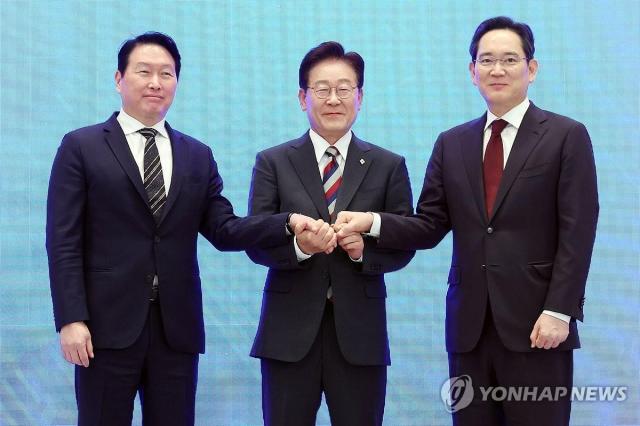
However, a blueprint does not automatically translate into industrial competitiveness. Companies are requesting the government to provide streamlined permitting, stable supplies of electricity and water, and improved living conditions. In the AI era, power is both the alpha and omega. Without a robust transmission and distribution network, water supply, and logistics infrastructure, investments worth trillions of won may remain mere plans on paper. The government's commitment to regulatory innovation and infrastructure development is crucial for this reason.
Most importantly, there is an urgent need for a shift in political attitudes. The cycle of national projects being disrupted with each change of administration and the reversal of project directions based on regional interests must be broken. The United States is revitalizing its semiconductor manufacturing base through the CHIPS Act, while China is pouring astronomical funds into AI and advanced manufacturing under state direction. Japan is also betting on the revival of its semiconductor industry, focusing on Rapidus and Kioxia. The competition for dominance in advanced industries has transformed into a rivalry between nations.
As the three mega projects move forward, the scale of investment, funding sources, and project viability must be scrutinized more closely, especially since taxpayer money is involved. Verification and obstruction are not the same. What is needed is rational criticism and improvement, not wasteful political disputes driven by self-interest.
South Korea has grown through industrialization and informatization and now stands at the threshold of a third inflection point with AI. This project is not just a corporate investment plan but an experiment in national growth strategy. Its success depends not only on the government but also on the cooperation of businesses, local governments, and the political sphere.
Changing the future requires determination and execution. The political arena should focus on gathering wisdom for the next 30 years of South Korea, rather than engaging in a competition of criticisms against one another. This will be a more valuable national competitive edge than the 4,755 trillion won investment.
* This article has been translated by AI.
Copyright ⓒ Aju Press All rights reserved.