
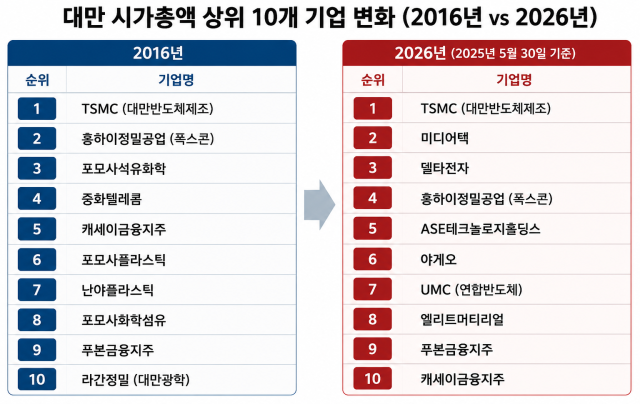
Taiwan's stock market has emerged as a leader in the AI and semiconductor sectors. Known for its flagship company TSMC, often referred to as the 'guardian of the nation,' Taiwan's market has undergone a transformation over the past decade. The top companies by market capitalization now encompass the entire AI infrastructure value chain, including fabless semiconductor firms, backend processing, semiconductor substrates, power and cooling solutions, and AI server assembly.
As of June 30, data from TradingView shows that the top 10 companies in Taiwan by market capitalization are dominated by semiconductor, electronic component, and AI infrastructure firms. TSMC leads with a market cap of approximately $223 billion. It is followed by MediaTek, a fabless semiconductor company, with about $206.3 billion; Delta Electronics, a power and cooling solutions provider, at around $156.7 billion; Hon Hai Precision Industry, a beneficiary of AI server assembly, at approximately $116.3 billion; and ASE Technology, a backend processing company, with about $92.3 billion, occupying the second to fifth positions, respectively.
The sixth to tenth positions also reflect a strong presence of semiconductor and AI companies. Yageo, an electronic components firm, is valued at about $70 billion, while UMC, a foundry company, has a market cap of approximately $68.7 billion. Elite Material, a semiconductor substrate company, is valued at around $62.7 billion. Financial firms Fubon Financial Holdings and Cathay Financial Holdings round out the list at approximately $62.7 billion and $51.7 billion, respectively. This means that eight out of the top ten companies are related to semiconductors, electronics, and AI infrastructure.
A decade ago, TSMC was already solidifying its position as the top company by market capitalization, but the landscape was different. The leading firms included a mix of petrochemicals, finance, telecommunications, and electronics manufacturing. According to the Taiwan Stock Exchange's official factbook, TSMC held the top spot in 2016 with a market cap of about $145.8 billion, followed by Hon Hai Precision Industry at approximately $45.2 billion, Formosa Petrochemical at around $33.1 billion, Chunghwa Telecom at about $24.4 billion, and Cathay Financial Holdings at approximately $18.8 billion.
The sixth to tenth positions were also dominated by traditional industries. Companies from the Formosa Group, including Formosa Plastics at about $17.6 billion, Nanya Plastics at around $17.5 billion, and Formosa Chemical & Fibre at approximately $17.5 billion, were listed. Additionally, Fubon Financial Holdings at about $17.3 billion and optical lens manufacturer Largan Precision at around $15.7 billion followed. The top tier included TSMC alongside traditional manufacturing, telecommunications, and financial firms.
Over the past decade, TSMC has been the driving force behind Taiwan's stock market, which has expanded into the broader semiconductor and AI value chain. Experts note that while Taiwan was previously viewed as a leading market for advanced foundries, it has recently positioned itself as a key player in AI infrastructure investment, reflecting the growth of AI data centers and server hardware supply chain companies.
Shin Seung-woong, a researcher at Shinhan Investment Corp, stated, "If Korea's stock market is sensitive to memory within the AI cycle, Taiwan is highly sensitive to AI infrastructure. Taiwan encompasses foundries, backend processing, substrates, server assembly, networks, power, and cooling solutions." He added that even without TSMC's market dominance, many companies in Taiwan excel in AI and hardware.
TSMC has undoubtedly been the central figure in Taiwan's stock market over the past decade. According to Shinhan Investment Corp, as of the end of last month, TSMC accounted for over 40% of the Taiwan Weighted Index and 54.8% of the MSCI Taiwan index. The IT sector comprises 88.9% of the market, while the top ten stocks represent 77.5%. Recently, Taiwan's stock market has climbed to become the fifth largest globally, following the U.S., mainland China, Japan, and Hong Kong, with a market capitalization of approximately $4.95 trillion.
The Taiwanese government's support for AI and semiconductors is expected to strengthen further. President Lai Ching-te highlighted semiconductors and AI as core areas in his inaugural speech last May, part of the 'Five Major Trust Projects.' Starting this year and continuing through 2028, Taiwan plans to invest NT$190 billion to establish nationwide AI-specific data centers, cloud, and edge computing infrastructure. On June 23, the first meeting of the 'National AI Strategy Special Committee' was held, indicating that investments in semiconductors and AI are being made at a national strategic level rather than just privately.
Shin noted, "As capital expenditures for AI and semiconductors increase, countries are strengthening their supply chains. This trend is evident not only in Taiwan but also in China and South Korea, where development environments and related industries are being established."
* This article has been translated by AI.
Copyright ⓒ Aju Press All rights reserved.