
The Fair Trade Commission's (FTC) imposition of penalties has been repeatedly overturned by courts, leaving companies to bear administrative and criminal risks for years. Critics argue that there is a lack of internal mechanisms to review the appropriateness of these penalties, similar to the prosecution's practice of assessing cases of acquittal, highlighting the need for checks on the FTC's authority.
◆ Repeated Refunds of Penalties Lead to Long-Term Criminal Risks for Companies
According to relevant authorities, the FTC refunded approximately 624.7 billion won ($550 million) in penalties to companies from 2017 to August 2022. During the same period, it also paid out 47.4 billion won ($40 million) in interest on these refunds. When the FTC's penalties are later canceled or revoked by the courts, companies receive their paid penalties back along with interest.
The majority of these refunds stem from the FTC losing administrative lawsuits. However, even when companies eventually reclaim their penalties, the burdens incurred during the process are often irrecoverable. The costs of prolonged administrative litigation, along with diminished trust from clients and investors and damage to corporate reputation, cannot be easily compensated, according to industry sources. Additionally, since the interest on refunds is paid from the national treasury, the social costs of the FTC's excessive penalties ultimately fall on taxpayers.
Given the number of instances where the FTC's decisions have been overturned by the courts, cases of penalties being canceled or refunded are becoming increasingly common. There are growing calls for institutional mechanisms to enhance the precision and predictability of these decisions. As the FTC exercises strong investigative and punitive powers, it is essential to establish procedures for analyzing the causes of overturned decisions and linking them to institutional improvements.
Criminal risks for companies are also becoming prolonged. The FTC not only imposes administrative penalties such as fines but also refers cases to prosecutors if it deems criminal punishment necessary. Companies must navigate both administrative lawsuits and criminal proceedings simultaneously, increasing their burden.
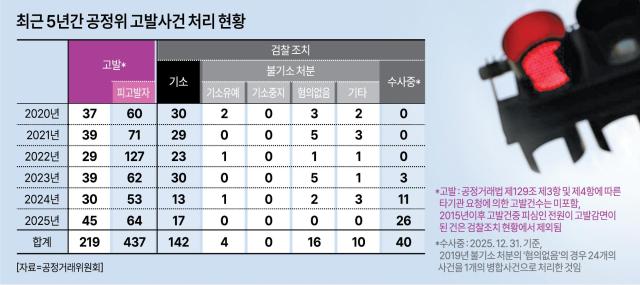
Last year, the FTC referred 45 cases to prosecutors, the highest number in six years since 2019, when 82 cases were referred. However, only 17 of these cases resulted in indictments, while 26 remain under investigation. More than half of the referred cases have not yet reached a decision on whether to prosecute, resulting in prolonged investigations.
The length of these investigations is also notable. As of the end of last year, there were 40 FTC-referred cases still under investigation over the past three years. Even excluding cases referred last year, 14 cases have been under investigation for several years. As criminal proceedings continue long after FTC referrals, companies are left with ongoing criminal risks separate from administrative penalties.
◆ Lack of Post-Verification Mechanisms at the Fair Trade Commission
The FTC's post-verification system has been criticized as inadequate compared to that of the prosecution. When a case is acquitted, the prosecution conducts an internal review to assess the appropriateness of the investigation and prosecution process. While an acquittal does not immediately lead to accountability or disciplinary action for the prosecutor, repeated acquittals serve as a mechanism for internal control to enhance the quality of future investigations.
In contrast, the FTC, which effectively operates at a first-instance level in competition law, lacks systematic evaluation or public verification processes when its decisions are overturned or when large penalties are refunded. From the perspective of companies, the FTC's decisions are often perceived as de facto guilty verdicts in the market, making it essential to have mechanisms to identify the causes and improvements when decisions are overturned.
The lack of sufficient public disclosure regarding decisions of no charges or court rulings is also seen as an area for improvement. While the FTC actively communicates major sanction cases and the issuance of review reports through press releases, cases where penalties are canceled or acquitted are often less well-known in the market.
Legal experts argue that this information disclosure is part of fair law enforcement. Given that the FTC's issuance of review reports is often interpreted as a de facto signal of guilt in the market, it is crucial to also disclose cases that are ultimately canceled or acquitted to enhance predictability for businesses.
Baek Kwang-hyun, a lawyer at Barun Law LLC, stated, "While some information is available on the FTC's website, there is no systematic disclosure of all cases of acquittal or those canceled by the courts. For businesses, both sanction cases and instances of acquittal or court cancellations are important precedents for compliance management." He added, "Understanding why a case was acquitted and the reasons behind a court's cancellation of an FTC decision is vital for future corporate activities and compliance. It is not easy for companies to actively publicize when a decision is overturned years later, so the FTC needs to balance the disclosure of both sanction cases and instances of cancellation or acquittal."
Experts agree that the FTC's strong investigative and punitive powers should not be questioned, but there is a need to strengthen accountability and procedural controls that align with those powers. Alongside enhancing investigations and penalties, a system must be established to systematically analyze cases where decisions are overturned by the courts and link them to institutional improvements, thereby increasing predictability for companies and trust in the market.
* This article has been translated by AI.
Copyright ⓒ Aju Press All rights reserved.