
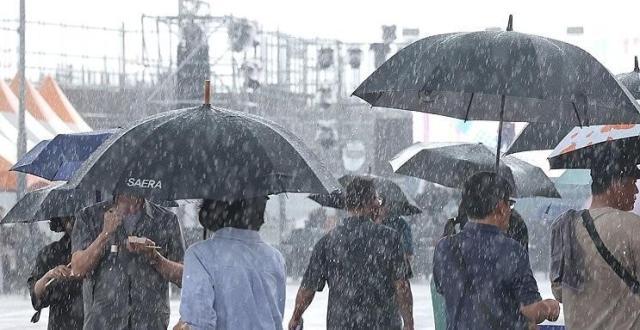
As Jeju Island officially enters the monsoon season, heavy rainfall has been recorded, particularly in Hallasan, where totals exceeded 200mm. The Korea Meteorological Administration (KMA) has warned of strong winds and thunderstorms, urging residents to exercise caution through late night.
According to the Jeju Regional Meteorological Administration, from the previous day until 8 a.m. today, Hallasan recorded cumulative rainfall of 222mm at Jindallaebat, 212mm at Hallasan South Wall, 176mm at Yeongsil, 164.5mm at Witseoreum, and 161.5mm at Seongpanak.
Significant rainfall was also observed across Jeju Island. Hanam received 134.5mm, while Saekdal and Pyoseon recorded 109mm each. Other areas reported 100mm in Gasi-ri, 99.5mm in Udo, 95mm in Seongsan, 85.3mm in Seogwipo, and 67.6mm in Gosan.
Currently, heavy rain warnings are in effect for mountainous areas, including Hallasan, and the mid-mountain regions of Seogwipo. Most other areas are under heavy rain advisories. Wind advisories remain in place for mountainous regions and mid-mountain areas of Jeju City and western Seogwipo, while a wave warning is active for most of Jeju's waters.
The KMA forecasts that rain will continue into late night due to a stationary front and a developing low-pressure system near Jeju. Very heavy rain, reaching around 30mm per hour, is expected until the morning, with a gradual decrease in intensity anticipated in the afternoon.
Additional rainfall is expected to reach 30-80mm in most areas, excluding northern Jeju and Chuja Island, where 20-60mm is forecasted. In mountainous regions, over 120mm of rain is possible.
The KMA cautioned that concentrated downpours accompanied by strong winds and thunderstorms could increase the risk of safety incidents, such as landslides and flooding, urging careful management of facilities. They also emphasized the need for traffic safety, noting that roads may become slippery and visibility could decrease rapidly in areas experiencing heavy rain.
Meanwhile, Jeju's monsoon season began on June 30 this year, marking the third-latest start since meteorological records began in 1973. The latest start on record was July 5, 1982, followed by July 3, 2021.
* This article has been translated by AI.
Copyright ⓒ Aju Press All rights reserved.