This is the twenty-sixth installment of AJP's Spiritual Asia series, which explores the religious traditions, philosophical ideas and moral foundations that have shaped Asia's civilizations. In this concluding chapter of our three-part journey through Japanese Shinto, we examine how a faith rooted in reverence for nature was transformed into an instrument of the modern state, and how it later returned to everyday life.
Human history holds certain rare stretches of time. They come when one age is closing and another is opening, and the world seems to demand new thought and new faith. India in the sixth century B.C. sat squarely inside such a turning point. The German philosopher Karl Jaspers later gave this period a name, calling it the Axial Age of the human spirit. In China, Confucius and Laozi were rethinking the order of human life and society. In West Asia, prophets were calling out for justice and faith. In Greece, philosophy was beginning to move past myth and toward reason. And in India, two great sages appeared within almost the same span of years. One founded Buddhism. He was Siddhartha Gautama, later known as the Buddha. The other completed Jainism. He was Mahavira.
Buddhism is familiar to most people around the world today. Jainism is not. Yet a close look at Indian civilization shows that Jainism is far from a minor tradition. It is a current of spiritual thought essential to understanding the Indian mind, and it carries out the shared human values of nonviolence and reverence for life with a thoroughness few other faiths have matched.
The story of Jainism does not begin with Mahavira. The tradition sees itself less as something newly founded than as something old, carried forward. Jain teaching holds that twenty-four Tirthankaras, a Sanskrit word meaning roughly one who builds a crossing, have guided humanity toward enlightenment across the ages. A Tirthankara is understood as a figure who lays the path across the river of human craving and suffering, so that others might reach the far shore. Mahavira was the last of the twenty-four.
Long before Mahavira, many ascetics walked this path. Parshva, the twenty-third Tirthankara, is widely considered a figure who most likely existed in history. Mahavira inherited that lineage and pushed it further, establishing a stricter discipline and a more complete philosophy of nonviolence. For this reason, he is called not the founder of Jainism but its perfecter.
India in the sixth century B.C. was a land in the middle of enormous change. Cities were growing. Trade was expanding. New social classes were forming. Religion, though, remained anchored in Brahmin ritual and sacrifice. More and more people began to question a system where ceremony and birth status counted for more than a person's spiritual salvation. The caste system fixed a person's rank from the moment of birth, and the rites of the priestly class were far removed from the daily lives of ordinary people.
It was inside this tension that Jainism and Buddhism emerged, nearly at the same moment. The two faiths took different paths, but they shared a common question. Both held that a person is not defined by the caste into which they are born, but is instead shaped and completed through discipline and moral living.
Mahavira, according to tradition, was born into a royal family. He could have lived a life free of want. Instead, around the age of thirty, he gave it all up and chose the life of a wandering ascetic. For years he moved through forests and open country, practicing extreme restraint and deep meditation. He endured hunger, heat, cold, and ridicule, all while trying to live in a way that harmed no living thing. In time he reached what Jains regard as complete enlightenment, and he went on to train a large community of followers who became the foundation of the Jain faith.
Mahavira and the Buddha have striking parallels. Both were born into royal or noble households. Both walked away from wealth and power. Both entered a life of discipline to find a way out of human suffering. Yet the paths they took toward enlightenment differed in an important way.
The Buddha went through a period of extreme self-denial before concluding that it was not the true road to enlightenment. From that experience he offered what became known as the middle way, a path that avoids both excess pleasure and excess hardship. Mahavira took a different view. He believed that cutting human desire off at the root demanded a far stricter and more sustained discipline. He placed harmlessness toward all life at the very top of his moral order, and he believed the soul could be purified only through rigorous self-restraint.
That difference shaped the character of the two faiths. Buddhism, built around balance and compassion, spread widely across Asia. Jainism, built around strict self-discipline and nonviolence, formed a smaller but unusually resilient community. It never grew as large as Buddhism, but few traditions have matched it for ethical consistency and lived practice.
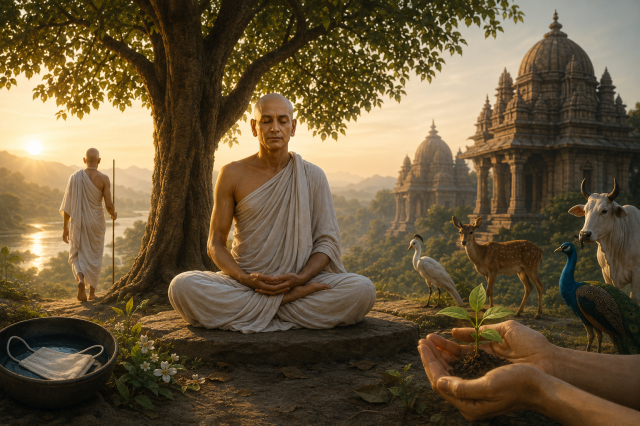
At the heart of Jainism lies the belief that every form of life deserves reverence, not only human beings. Large animals, small insects, even microorganisms invisible to the eye are all treated as beings worthy of respect. This conviction eventually developed into the philosophy of Ahimsa, or nonviolence. It is the same conviction behind the traditional image of the Jain monk who watches the ground carefully before each step so as not to crush some small creature, and who covers the mouth with a cloth to avoid harming even the tiniest forms of life in the air.
Many people today think of Jainism as an unusually severe religion. Look a little closer, though, and that severity reveals something else: a deep, sustained reflection on restraining human desire so that nature and all living things might flourish together. At a moment when climate change, ecological collapse, endless consumption, and relentless competition threaten humanity's future, the questions Jainism raises feel more urgent than ever. How much does a person truly need. How far can life be used for human ends. Can the advance of civilization ever be sustained without coexisting with nature.
Jainism asked these questions more than 2,500 years ago. They were never simple points of doctrine. They were ethical questions that human civilization put to itself.
A genuine civilization begins not with the capacity to possess more, but with the wisdom to want less. Jainism teaches that the strong are not those who defeat others, but those who defeat their own desire. Business cannot think only of profit. It must think of life and the environment together. Politics must place the common good ahead of power. Journalism must choose truth over sensation. And each person, when restraint and consideration take the place of endless consumption, finds a life that runs deeper, inside a society that grows healthier.
Ahimsa and liberation, the strictest discipline in the service of life
The single most important key to understanding Jainism is Ahimsa, nonviolence. Yet nonviolence in the Jain sense reaches well beyond simply refraining from harming other people. It begins with the belief that every living thing carries its own dignity and holds its own place and purpose within the universe. Human beings are not set apart as uniquely special. A single insect, a blade of grass, even forms of life too small to see are all regarded as members of the same living order, deserving the same respect.
This view of life was strikingly radical for its time. Most religions of the era centered their teaching on the relationship between humans and the divine. Jainism instead placed the relationship between human beings and all other life at the center of its thought. Nature was not something for humans to rule over. It was a community to be shared, and to harm life carelessly was, in the end, to stain one's own soul.
Jain cosmology divides existence into two broad categories. One is Jiva, the soul. The other is Ajiva, which includes matter, time, space, and the other non-living elements of the universe. A human being, in this framework, is not simply a body. Each person carries a soul, and that soul possesses, in its original nature, boundless wisdom and freedom. Desire, attachment, anger, and greed cause karma to cling to the soul like fine particles, and this gradually dims its natural light.
Jain teaching on karma stands apart from the Buddhist view. Buddhism treats karma largely as the consequence of action. Jainism describes karma as something closer to actual matter, a fine substance that physically attaches itself to the soul. Greed, deceit, violence, and attachment weigh the soul down, and that weight is what keeps it bound to the cycle of rebirth. The purpose of spiritual practice, then, is not simply to live a good life. It is to wash away, piece by piece, the karma clinging to the soul.
The final goal of this practice is Moksha, liberation. Moksha is not a passage to some other world after death. It is a state in which the soul, freed completely from karma, recovers its original purity. In Jainism, liberation is not a gift handed down by a god. It is the highest state a person must reach through personal effort and sustained discipline.
This is why Jainism places such weight on rigorous self-restraint. Defeating oneself, in this view, is harder and more admirable than defeating another. Mahavira's own life embodies that philosophy completely. Before he set out to change the world, he set out to change himself. Before he sought to save others, he sought to overcome his own desire.
Jain practice rests on five great vows. The first is Ahimsa, nonviolence. The second is truthfulness. The third is not coveting what belongs to others. The fourth is a disciplined, restrained life free of indulgence. The fifth is non-possession. These five vows are not simply ethical guidelines. They form a path meant to set the soul free.
The principle of non-possession, in particular, still carries weight today. Modern life runs on the belief that owning more brings more happiness. Jainism argues the opposite, that greater possession breeds greater attachment and greater anxiety. More material wealth does not expand human freedom. It tightens the grip of desire.
This is why the lives of Jain monks remain so austere. Some keep only the barest minimum of clothing and belongings. Many travel everywhere on foot for their entire lives, and they watch the ground as they walk so as not to harm the smallest living thing. Some cover their mouths with cloth to guard against swallowing even the tiniest creature by accident. To modern eyes this discipline can look extreme, but underneath it lies an absolute reverence for life.
Buddhism and Jainism were born in the same age, yet they walked different roads. Buddhism sought to ease human suffering through balance and compassion. Jainism sought to purify the soul through strict discipline and nonviolence. One emphasized equilibrium. The other emphasized rigor. Still, both placed human dignity and moral responsibility above all else, and for that reason both remain among the great inheritances of human civilization.
The reach of Jainism eventually moved beyond India and into the wider world. Its philosophy of nonviolence, in particular, left a lasting mark on later generations. Mahatma Gandhi, who led India's independence movement, drew deeply on the Jain principle of Ahimsa and built it into his political philosophy of nonviolent resistance. His conviction that conscience and truth carry more force than any gun or blade stands as a modern expression of Jain spirituality in practice.
Humanity today stands at another crossroads. Climate change, ecological destruction, boundless competition and consumption, and the rapid rise of artificial intelligence are forcing people to confront the same basic questions once again. How far should technology be allowed to go. What kind of relationship should humans have with nature. Is growth alone ever a true measure of progress.
At a moment like this, the voice of Jainism carries fresh meaning. A life built on respect for other beings, restraint of desire, and coexistence with nature is no longer only a religious ideal. It is fast becoming a strategy for survival. ESG management and sustainable development, animal welfare and environmental protection, ethical consumption and the ethics of artificial intelligence all trace back, if followed far enough, to the same single value: respect for life.
Jainism does not ask for grand miracles. It teaches that spiritual life begins with something far smaller: setting aside one unnecessary craving today, showing care for one small living creature, speaking a single kind word, and treating nature with a little more respect.
Nations and companies today would do well to take the same lesson to heart. Business must consider people and the environment alongside profit. Politics must choose coexistence over confrontation. Journalism must walk the path of truth rather than feed conflict. And each person, when restraint and consideration replace endless acquisition, finds a life carried with greater dignity.
Copyright ⓒ Aju Press All rights reserved.