
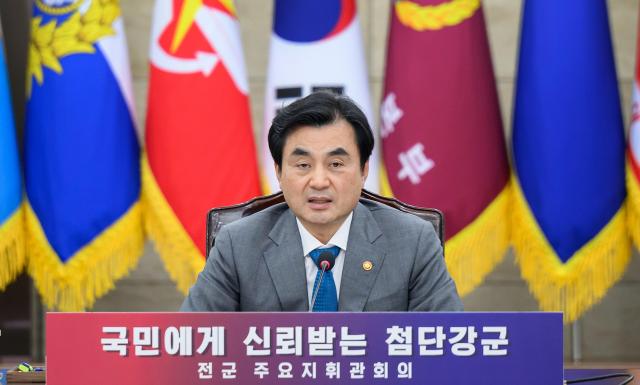
On July 1, Defense Minister Ahn Kyung-baek emphasized the urgent need for fundamental reforms in military academies, stating, "The expertise of each branch (Army, Navy, Air Force) must be preserved, but it should not become compartmentalized."
Ahn made these remarks during the Major Commanders' Meeting held at the Ministry of National Defense in Yongsan, Seoul, where he stressed the importance of institutionalizing joint operations.
The meeting was attended by over 150 key officials, including the Chairman of the Joint Chiefs of Staff, the chiefs of each military branch, and commanders at the corps level, as well as heads of national defense agencies.
He urged commanders to reflect on how much time each branch allocates for joint training throughout the year, asking, "How much time is that on a personal basis?"
Ahn highlighted that joint operations should be ingrained from the military academies, where cadets learn, train, and think together, and that this foundation should be refined and evolved in the field.
To enhance joint operations in modern warfare, the Ministry of National Defense is working on a reform plan to establish the 'National Military Academy,' which will integrate the selection of cadets from the Army, Navy, and Air Force. The plan includes common education for first and second-year students, followed by specialized training in their respective branches for third and fourth-year students.
Additionally, Ahn addressed the restoration of wartime operational control, stating, "A military that cannot make its own decisions cannot become a strong military."
He reiterated, "As I have mentioned several times, I hope to report the 'X year' for the recovery of operational control after completing the FOC verification at this year's SCM."
Furthermore, Ahn discussed the reorganization of intelligence and counterintelligence agencies, including the Defense Security Command, stating, "We must fundamentally abolish missions that lack clear legal basis or have the potential for illegality and completely restructure the organization based on functionality."
During the meeting, participants analyzed the dynamics of the Middle East and the Russia-Ukraine war, recognizing the importance of low-cost, high-efficiency advanced military capabilities such as AI, drones, and robots in modern warfare. They also reached a consensus on fostering a smart elite military based on AI and advanced scientific technology.
Moreover, they shared updates on the restructuring of military personnel, units, and force structure to proactively respond to changes in future security environments, including the decline in military conscription resources due to demographic shifts, and gathered feedback from attendees.
* This article has been translated by AI.
Copyright ⓒ Aju Press All rights reserved.