
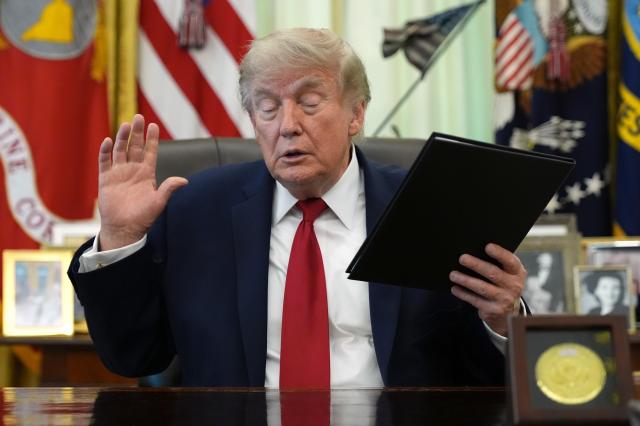
On June 30, the Supreme Court upheld a lower court's ruling by a 6-3 vote, which blocked Trump's executive order to restrict birthright citizenship for children born in the U.S. to parents without legal residency. The court determined that the order violated the 14th Amendment.
Chief Justice John Roberts, writing for the majority, defined citizenship as a fundamental right to participate in the American political community, stating, "The 14th Amendment should be interpreted to guarantee citizenship to all persons born in the United States."
On his first day in office on January 20, 2025, Trump signed an executive order that denied birthright citizenship to children born in the U.S. to undocumented or temporarily residing foreign parents. This order aimed to exclude not only children of illegal immigrants but also those born to parents with temporary visas for students, employment, or tourism.
In response, 22 states led by Democratic governors and Washington, D.C., filed a lawsuit claiming the order violated the 14th Amendment. Lower courts had previously ruled the order unconstitutional and suspended its enforcement, preventing the birthright citizenship restrictions from being implemented.
The 14th Amendment, adopted in 1868 shortly after the Civil War, states that all persons born or naturalized in the United States are citizens. Historically, the U.S. has granted automatic citizenship to children born on its soil, regardless of their parents' immigration status.
Trump quickly condemned the ruling, stating on his social media platform Truth Social, "The Supreme Court's decision to maintain the birthright citizenship system is a great misfortune for our country." He urged Congress to begin work immediately to end the costly and unfair birthright citizenship policy through legislation.
This ruling is another indication that Trump's key initiatives are being blocked at the Supreme Court. Earlier this year, the court invalidated Trump's major policy on reciprocal tariffs and recently halted his attempt to dismiss Federal Reserve Board member Lisa Cook. Additionally, the court dismissed a Republican lawsuit aimed at invalidating mail-in ballots received after Election Day, raising concerns for the upcoming midterm elections in November.
Texas, which has been classified as a Republican stronghold for over 30 years, is now emerging as a competitive battleground in the midterms. A recent poll conducted by The New York Times in collaboration with Siena College showed Democratic Senate candidate James Talarico with 47% support, tying with Republican Senate candidate Ken Paxton. This result is particularly notable as Texas has not lost a statewide election to Democrats since 1994.
In light of these developments, Trump is mobilizing conservative support ahead of the midterms. He announced that the Republican Party will hold a "Midterm Convention" in Dallas, Texas, on September 10-11. Typically, party conventions are held in election years to nominate presidential candidates, making this midterm convention unusual. Trump emphasized that this will be a historic event.
Given that this midterm election is seen as a pivotal moment for Trump's second term governance, the Republican Party is expected to focus on highlighting the achievements of the Trump administration and rallying conservative support through the convention.
* This article has been translated by AI.
Copyright ⓒ Aju Press All rights reserved.