
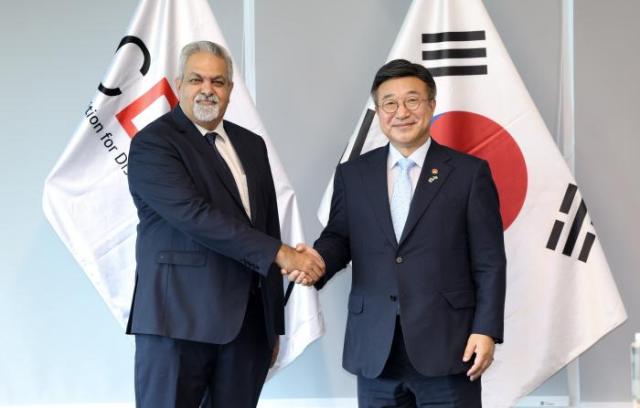
From June 17 to 24, Yoon visited India and Uzbekistan to lay the groundwork for cooperation in public administration, digital government, and disaster management. This trip followed President Lee Jae-myung's state visit to India in April and served as a precursor to agenda-setting for the upcoming Korea-Central Asia summit in September.
The mission focused on two main areas: digital government and disaster management cooperation. These sectors reflect the competitiveness of national systems, distinguishing them from mere technology transfer. Yoon's formal expression of intent to join the CDRI in India signals South Korea's serious entry into global disaster response governance. In an era of climate crisis, disasters transcend borders, and infrastructure resilience is directly linked to national competitiveness. Observers suggest that if South Korea establishes itself as a key player in norm formation and technological collaboration, its influence in international markets will likely expand.
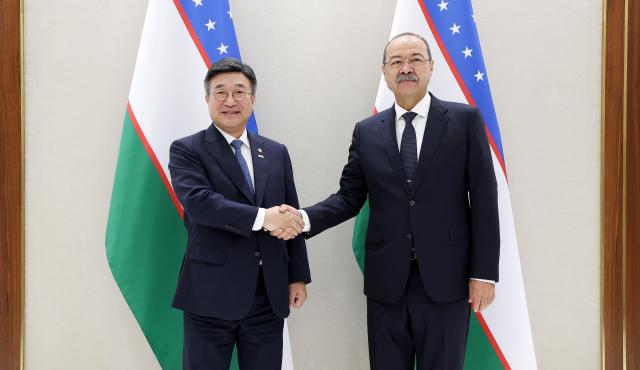
The establishment of a digital government cooperation center in Uzbekistan represents a more direct 'export model.' E-government is an area where South Korea already excels, but previous efforts have often been limited to 'reference cases.' Yoon's collaboration differs in that it is designed to combine systems, personnel, and technology at a permanent local base. This approach aims for a long-term ecosystem transfer rather than a one-off system setup, marking a shift toward 'platform export.'
Notably, the potential for expansion into AI administration is significant. Yoon's vision of an 'AI democratic government' transcends simple technology adoption, proposing a fundamental change in administrative operations. This model, which integrates data-driven decision-making, public service automation, and increased citizen participation, is likely to lead to global standard competition. If the digital government cooperation center serves as a testing ground for these experiments, South Korea could advance from merely exporting technology to exporting administrative models themselves.
However, several challenges remain. The first is sustainability. The implementation of international cooperation MOUs is more critical than the signing itself. Past similar initiatives have often faltered due to changes in government or shifts in policy priorities. For this collaboration to yield tangible results, it must be supported by institutional mechanisms, budgets, and public-private partnership structures.
The second challenge is localization. Digital government is closely tied to the political and administrative cultures of each country. This means that simply transplanting the South Korean model may not be effective. For the Uzbekistan cooperation center to succeed, it must evolve into a customized model that integrates local systems beyond mere technology transfer. This strategy should encompass domestic corporate participation, education, and workforce development.
The third challenge is the global competitive landscape. The fields of digital government and disaster management are already highly competitive, with major countries like the United States, Europe, and China vying for dominance. The intertwining of data sovereignty and cybersecurity issues is expanding these areas beyond mere technology cooperation into diplomatic and security concerns. For South Korea to secure competitiveness in this market, it must build a cooperation model based on trust, in addition to its technological capabilities.
In response, a Ministry of the Interior and Safety official stated, "We have achieved concrete results in solidifying the cooperation infrastructure between the two countries in the face of the era's challenges of government innovation and global disaster response." He emphasized the need to expedite follow-up actions, such as the operation of the digital government cooperation center and CDRI membership, to ensure that South Korea's administrative model can maintain sustainable influence in the global market through public-private collaboration.
* This article has been translated by AI.
Copyright ⓒ Aju Press All rights reserved.