
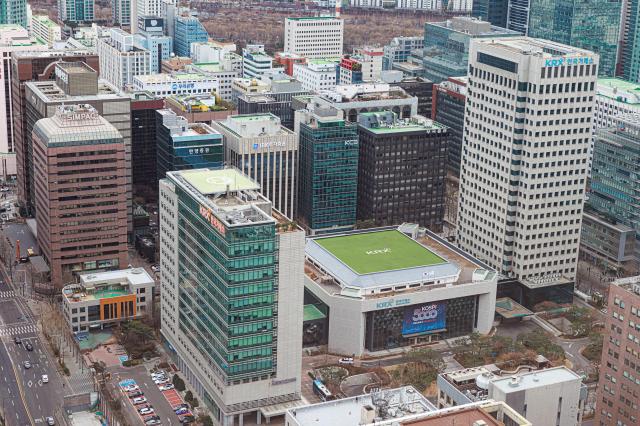
On the first day of the National Pension Service's domestic stock rebalancing for the second half of the year, the fund recorded a net sell-off of 220.2 billion won in the securities market. Contrary to concerns about a large-scale sell-off, the actual transactions were diversified, primarily focusing on large-cap stocks.
According to the Korea Exchange, the pension fund sold off 210.3 billion won in large-cap stocks, while it bought 53 billion won in mid-cap stocks and 13 billion won in small-cap stocks. By sector, the fund reduced its holdings in the financial sector by 137.6 billion won, the largest decrease, followed by manufacturing at 72.9 billion won, electrical and electronic at 59.4 billion won, insurance at 29.4 billion won, transportation equipment and parts at 26 billion won, and retail at 20.8 billion won. Conversely, it increased its holdings in machinery and equipment by 13.5 billion won, pharmaceuticals by 8.4 billion won, securities by 6.9 billion won, and construction by 5.3 billion won.
As of 2:14 PM, the largest sell-off was in Samsung Electronics, with 32.9 billion won sold, followed by SK Square at 16.5 billion won and Samsung C&T at 13.5 billion won. However, the sell-off was spread across several large-cap stocks rather than being concentrated on specific ones.
The National Pension Service resumed its rebalancing process to adjust the proportion of domestic stocks in its portfolio. Rebalancing is a management procedure that realigns a portfolio that has deviated from its target allocation due to asset price fluctuations. When the proportion of domestic stocks increases due to rising prices, the fund reduces its holdings in those stocks and increases its allocation to other assets, following long-term management principles rather than short-term market forecasts.
As of the end of March this year, the National Pension Service's domestic stock holdings amounted to 321 trillion won, or 21% of its total assets of 1,526 trillion won. Following a surge in the KOSPI index, which reached around 8,500 by the end of May, the proportion increased to approximately 29%. It is estimated that the proportion rose to 31.4% when the KOSPI surpassed 9,000 on June 19.
In this context, there were concerns in the market that the National Pension Service could sell off up to 74 trillion won in domestic stocks, referred to as the '74 trillion won sell-off bomb theory.' However, the actual net sell-off on the first trading day was limited to 220.2 billion won, showing a different trend than the feared large-scale sell-off.
On the same day, Kim Sung-joo, the chairman of the National Pension Service, strongly denied the '74 trillion won sell-off bomb theory' through social media. He stated, "The figure of '74 trillion' itself is incorrect," adding, "Rebalancing is not a bomb, but rather an asset adjustment." He emphasized that the likelihood of a large-scale sell-off occurring in the short term is zero.
* This article has been translated by AI.
Copyright ⓒ Aju Press All rights reserved.