
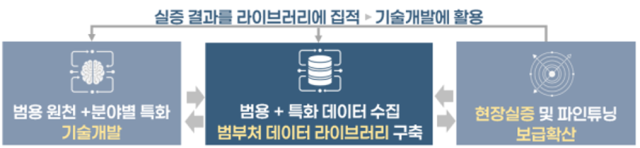
The Ministry of Science and ICT is embarking on a data acquisition initiative as part of its three major mega projects aimed at establishing South Korea as a global leader in Physical AI by 2028. The plan involves securing 1 to 2 petabytes (PB) of data primarily through the AI Transformation (AX) projects in Jeonbuk and Gyeongnam, as well as through leading technology development projects.
On July 1, the ministry announced its "Strategy for Securing Core Competitiveness in Physical AI" at the KT West building in Gwanghwamun, Seoul. The ministry views data as the cornerstone of Physical AI competitiveness and plans to establish a cross-ministerial data acquisition system.
Data necessary for training Physical AI is currently dispersed across various ministries and industries, resulting in low utilization. To address this, the ministry aims to create a government-wide data library that consolidates data generated from government projects, ensuring quality verification and standardization for AI training.
Song Chang-jong, head of the Device AX Innovation Team at the ministry, stated, "There are not many ministries producing Physical AI data, and we need to clarify what and how to produce it. We plan to prioritize the accumulation of 1 to 2 petabytes of data from the Jeonbuk and Gyeongnam projects and prepare a system for efficient utilization by the government and businesses."
The ministry also plans to simultaneously secure synthetic data alongside real-world data. Song noted, "Recent general models often use a 50-50 mix of synthetic and real data, but we expect the proportion of synthetic data to rise to 80-90% in the future. The key is how well we can generate synthetic data."
He added, "Synthetic data can be generated using world models and simulators. We will secure core technologies through large-scale R&D for world models and establish systems to create data tailored to specific fields using simulators."
The acquired data will be utilized for the development of core technologies in Physical AI, including foundation models, world models for predicting future scenarios, and on-device computing platforms. The ministry plans to first validate these technologies in manufacturing settings before expanding them across all industries.
Given that much of the manufacturing data is considered proprietary, increasing private sector participation remains a challenge. Park Tae-wan, director of the Information and Communication Industry Policy Bureau at the ministry, explained, "It is difficult for large companies to easily share sensitive manufacturing data. We will create incentives for companies to provide data and prioritize the acquisition of basic behavioral data that can be easily utilized."
The ministry assessed that Physical AI operates in a different competitive landscape compared to generative AI. Lee Do-kyu, director of the Information and Communication Policy Office, remarked, "While large language models (LLMs) learn from existing texts and images, which limits latecomers like us, there is currently no dominant player in Physical AI. South Korea has untapped resources across all manufacturing sectors, and Physical AI holds significant potential."
On the same day, the ministry clarified the roles of its Physical AI strategy in relation to the manufacturing AI policy, M.A.X., being pursued by the Ministry of Trade, Industry and Energy. While the Ministry of Trade is responsible for applying AI in manufacturing settings through the AX project, the Ministry of Science and ICT will focus on securing future foundational technologies such as Physical AI foundation models and world models.
Lee stated, "The Ministry of Trade's manufacturing AX project involves applying AI to current manufacturing practices, such as inventory management and vision sensor-based automation, while our ministry is driving R&D to seize future technologies in Physical AI. Although it may appear that our roles overlap, we are coordinating our efforts through senior-level discussions to collaborate effectively."
* This article has been translated by AI.
Copyright ⓒ Aju Press All rights reserved.