
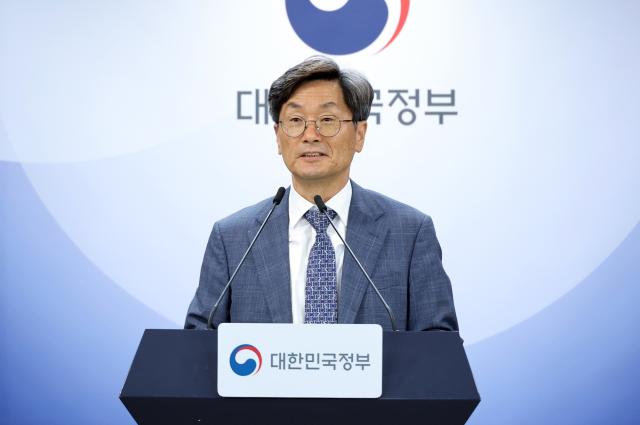
During a press briefing held at a restaurant in Seoul, Jeong acknowledged that while the allegations reported by lawmaker Joo Jin-woo from the People Power Party regarding the Election Commission's direct contracts will be reviewed and processed according to the law and procedures, the commission has limited options at this time. He explained that the Election Commission is a constitutional body, which restricts the commission's ability to investigate.
On June 25, lawmaker Joo submitted a corruption report to the Anti-Corruption Commission, alleging that the Election Commission had colluded with private contractors. Joo claimed during a press conference that an analysis of 2,665 contracts from the past five years revealed that 82.1% were direct agreements, with 9 out of 10 contracts awarded without competitive bidding, citing "security" as the reason.
Jeong pointed out that the Anti-Corruption Commission faces many restrictions under the Anti-Corruption and Civil Rights Commission Act regarding conducting investigations. He noted, "For example, if the Board of Audit and Inspection begins an audit or if a law enforcement agency starts an investigation, the Anti-Corruption Commission cannot conduct its own investigation."
According to the Anti-Corruption and Civil Rights Commission Act, the commission can request data from public institutions and conduct investigations when a corruption report is received. However, it cannot conduct separate investigations or interviews if an audit by the Board of Audit and Inspection is underway.
The Board of Audit and Inspection began an audit of the Election Commission on June 24, which includes an examination of the direct contract issues.
Jeong also revealed that an amendment to the Anti-Corruption and Civil Rights Commission Act, aimed at strengthening the commission's investigative powers compared to other audit and investigative bodies, was approved by the Cabinet the previous day and will be sent to the National Assembly. The amendment proposes imposing fines of up to 10 million won on heads of public institutions that fail to comply with the commission's requests for data without justifiable reasons.
Jeong expressed, "Considering the public's expectations of the Anti-Corruption Commission, it would be beneficial for us to have more investigative powers. We have many desired investigative authorities." However, he emphasized that there needs to be a consensus among the public regarding whether such powers should be granted to the commission.
Regarding the 10th anniversary of the Improper Solicitation and Graft Act, Jeong noted, "There have been many criticisms from the public that it does not align with social norms, and we are gathering opinions from various sectors. We will announce our findings soon."
Meanwhile, the Anti-Corruption Commission will co-host the 'Korea-UNDP International Anti-Corruption Forum' at the Lotte Hotel in Jung-gu, Seoul, from July 2 to 3.
During the forum, both organizations will discuss the achievements of the anti-corruption technical support project over the past decade and future sustainable anti-corruption strategies and governance.
The Anti-Corruption Commission has shared anti-corruption systems and frameworks with a total of 14 countries through this technical support project. Key topics include comprehensive integrity assessments of public institutions, corruption impact assessments, digital systems for handling corruption and public interest reports, and protection and compensation systems for whistleblowers.
A total of 17 countries will participate in this forum, along with anti-corruption experts from international organizations such as the United Nations Office on Drugs and Crime (UNODC) and the World Bank (WB), as well as government officials, academics, civil society organizations, and private sector representatives.
* This article has been translated by AI.
Copyright ⓒ Aju Press All rights reserved.