
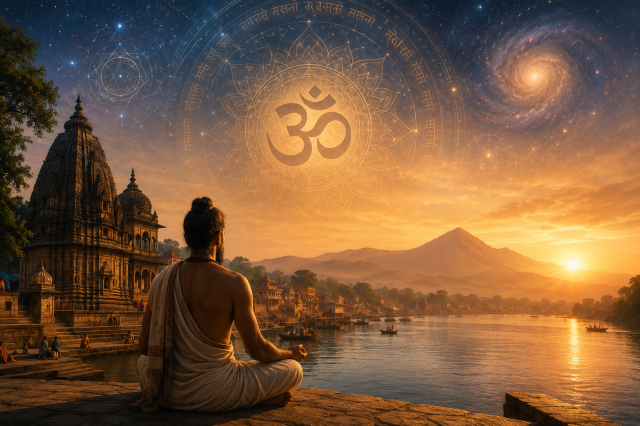
21st-century humanity stands at the threshold of a monumental civilizational shift. Artificial intelligence (AI) has begun to learn human language, robots are replacing human labor, and algorithms are rapidly infiltrating human judgment. The world is transitioning into a civilization era unlike any before. Ironically, as technology advances, humanity finds itself confronting the oldest questions once again.
What does it mean to be human?
Where did the universe come from?
What is consciousness, and does the human soul exist?
And where are we headed?
In light of these questions, humanity is revisiting ancient spirituality. The Hindu scriptures, the Vedas and Upanishads, are not merely religious texts; they are monumental records of civilizational thought that have explored the cosmos, humanity, existence, and consciousness for thousands of years. Notably, the cosmology found in these texts closely resembles the philosophy of Cheonbugyeong, which emphasizes the interconnectedness of heaven, earth, and humanity, viewing humans as integral parts of the vast universe.
In today's AI era, the strong presence of young Indians in the global IT and AI sectors may be influenced by this deep philosophical tradition and culture of abstract thinking. The Vedas and Upanishads pose timeless questions that resonate with the future of civilization.
The Vedas: Humanity's First Questions About the Universe
The term Veda means "knowledge" or "wisdom" in Sanskrit and is regarded as one of the oldest scriptures left by humanity. The Vedas are divided into four main texts: the Rigveda, Samaveda, Yajurveda, and Atharvaveda. Among these, the Rigveda is the oldest and most essential. It is not merely a collection of myths but a philosophical inquiry into the universe and poetic questions about the origins of existence. The famous hymn from the Rigveda, the 'Nasadiya Sukta,' is considered one of the most profound cosmic questions in human history."At that time, there was neither existence nor non-existence." - Rigveda
This statement intriguingly connects to modern cosmology, echoing today's scientific inquiries about what existed before the Big Bang. Ancient Indians did not view the universe as a mere material realm; they believed it contained a vast order and mystery beyond human comprehension. The Rigveda describes this as 'Rta,' the fundamental order that governs the universe. This concept suggests that the movements of the sun, the changing of seasons, and the cycle of life and death all exist within a singular order. This idea resonates with the Cheonbugyeong's notion of "Ilshi Musil (一始無始一)," which posits that all existence began from one source that existed before time. Eastern spirituality has consistently emphasized the fundamental unity of the universe.
"Truth is one, but the names are many." The Rigveda contains a statement that deeply resonates with contemporary civilization: "Truth is one. The wise call it by various names." - Rigveda 1:164:46
This brief statement encapsulates the tolerance and inclusivity of human civilization. The world is home to numerous religions and cultures, each discussing different deities and explaining truth in various ways. However, the Rigveda suggests that the source may be one. This idea aligns with the philosophy of Korean thinker Yoo Young-mo, who famously stated, "Truth is one, but prophets are many." He is known for unifying all religions of the East and West into a singular understanding.
Cheonbugyeong also explains the universe's origin as 'Il (一).' Ultimately, human civilization, despite its diverse languages and religions, has posed the same questions under the same sky. Today, the world is shaken by conflicts of religion, ideology, ethnicity, and nation. AI technology connects people while simultaneously causing divisions. This is why the Rigveda's message has become increasingly significant; a civilizational perspective that acknowledges differences while seeking a fundamental unity is essential.
The Upanishads: Discovering the Universe Within Humanity
While the Vedas sang of the order of the universe, the Upanishads explored the universe within humanity. The term Upanishad means "to sit near the teacher and listen to the truth." Here, Hindu philosophy begins to question the essence of human existence beyond mere rituals and ceremonies.The core of the Upanishads is the concepts of Brahman and Atman. Brahman represents the ultimate reality of the universe, while Atman signifies the true self within humans. The Upanishads assert that the human soul and the essence of the universe are ultimately one.
"Tat Tvam Asi (That Thou Art)." - Chandogya Upanishad
This statement dramatically illustrates the dignity of human existence. It implies that humans are not isolated beings disconnected from the universe but rather integral parts of it. The Cheonbugyeong's philosophy of heaven, earth, and humanity also views humans as beings existing within the flow of nature. Ancient Eastern spirituality did not regard humans as rulers over nature; instead, it understood them as beings that breathe in harmony with the universe.
"From darkness to light." The Upanishads contain one of the oldest prayers of the human soul.
"Lead me from darkness to light. Lead me from death to immortality." - Brihadaranyaka Upanishad
This passage is not merely a religious statement; it reflects the eternal longing of human existence. Darkness symbolizes ignorance, greed, hatred, and fear, while light represents truth, love, and enlightenment.
Today, humanity has achieved a level of civilization more abundant than ever before. Yet, it also lives amidst profound anxiety and emptiness. AI mimics human language, creates art, and composes music, but it cannot fully explain the human soul, love, pain, and hope. Thus, humanity is once again seeking spirituality. The Upanishads assert that there is a cosmic light within humans, emphasizing that humans are not merely data and mechanical entities.
"Walk together." Another famous verse from the Rigveda illustrates the essence of community spirit.
"Walk together. Speak together. Let your hearts be one." - Rigveda 10:191
Modern society is increasingly losing its sense of community amidst a civilization driven by competition and speed. The AI era has improved productivity and efficiency, yet the disconnection between humans has deepened. However, the Vedas remind us that humans are interconnected beings. The Cheonbugyeong also understands humans as existing within relationships. Heaven, earth, and humanity are not separate entities but part of a cyclical structure of life. Ultimately, the key to future civilization may lie not in technology itself but in the ability to connect humans with one another.
Hindu Scriptures and India's Role in the AI Era
Today, the presence of Indian talent in the global AI and IT industries is overwhelming. Figures like Sundar Pichai of Google and Satya Nadella of Microsoft, along with many other Indian professionals, are leading the global technology sector. While this phenomenon cannot be solely attributed to the influence of Hindu scriptures, factors such as English education, a strong emphasis on mathematics, a large population, and a competitive system also play significant roles.However, India's rich philosophical tradition is an undeniable background. Indian civilization has long explored existence, consciousness, logic, and abstract thought. The numerical system and the concept of zero also developed within Indian civilization. The AI era demands abstract thinking and creative synthesis over mere memorization, and these skills are likely linked to the depth of philosophical reasoning.
Interestingly, the Cheonbugyeong also emphasizes cosmic integrative thinking. It views humans, nature, the universe, and life as part of a cyclical structure. This offers crucial insights for the AI era. While technology can empower human hands, it cannot replace the human soul. Ultimately, the competitiveness of future civilization may hinge not only on technological prowess but also on the depth of human understanding.
Facing Ancient Questions in the Age of AI
The Vedas and Upanishads, though thousands of years old, pose questions that remain astonishingly relevant today.What does it mean to be human?
What is consciousness?
Is the universe merely a machine, or is it a living order?
In the age of AI, humanity stands once again before these ancient questions. The ancient Hindu scriptures quietly assert that humans are not separate from the universe, that life is interconnected, and that while truth is one, its expressions may vary.
The Cheonbugyeong conveys a similar message: heaven, earth, and humanity are not distinct entities but part of a vast flow of life. It states, "In the midst of humanity, heaven and earth are one."
Perhaps what humanity needs to revisit in the 21st century is not faster technological manuals but the ancient spiritual texts that reflect on the relationship between humans and the universe.
※ This article was generated using generative AI and has been reviewed by an editor.
* This article has been translated by AI.
Copyright ⓒ Aju Press All rights reserved.