
KT plans to invest approximately 18 trillion won over the next three years to transform into an artificial intelligence (AI) platform company. The strategy aims to enhance information security and network competitiveness while expanding AI data centers (AIDC) and physical AI infrastructure, as well as developing new businesses such as token factories and stablecoins to secure a leading position in the AI market.
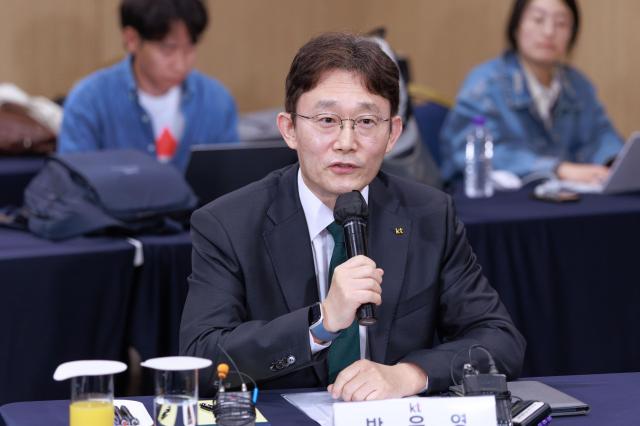
On July 6, Park Yoon-young, KT CEO, held his first press conference at the Pullman Ambassador Hotel in Gwangjin-gu, Seoul, where he announced the 'AX Platform Company' strategy. KT aims to strengthen its core telecommunications competitiveness as a national telecommunications provider while transitioning to a platform company that supports AI transformation for public, industrial, and individual sectors.
KT will invest about 12 trillion won over the next three years to enhance information security, information technology (IT), and network competitiveness. Approximately 4 trillion won will be allocated to establish a zero-trust security framework and integrate security operation governance. The company plans to separate the roles of Chief Information Security Officer (CISO) and Chief Privacy Officer (CPO) and double its security personnel to bolster its security capabilities.
In the network sector, around 8 trillion won will be invested to secure future network technologies, including sixth-generation mobile communication (6G), satellites, and data center interconnections (DCI), with the goal of improving customer experience. KT also plans to expand its operations from geostationary (GEO) satellites to low Earth orbit (LEO) satellites to ensure stable communication networks in disaster and security situations.
An investment of approximately 6 trillion won will be directed toward building AI infrastructure. Of this, about 5 trillion won will be used to establish a total of 1 gigawatt of AIDC based on actual demand and to expand AI edge computing. The plan includes connecting central AIDC with AI edges near industrial sites to create ultra-low-latency AI inference environments necessary for physical AI and autonomous driving.
To respond to the growing global AI traffic, KT will invest 1 trillion won in undersea cables, expanding supply capacity to over 90 terabits per second. This investment aims to attract domestic AIDC investments from global tech giants and develop Korea into an 'Asian AX connection hub.'
In the business-to-business (B2B) sector, KT will expand AI services primarily in finance, public, manufacturing, and healthcare sectors. In finance, it will provide AI contact centers (AICC) and sales agents, while in the public sector, it will promote sovereign AI-based services. In manufacturing and healthcare, KT plans to participate in physical AI demonstration projects led by the Ministry of Science and ICT to expand its business.
In the business-to-consumer (B2C) sector, KT will introduce hyper-personalized services that allow customers to design their own plans and benefits. The company aims to provide tailored services based on usage pattern analysis and to digitize the entire process from subscription to customer support.
KT also presented 'token factories' and stablecoin businesses as future growth drivers. By leveraging its billing and settlement capabilities accumulated through network operations, KT plans to build a platform that supports the generation, mediation, and billing of AI tokens. Additionally, it will pursue stablecoin-based digital finance initiatives by combining the capabilities of its affiliates, such as K Bank and BC Card.
The company aims to expand global collaborations, continuing its partnership with Microsoft while broadening its cooperation with global AI firms like Google and Palantir, as well as domestic AI companies such as Upstage, Rebellion, and Saltlux to strengthen the AI ecosystem.
Park stated, "The essence of KT is to be responsible for connecting South Korea," adding, "We will further strengthen our telecommunications competitiveness and create new growth engines in the AI market to enhance South Korea's AX competitiveness."
Park officially took office on March 31 and will serve a three-year term until 2029.
* This article has been translated by AI.
Copyright ⓒ Aju Press All rights reserved.