SEOUL, July 08 (AJP) - South Korea posted another record current account surplus in May, but the windfall was overshadowed by the largest foreign exodus from the country's stock market on record, exposing a widening disconnect between the economy's external strength and global investors' appetite for Korean assets — a divergence that has helped keep the won stubbornly weak.
The Bank of Korea said Wednesday the current account surplus widened to a record $38.61 billion in May, driven by booming semiconductor exports and investment income. At the same time, foreign investors sold a record net $31.05 billion worth of Korean equities, resulting in a $24.65 billion decline in foreign portfolio investment in domestic markets.
The May current account surplus surpassed the previous record set in March and rising sharply from $28.29 billion in April and $9.91 billion a year earlier. For January-May, the black stretched to $141.28 billion, more than four times $33.9 billion a year-ago period.
The goods account, the main driver of the overall surplus, also logged a record surplus of $37.86 billion. Goods exports rose 62.9 percent from a year earlier to $94.34 billion, while imports increased 22.2 percent to $56.48 billion.
Exports under the balance-of-payments framework reached a fresh high, slightly topping the previous peak in March. Imports were not at a record high and edged down from $56.70 billion in April, widening the goods surplus sharply.
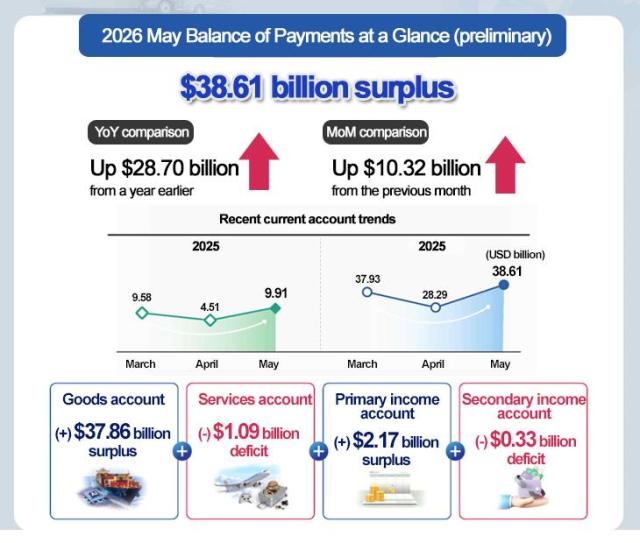
The services account remained in deficit, but the shortfall narrowed to $1.09 billion from $2.42 billion a month earlier. The travel account swung to a small surplus of $50 million, while deficits continued in other business services and manufacturing services.
The primary income account recorded a surplus of $2.17 billion, led by dividend income, while the secondary income account posted a deficit of $330 million.
For the first five months of the year, the current account surplus reached $141.28 billion. The goods surplus over the same period stood at $145.96 billion.
Customs-cleared trade data included in the Bank of Korea (BOK) release showed how heavily the export rebound depended on semiconductors. Exports on a customs basis rose 53.4 percent from a year earlier to $87.82 billion in May.
Semiconductor exports jumped 167.7 percent to $37.29 billion, accounting for more than 40 percent of total customs-cleared exports. The increase in semiconductor exports alone accounted for roughly three quarters of the overall export gain from a year earlier.
Exports of electrical and electronic products more than doubled to $47.61 billion, while information and communications devices rose 103.9 percent to $6.59 billion. Outside the technology sector, petroleum product exports rose 49.1 percent to $5.44 billion, while chemical and steel products posted moderate gains.
But the recovery remained uneven, with passenger cars, auto parts and machinery all declining from a year earlier. Passenger car exports fell 7.5 percent to $5.49 billion, while auto parts declined 7.8 percent to $1.48 billion. Machinery and precision equipment exports also dropped 4.9 percent to $5.59 billion.
By destination, exports to China rose 80.8 percent to $18.89 billion, while shipments to Southeast Asia increased 74.4 percent to $29.02 billion. Exports to the United States climbed 59.4 percent to $16 billion. Exports to the European Union rose only 3.2 percent, while shipments to the Middle East fell 7.5 percent.
Imports on a customs basis rose 20.7 percent to $60.79 billion in May. Raw material imports increased 22.1 percent, while capital goods imports rose 28 percent. Consumer goods imports gained only 1.8 percent.
Crude oil imports rose 24.8 percent in value terms, even as import volume fell 22.9 percent, as the average import price of crude oil surged 61.9 percent from a year earlier.
Semiconductor-related imports also remained strong. Semiconductor imports rose 61.1 percent, while imports of chipmaking equipment increased 54.9 percent.
The financial account recorded a net asset increase of $31.08 billion. Portfolio investment rose by $30.89 billion as South Korean residents purchased a net $6.24 billion of overseas securities, mainly equities, while foreign investors sharply reduced their holdings of Korean assets.
For the first five months of the year, foreign investors dumped a total $74.67 billion of Korean equities - more than seven times $10.16 billion net sales in the same period last year.
Korean investors bought $41.03 billion of overseas stocks during the period, resulting a cascade of capital outflow that has helped keep the won above 1,500 per U.S. dollar on average this year for the first time since the Asian financial crisis of the late 1990s.
Direct investment remained positive, with Korean companies investing $4.56 billion overseas and foreign direct investment into South Korea increasing by $2.69 billion. Reserve assets fell by $1.73 billion during the month.
Reserve assets decreased by $1.73 billion in May.

Copyright ⓒ Aju Press All rights reserved.