The current-account surplus set the tone for the Korean won against the U.S. dollar in the export-reliant economy. Strong exports bolstered the won, while a weaker won made Korean goods more competitive overseas. For foreign-exchange watchers, trade data mattered most.
Not anymore.
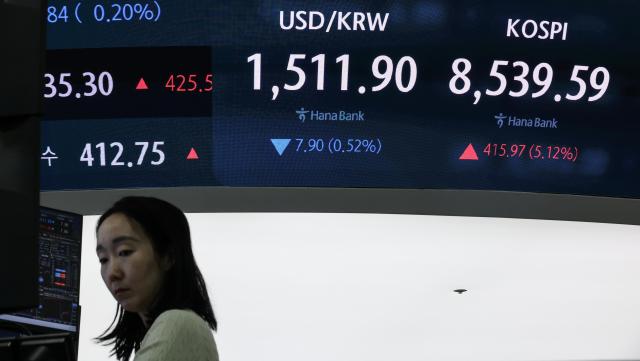
The Korean won has hovered around 1,500 per U.S. dollar since late last year. The dollar ended June at 1,549.4 won, compared with 1,439 won at the end of 2025 and 1,472.5 won at the end of 2024. In the first five months, it averaged at 1,476.99.
The weak currency sits uneasily with the broader economy.
Exports reached a record $496.71 billion in the first half and the economy grew 3.8 percent from a year earlier in the first quarter — among the fastest in the OECD —while the benchmark KOSPI ended June at 8,476, roughly double its level six months earlier.
By the old formula, the won should have been one of Asia's strongest currencies.
Instead, it has remained near its weakest level since the 1997-98 Asian financial crisis.
The mystery is explained by South Korea's latest balance-of-payments data.
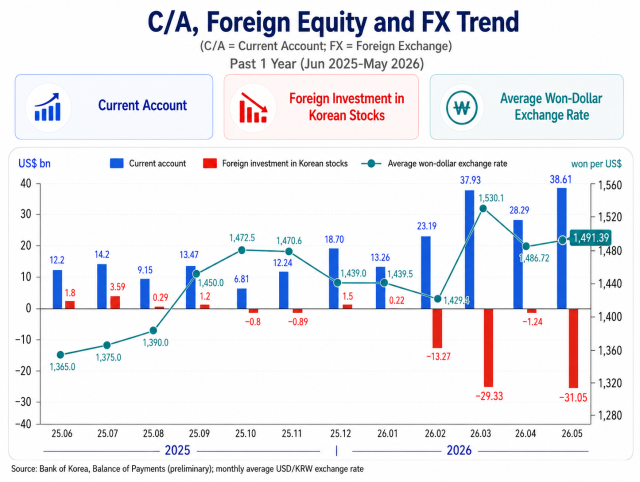
Together, the two equity-related flows reached $115.70 billion, or more than 80 percent of the cumulative current account surplus.
Much of the foreign selling centered on Samsung Electronics and SK hynix, the KOSPI's two largest companies, whose shares have surged five- to six-fold over the past year. Foreign investors still own roughly half of both chipmakers, allowing them to realize substantial gains from the AI-driven semiconductor rally.
Semiconductors accounted for roughly half of Korea’s customs-cleared exports in May, underscoring how heavily the record current-account surplus depended on the AI-driven chip cycle.
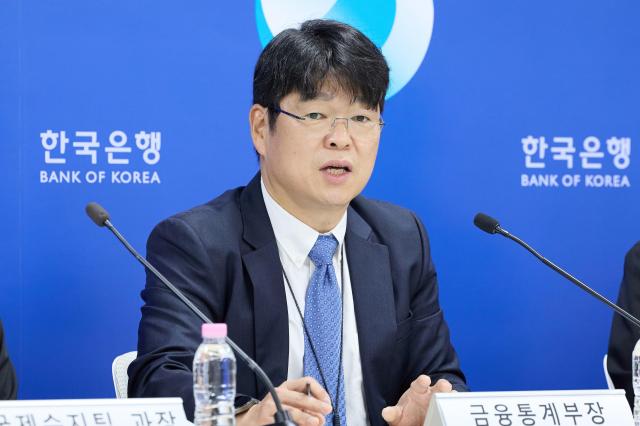
Yoo Sung-wook, head of the Bank of Korea's Financial Statistics Department, said foreign investors continued to show a tendency to sell Korean stocks in June and that it would take more time to determine when rebalancing-driven selling would come to an end.
The government's assessment echoed that view.
Following an interagency market-monitoring meeting Wednesday, officials said financial and foreign-exchange markets continued to face elevated volatility despite record exports and current-account surpluses because of persistent foreign fund outflows and expectations of higher global interest rates.
While exports continue to generate record foreign-exchange earnings, capital flows are increasingly determining whether those dollars remain in Korea or leave the country, limiting the traditional support that trade surpluses once provided to the currency.
The government said it would strengthen its 24-hour monitoring system after Korea began round-the-clock foreign exchange trading earlier this week.
It also plans to announce a roadmap this month to promote the international use of the won in current and capital account transactions.

Copyright ⓒ Aju Press All rights reserved.