SEOUL, July 9 (AJP) -South Korea's economy is expected to survive global-wide setback from the prolonged Gulf crisis and run above its growth potential through next year as it benefits from feverish chip demand amid artificial intelligence investment boom, drawing one of the steepest outlook upgrades from the International Monetary Fund and the Asian Development Bank.
The IMF on Wednesday raised its 2026 growth forecast for South Korea to 2.6 percent, up 0.7 percentage point from its April projection — the largest upward revision among the 30 economies covered in its July World Economic Outlook Update. It also lifted next year's forecast by 0.4 percentage point to 2.5 percent.
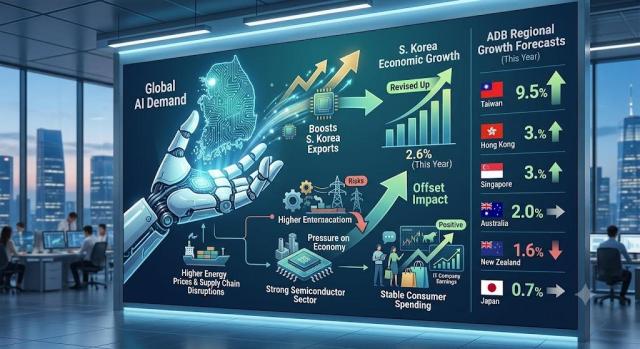
The ADB in its latest revised outlook released on Thursday also upgraded this year's growth forecast for Korea to 2.6 percent from 1.9 percent projected in April and nudging next year's estimate to 2.0 percent from 1.9 percent, likewise citing robust AI-led semiconductor exports.
The IMF said South Korea's strong overseas demand for semiconductors and AI hardware had more than offset the drag from the Middle East conflict, identifying Korea as one of the world's four largest net exporters of AI hardware alongside Taiwan, Thailand and Malaysia.
It noted the Korean economy expanded at an annualized 7.5 percent in the first quarter, far exceeding its earlier estimate of 1.8 percent.
The ADB similarly said resilient exports driven by global AI demand would continue supporting growth into next year, while stronger corporate earnings, buoyant equity markets and government support should underpin domestic consumption.
Both institutions nevertheless warned that the outlook remains vulnerable to rising energy prices and geopolitical uncertainty.
The IMF trimmed its 2026 global growth forecast to 3.0 percent from 3.1 percent, saying the world economy is caught between supply disruptions caused by the Middle East conflict and an AI-driven technology cycle. It warned that geopolitical tensions, trade fragmentation and elevated energy costs remain major downside risks, although it expects energy markets to normalize gradually next year.
The ADB likewise cautioned that higher production costs stemming from energy prices and supply-chain disruptions could weigh on Korea's economy. It also pointed to the potential return of U.S. tariffs and a correction in equity markets as additional risks, even as the country's semiconductor industry is expected to cushion those headwinds.
It projected South Korea's inflation at 2.7 percent this year and 2.2 percent next year, citing the impact of higher international energy prices on consumer prices. The figures are 0.4 and 0.2 percentage points higher, respectively, than its April forecasts.
Meanwhile, the ADB revised up its growth forecast for Taiwan to 9.5 percent, while projecting Hong Kong and Singapore to grow in the 3 percent range.
But forecasts for Japan and Australia were unchanged from earlier projections, at 0.7 percent and 2.0 percent, respectively, while New Zealand's growth forecast was lowered by 0.3 percentage point from April to 1.6 percent.
The IMF on Wednesday raised its 2026 growth forecast for South Korea to 2.6 percent, up 0.7 percentage point from its April projection — the largest upward revision among the 30 economies covered in its July World Economic Outlook Update. It also lifted next year's forecast by 0.4 percentage point to 2.5 percent.
The ADB in its latest revised outlook released on Thursday also upgraded this year's growth forecast for Korea to 2.6 percent from 1.9 percent projected in April and nudging next year's estimate to 2.0 percent from 1.9 percent, likewise citing robust AI-led semiconductor exports.
The IMF said South Korea's strong overseas demand for semiconductors and AI hardware had more than offset the drag from the Middle East conflict, identifying Korea as one of the world's four largest net exporters of AI hardware alongside Taiwan, Thailand and Malaysia.
It noted the Korean economy expanded at an annualized 7.5 percent in the first quarter, far exceeding its earlier estimate of 1.8 percent.
The ADB similarly said resilient exports driven by global AI demand would continue supporting growth into next year, while stronger corporate earnings, buoyant equity markets and government support should underpin domestic consumption.
Both institutions nevertheless warned that the outlook remains vulnerable to rising energy prices and geopolitical uncertainty.
The IMF trimmed its 2026 global growth forecast to 3.0 percent from 3.1 percent, saying the world economy is caught between supply disruptions caused by the Middle East conflict and an AI-driven technology cycle. It warned that geopolitical tensions, trade fragmentation and elevated energy costs remain major downside risks, although it expects energy markets to normalize gradually next year.
The ADB likewise cautioned that higher production costs stemming from energy prices and supply-chain disruptions could weigh on Korea's economy. It also pointed to the potential return of U.S. tariffs and a correction in equity markets as additional risks, even as the country's semiconductor industry is expected to cushion those headwinds.
It projected South Korea's inflation at 2.7 percent this year and 2.2 percent next year, citing the impact of higher international energy prices on consumer prices. The figures are 0.4 and 0.2 percentage points higher, respectively, than its April forecasts.
Meanwhile, the ADB revised up its growth forecast for Taiwan to 9.5 percent, while projecting Hong Kong and Singapore to grow in the 3 percent range.
But forecasts for Japan and Australia were unchanged from earlier projections, at 0.7 percent and 2.0 percent, respectively, while New Zealand's growth forecast was lowered by 0.3 percentage point from April to 1.6 percent.

Copyright ⓒ Aju Press All rights reserved.