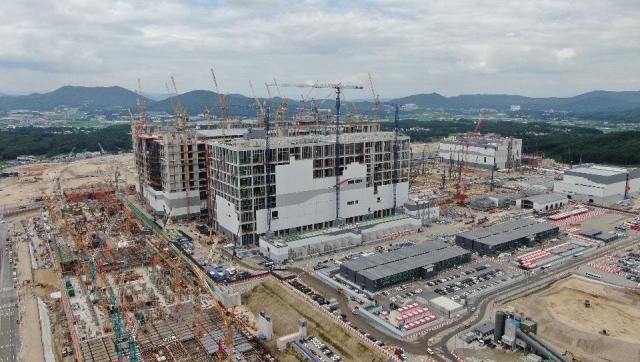
The Bank of Korea will release its preliminary second-quarter gross domestic product data on Thursday, providing the first official gauge of whether the country's semiconductor-led export boom has continued to offset sluggish domestic demand and mounting external uncertainties stemming from the prolonged Middle East conflict.
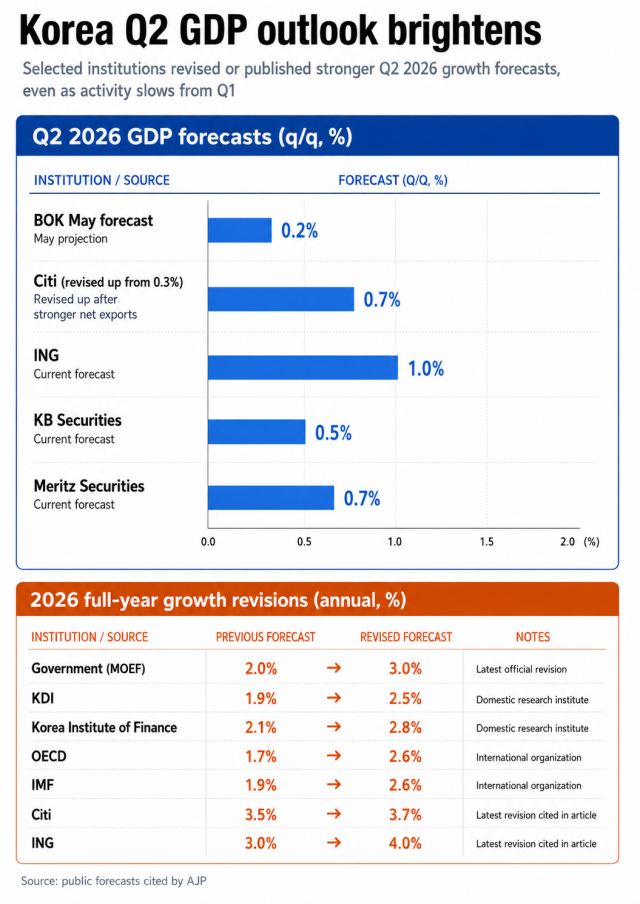
Economists expect quarterly growth to range between 0.5 percent and 1.0 percent, down from the first quarter's exceptional 1.8 percent expansion but comfortably above the central bank's May projection of 0.2 percent.
In the January-March period, the economy grew 3.8 percent from a year earlier, driven by record semiconductor exports and strong investment.
The momentum has largely continued through the second quarter. South Korea's exports reached a record $496.7 billion in the first half, fueled by booming semiconductor shipments totaling $192.4 billion, raising expectations that annual exports could exceed the $1 trillion mark for the first time.
Among major forecasters, ING projects second-quarter growth of 1.0 percent from the previous quarter, the most optimistic estimate reviewed by AJP.
The Dutch bank said that although export growth moderated, imports contracted even more sharply, allowing net exports to make a positive contribution to GDP. Government support measures to cushion the impact of higher energy costs also helped prevent a sharp slowdown in private consumption.
Citi recently raised its second-quarter growth estimate to 0.7 percent from 0.3 percent after trade data showed net exports were considerably stronger than previously expected.
KB Securities forecasts 0.5 percent quarterly growth, citing resilient export volumes and improving service-sector activity, while noting that stronger-than-expected contributions from net exports and services could lift the final figure further.
Meritz Securities expects growth of around 0.7 percent as export volumes expanded more strongly than anticipated.
Semiconductor exports, facilities investment related to chip production and net exports are expected to remain the principal drivers of growth, while weak construction investment and lingering effects from the energy shock likely weighed on domestic demand.
The stronger-than-expected performance has prompted several institutions to raise their full-year outlooks. Citi now expects the economy to grow 3.7 percent this year, up from 3.5 percent previously, while ING lifted its forecast to 4.0 percent from 3.0 percent. Meritz Securities has also indicated it may revise its projection into the mid-3 percent range after Thursday's data.
The government has recently revised up its growth target to around 3.0 percent, while the Bank of Korea indicated upgrade to its May projection of 2.6 percent in August.

Copyright ⓒ Aju Press All rights reserved.