Nearly two in 10 — a record high — had gone at least three years without work, pointing to a widening pool of young adults left on the sidelines.
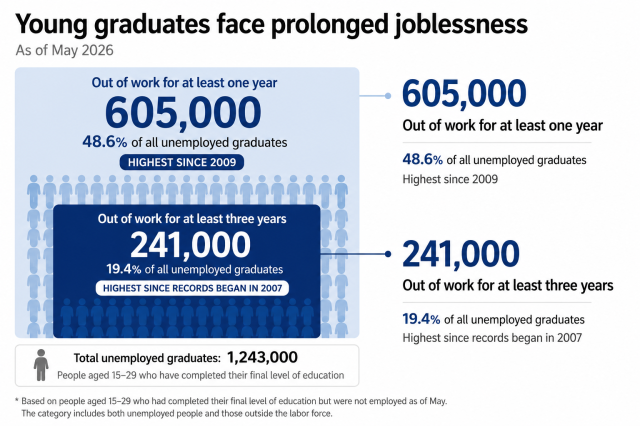
The proportion of graduates unemployed for at least one year rose 2.0 percentage points from a year earlier to 48.6 percent, equivalent to 605,000 people, according to a supplementary youth survey released Thursday by the Ministry of Data and Statistics.
It was the highest level since the 51.7 percent recorded in 2009 during the global financial crisis, while the share without work for at least three years rose to a record 19.4 percent, or 241,000 people.
The survey’s non-employed category covers people who have graduated, withdrawn from or completed their final level of education but are not currently working, including both officially unemployed people and those outside the labor force.
The number of young people who had completed their education fell by 171,000 to 4.003 million, with employment declining by 202,000 to 2.76 million and the non-employed population rising by 31,000 to 1.243 million.
Job training and preparations for employment examinations were the most common activities among non-employed graduates at 39.3 percent, followed by simply passing the time at 25.3 percent and preparing for further education at 12.5 percent.
The average time required to graduate from college increased by 1.3 months to four years and 5.7 months, the longest since the series began in 2007, while the share who had taken a leave of absence rose 2.5 percentage points to 48.9 percent.
Kim Rak-hyun, director of the ministry’s Employment Statistics Division, attributed the increase to the growing proportion of four-year college graduates and more students taking leave to prepare for jobs or qualification examinations.
Among young people outside the labor force, 600,000 had prepared for an employment examination during the previous week, up by 15,000 from a year earlier, although their share remained unchanged at 14.5 percent.
The proportion preparing for private-sector jobs fell 2.0 percentage points to 34.0 percent, while the share studying for general civil service examinations climbed 3.9 percentage points to 22.1 percent, its first increase in five years.
Kim said improved conditions for lower-ranking civil servants and companies’ growing preference for experienced workers and rolling recruitment had made private-sector entry more difficult for young applicants.
For graduates whose first job was a paid position, the average time required to find work shortened by 0.1 month to 11.2 months, while average tenure at their first workplace increased by 0.4 month to one year and 6.8 months.
Monthly pay of between 2 million won and less than 3 million won was the most common starting income bracket at 42.1 percent, followed by 1.5 million won to less than 2 million won at 23.3 percent and 500,000 won to less than 1 million won at 11.8 percent.
Dissatisfaction with pay, working hours and other employment conditions was the leading reason for leaving a first job at 44.4 percent, followed by the completion of temporary or seasonal work at 18.0 percent and personal or family reasons at 14.5 percent.
The overall number of employed people aged 15 to 29 fell by 255,000 from a year earlier to 3.427 million, lowering the youth employment rate by 2.4 percentage points to 43.8 percent.
The number of unemployed young people increased by 5,000 to 266,000, pushing the unemployment rate up by 0.6 percentage point to 7.2 percent.

Copyright ⓒ Aju Press All rights reserved.