The number of wage-worker jobs stood at 20.828 million in the first quarter, measured as of February, up 292,000 or 1.4 percent from a year earlier, the Ministry of Data and Statistics said Monday.
The increase widened from just 15,000 a year earlier and 221,000 in the fourth quarter, extending a steady recovery from last year's near-stagnation.
Jobs held by people in their 20s or younger, however, fell by 76,000 from a year earlier, while positions held by workers in their 40s declined by 19,000.
By contrast, jobs held by people aged 60 and above increased by 233,000, equivalent to nearly four-fifths of the overall net gain, while those held by workers in their 30s rose by 115,000 and those in their 50s by 40,000.
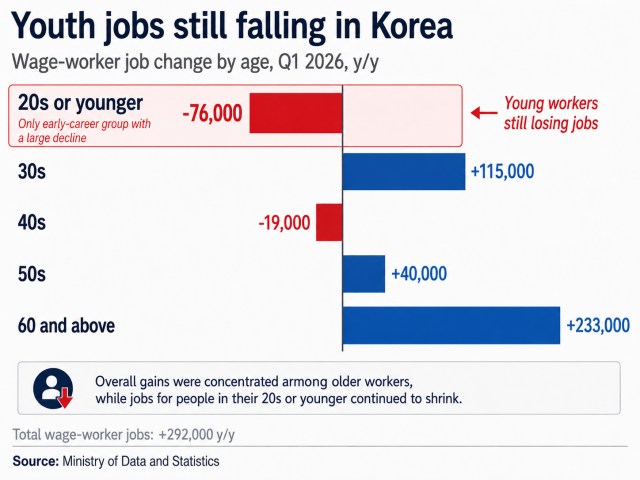
The decline among younger workers has moderated from 168,000 a year earlier and 111,000 in the fourth quarter, suggesting the downturn is easing without yet turning into a recovery.
Weakness among younger workers was particularly evident in sectors that typically provide entry points into more stable employment.
Jobs held by people in their 20s or younger fell by 26,000 in manufacturing and by 14,000 each in information and communications and public administration.
The figures add to signs that improvements in Korea's headline labor-market indicators have yet to translate into a broad recovery in employment opportunities for younger workers.
Service industries, meanwhile, accounted for most of the overall increase.
Service-sector jobs increased by 342,000 from a year earlier, exceeding the economy-wide net gain, as health and social welfare added 127,000 positions, accommodation and food services 59,000 and professional, scientific and technical services 37,000.
Within health and social welfare, social welfare services added 88,000 jobs and healthcare gained another 40,000, showing that care-related industries remained a major source of employment growth.
Manufacturing offered a more mixed picture despite the export-led semiconductor boom.
Semiconductor jobs rose by 5,000 from a year earlier to 174,000 and jobs in new automobile parts increased by 4,000, but manufacturing employment as a whole edged down by 1,000 to 4.294 million.
The decline was much smaller than losses of 12,000 in the first quarter of last year and 14,000 in the fourth quarter, pointing to some improvement in factory employment even as gains in semiconductors have yet to spread broadly across the sector.
Construction remained the largest drag, shedding 52,000 jobs from a year earlier to 1.638 million, although the decline narrowed sharply from 154,000 a year earlier and 88,000 in the previous quarter.
Specialized construction activities lost 35,000 positions and general construction shed 17,000.
The administrative series counts individual jobs rather than employed people, meaning one worker holding more than one position can be counted more than once.
The figures point to a labor market recovering from last year's near-stagnation, while persistent declines among younger workers show that the improvement has yet to broaden fully across generations and industries.
AJP Takeaways:
- Jobs held by people in their 20s or younger fell by 76,000 year on year despite a 292,000 increase in overall wage-worker jobs.
- Workers aged 60 and above added 233,000 jobs, equivalent to nearly 80 percent of the economy-wide net gain.
- Semiconductor jobs rose by 5,000, but overall manufacturing employment remained broadly flat and youth manufacturing jobs fell by 26,000.

Copyright ⓒ Aju Press All rights reserved.