
SEOUL, July 28 (AJP) — Grabbing a beer after work, unwinding with a glass of wine while watching Netflix or sharing a highball with friends has become a familiar scene in South Korean dramas. Increasingly, it is reflecting real life.
Every evening, Kim Ji-hyun, a 45-year-old office worker in Ilsan, pours herself a glass of wine or mixes a highball before settling in with Netflix. Her husband sometimes joins her.
"It's not that I drink because of stress," she said. "It helps me relax, and it feels like a pleasant way to finish the day."
Ironically, she now drinks less than she once did at company dinners, where heavy drinking has become less common. Instead, drinking has quietly moved into the home.
Kim's routine bears little resemblance to the repeated heavy drinking measured by public health officials. But it illustrates a broader cultural shift: alcohol has become more varied, more accessible and more seamlessly woven into everyday life for many South Korean women.
New government data suggest that shift is extending beyond casual drinking.
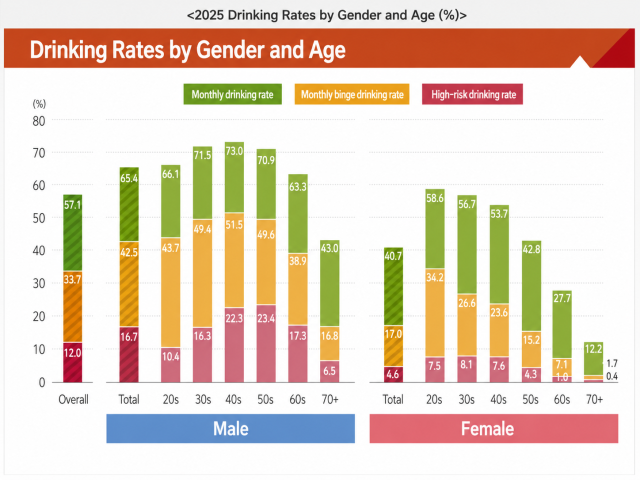
A health behavior analysis released Monday by the Korea Disease Control and Prevention Agency (KDCA), based on the 2025 Community Health Survey of about 230,000 adults aged 19 and older, found that women over 30 are drinking heavily more often than a decade ago even as men steadily cut back.
The sharpest increase came among women in their 40s, whose high-risk drinking rate rose from 5.8 percent in 2016 to 7.6 percent in 2025. Women in their 30s also saw the rate climb from 6.8 percent to 8.1 percent, while women in their 50s and 60s posted more modest increases. Women in their 20s were the only exception, with the rate falling from 9.2 percent to 7.5 percent.
The KDCA defines high-risk drinking for women as consuming at least five alcoholic drinks on one occasion at least twice a week. For men, the threshold is seven drinks.
Men moved in the opposite direction across every age group. High-risk drinking among men in their 20s fell 41.6 percent over the decade, the steepest decline of any male age group, while the rate among men in their 30s dropped 36.1 percent.
Men nevertheless continue to drink substantially more in absolute terms. Nearly half of men in their 30s, 40s and 50s reported binge drinking at least once a month in 2025, while more than one in five men in their 40s and 50s qualified as high-risk drinkers.
South Korea's overall monthly binge-drinking rate stood at 33.7 percent in 2025. According to the OECD's Health at a Glance 2025, the country ranked fifth among 27 member economies with comparable 2023 data, although survey methods differ across countries.
The figures raise a bigger question than who drinks more: why are women's drinking habits changing while men's are becoming more moderate?
Beyond workplace stress
One popular explanation is straightforward. As more women have entered the workforce, they have also become more exposed to Korea's long-standing drinking culture while balancing careers, child care and household responsibilities.
Kim Yoon-tae, a sociology professor at Korea University, argues the answer is more complicated.
"It is difficult to attribute the increase solely to stress," Kim said.
Instead, he sees several social changes unfolding simultaneously.
The first is women's expanding participation in economic and social life. More women now attend company dinners, professional networking events and social gatherings where drinking remains an established way of building relationships.
"As women's economic and social participation has expanded, there may be more occasions when they drink at workplaces or social gatherings," Kim said. "In Korea, drinking remains a strong part of social culture and can be used to increase familiarity."
The second is a profound shift in how and where people drink.
South Korea's growing number of single-person households has normalized honsul—drinking alone—while convenience stores have become major retailers of alcoholic beverages. At the same time, wine, highballs and ready-to-drink cocktails have broadened alcohol's appeal beyond the traditional soju-centered drinking culture.
"Drinking no longer simply means soju," Kim said. "Wine and highballs have become popular, and more people drink alone, whether they are feeling good or bad."
A third factor may be the double burden many women face as they juggle careers with child care and household responsibilities. Kim acknowledged that stress likely contributes to higher drinking among women in their 30s and 40s, but argued it represents only one part of a broader cultural transition.
"Drinking is not an appropriate way to relieve stress," he said. "It does not resolve stress and may ultimately make things worse."
Popular culture reflects the same shift.
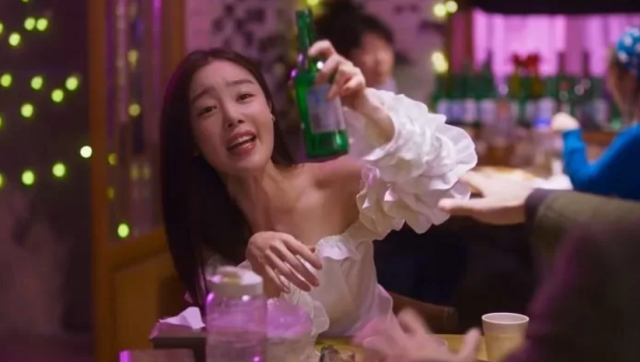
The TVING series Work Later, Drink Now, which became a surprise hit after premiering in 2021, follows three women in their 30s whose friendships revolve around sharing drinks after work. Alcohol is portrayed not as an act of excess but as an ordinary ritual—a way to unwind, console one another and mark the end of another demanding day.
The series cannot explain why more women are drinking heavily. It does, however, capture a cultural change in which alcohol has become a familiar part of women's everyday routines rather than a predominantly male social ritual.
The KDCA's own findings also complicate a simple workplace-stress narrative.
Monthly drinking and binge drinking were most common among office workers. High-risk drinking, however, was highest among people in craft and elementary occupations. Likewise, college graduates recorded the highest rates of monthly drinking, while high-risk drinking was most prevalent among high school graduates.
Adults reporting stress were 1.12 times more likely to qualify as high-risk drinkers than those reporting lower stress levels.
But the analysis covered adults overall, not women specifically, making it impossible to conclude that stress alone explains the increase among women over 30.
The government data cannot fully explain why repeated heavy drinking has become more common among a subset of South Korean women over 30.
What they do show is that South Korea's drinking culture is evolving. As after-work drinks migrate from mandatory company dinners to living rooms, wine glasses increasingly replace soju bottles, and women become more visible participants in drinking culture, the country's traditional image of who drinks—and why—is changing alongside society itself.

Copyright ⓒ Aju Press All rights reserved.
