
Islamic Republic of Iran's Alamut fortress added to UNESCO World Heritage List

by Joonha Yoo Posted : July 28, 2026, 19:26Updated : July 28, 2026, 19:26
Alamut Castle rock under a starlit sky with vivid pink and orange light glowing along the horizon — a dramatic night panorama of the fortress plateau in the Alborz Mountains Courtesy of The Embassy of the Islamic Republic of Iran
Alamut Castle rock under a starlit sky, with vivid pink and orange light glowing along the horizon — a dramatic night panorama of the fortress plateau in the Alborz Mountains. Courtesy of The Embassy of the Islamic Republic of Iran

SEOUL, July 28 (AJP) - UNESCO's World Heritage Committee has inscribed Alamut Castle and six associated mountain fortifications in Iran on the World Heritage List during its 48th session in Busan, making the serial property Iran's 30th UNESCO World Heritage property, the Embassy of the Islamic Republic of Iran in Seoul said Tuesday.

The inscription covers Alamut Castle and six associated fortifications that together formed a defensive network across the rugged Alborz Mountains in Qazvin Province, about 150 kilometers west of Tehran. Built into steep cliffs overlooking narrow valleys, the fortifications relied as much on the surrounding terrain as on walls and towers, with the mountain itself serving as part of the defensive system, according to the embassy.
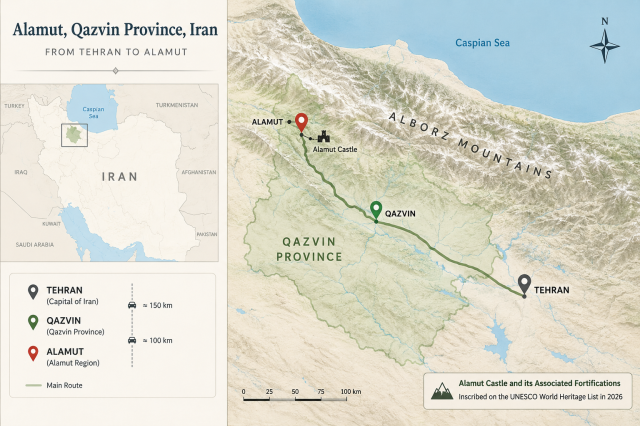
 
Alamut Qazvin Province Iran — a route map showing the journey from Tehran through Qazvin to the Alamut region in the Alborz Mountains home to the historic Alamut Castle The map notes that Alamut Castle and its associated fortifications were inscribed on the UNESCO World Heritage List in 2026
Alamut, Qazvin Province, Iran — a route map showing the journey from Tehran through Qazvin to the Alamut region in the Alborz Mountains, home to the historic Alamut Castle. The map notes that Alamut Castle and its associated fortifications were inscribed on the UNESCO World Heritage List in 2026. Courtesy of The Embassy of the Islamic Republic of Iran.

From the late 11th century to the mid-13th century, Alamut served as the political, administrative and intellectual center of the Nizari Ismaili state after its leader, Hasan-i Sabbah, a prominent Ismaili leader who took control of the castle in 1090, established it as his base of operations. Historical accounts referenced in UNESCO's evaluation indicate that the site's library attracted scholars from across the Islamic world and contributed to advances in astronomy, medicine and philosophy, the embassy said.

Although Alamut is widely associated with Hasan-i Sabbah and the legends surrounding the so-called "Assassins," the embassy said the UNESCO inscription offers an opportunity to recognize the site's broader historical significance as a cultural landscape shaped by architecture, religious and intellectual life, and the natural environment.
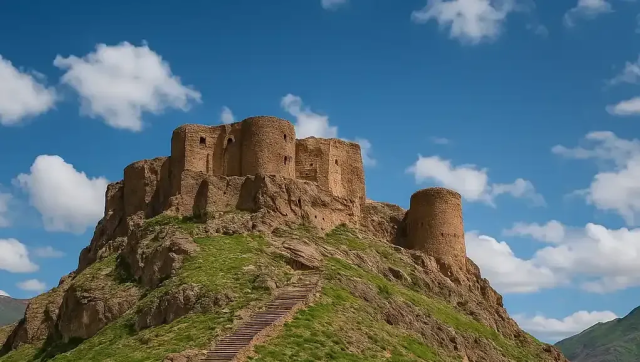
 
The ruins of Alamut Castle perched atop a steep rocky outcrop with weathered stone towers and a long stairway winding up the hillside set against a bright blue sky with scattered clouds Courtesy of The Embassy of the Islamic Republic of Iran
The ruins of Alamut Castle perched atop a steep rocky outcrop, with weathered stone towers and a long stairway winding up the hillside, set against a bright blue sky with scattered clouds. Courtesy of The Embassy of the Islamic Republic of Iran.