

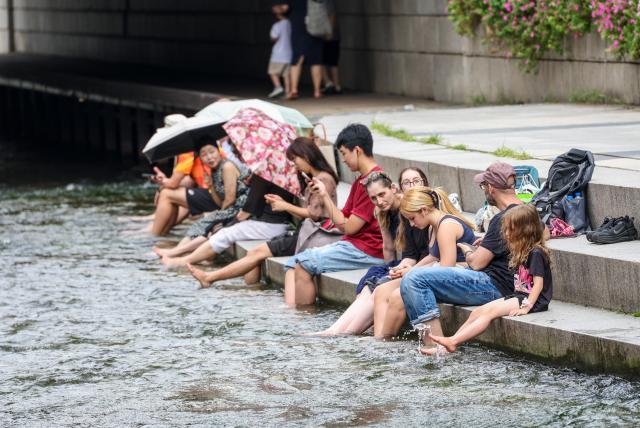
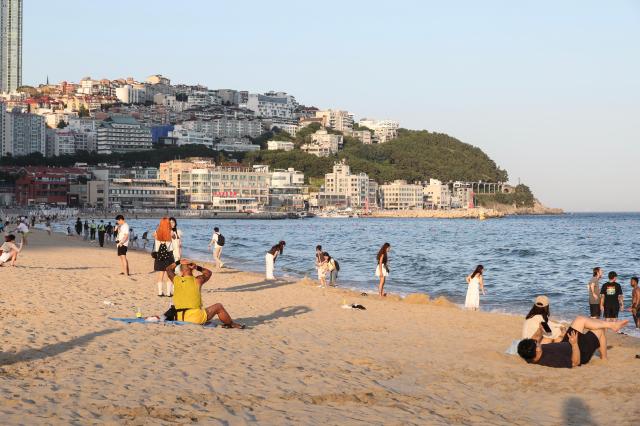
The country recorded an average of 7.8 tropical nights between June 1 and July 27, the highest number for the period since nationwide records began in 1973. Its average temperature over the same stretch reached 24.2 degrees Celsius, the second-highest on record.
With the Tibetan high-pressure system now settling in above the North Pacific high, the heatwave will continue throughout the week, trapping hot, humid air over the peninsula.
Tropical nights were reported nationwide overnight. In Yangsan, South Gyeongsang Province — under an extreme heatwave warning — the temperature never dropped below 29.1 degrees Celsius overnight, narrowly missing the threshold for a "super tropical night," defined as a night that never cools below 30 degrees.
The Korea Meteorological Administration expects daytime highs of 33 to 39 degrees Celsius from Aug. 1 to 7, with Daegu forecast to hit 39 degrees every day of that stretch.
A loaded die, not a single cause
Climate scientists do not generally argue that global warming independently creates every high-pressure system or blocking pattern behind an individual heatwave.
Instead, they say, it raises the baseline temperature those natural systems operate from — so a heat dome that once produced exceptionally hot conditions now starts from a warmer floor and can push temperatures even higher.
"The severity of heatwaves in South Korea and globally can be put down to climate change," said James Renwick, a professor of climate science and physical geography at Victoria University of Wellington. Weather extremes have always occurred, he said, but hot extremes now happen more easily and often more intensely in a warmer climate — even a 1 to 1.5 degree Celsius rise in average temperature can produce a disproportionately large jump in extreme heat.
Ashish Sharma, of the Discovery Partners Institute at the University of Illinois Urbana-Champaign, compared it to a loaded die: weather still determines the outcome of any single roll, he said, but climate change has weighted the die so that extremely hot outcomes turn up far more often. Natural atmospheric patterns still trigger heatwaves, he added — global warming simply raises how much heat those patterns can generate.
Persistent high-pressure systems — heat domes — are the most direct cause of major heatwaves. Air sinks beneath them, compressing and warming as it descends, while the same sinking air suppresses cloud cover and rainfall, letting sunlight bake the surface more intensely. How long such a system lingers matters: a short-lived high may bring a few hot days, while a blocking pattern can lock a heat dome in place for a week or more.
Dry soil compounds the effect. Moist ground uses some of the sun's energy to evaporate water; dry ground sends nearly all of that energy straight into heating the surface and the air above it. Unusually warm oceans add further heat and humidity, limit nighttime cooling along coastlines, and can shift where large-scale pressure systems sit.
Shang-Ping Xie, a distinguished professor of climate science at the University of California San Diego, said blocking patterns are typically the direct meteorological trigger, with dry soil worsening the surface warming on top of it. The broader rise in heatwave frequency and severity, he said, comes from the "slow but relentless background warming" driven by greenhouse gases. For South Korea specifically, warming seas on both the western and eastern coasts add extra heat during summer.

Scientists draw a line between this general mechanism and the attribution of any one event. Pinning down exactly how much climate change increased the odds or intensity of South Korea's current heatwave would require a formal event-attribution study, which compares today's climate against a hypothetical one without the buildup of human-caused greenhouse gases. Absent that analysis, Sharma cautioned, scientists shouldn't claim climate change made this particular heatwave precisely five or ten times more likely.
That doesn't mean the underlying relationship is in doubt. "The Earth has been heated so much by fossil fuel emissions, there is no weather phenomenon — warm, cold, rainy or dry — that isn't influenced by industrial activity," said Dargan Frierson, a professor of atmospheric sciences at the University of Washington. "Heat waves are much more likely to occur, and are made more extreme by the huge amount of energy that's been trapped in the climate system by fossil fuel emissions."
Natural variability, including El Niño, shapes the timing and location of heat but can't explain the decades-long rise in temperatures. Francina Dominguez, also of the University of Illinois Urbana-Champaign, said climate change and a strong El Niño can amplify each other's effects on atmospheric patterns worldwide; separating how much of a given event owes to each requires dedicated attribution research. Natural variability, in short, governs how climate swings year to year — greenhouse gases steadily raise the level those swings occur around.
The scientists interviewed broadly agreed heatwaves will grow more frequent, intense, or prolonged as greenhouse gases keep accumulating. "They are predicted to get worse," Frierson said. "More fossil fuel burning leads to more extreme heat waves."
Xie said climate models have flagged this for years. "Climate models have been sounding the alarms for a long time," he said. "The observed widespread increase in heatwaves and wildfires is confirming this prediction."
Gan Zhang, also of the University of Illinois Urbana-Champaign, said the gap between lower- and higher-emissions scenarios may not look dramatic over the next 10 to 30 years, simply because of how much greenhouse gas has already been released — the system will keep warming for a while before it can stabilize. That makes decisions made now especially consequential for the second half of the century. "We are moving into new territories, and ongoing emissions will push the system farther before the shift stops," Zhang said. "The choices we make right now will dictate whether the climate stabilizes in the second half of the century. They matter tremendously for future generations." Some further extreme heat is already locked in; how much worse it gets is still up to how fast emissions come down.
These assessments sit in stark contrast to U.S. President Donald Trump's repeated dismissal of climate change. In a September 2025 address to the United Nations, Trump called climate change a "con job" and described the carbon footprint as "a hoax." Scientists who addressed the remarks rejected them as inconsistent with established science.

Zhang said political rhetoric doesn't change physical reality. "I'll leave the politics to the politicians, but as a scientist, I can tell you that the physical reality doesn't bend to rhetoric," he said. "Calling it a hoax or a consensus doesn't lower the thermometer."
The stakes of that rhetoric are practical, scientists said. Whether city planners get funding to plant trees, whether emergency authorities set up cooling centers, and whether residents can heat-proof their homes are all political decisions, Zhang said — and "by the time the heatwave hits, many are caught off guard." Jennifer Marlon, executive director of the Yale Center for Geospatial Solutions, said dismissing climate concerns is dangerous because it can confuse the public and lead people to underestimate the threat to health, infrastructure, and economies.
Extreme heat itself doesn't wait for political leaders to accept the science behind it.
South Korea's current temperatures trace to identifiable weather systems — the North Pacific and Tibetan highs — but those systems are now operating in a climate already warmed by human activity.
Weather still decides where and when a heatwave forms.
Climate change has loaded the die underneath it, raising the odds that when the conditions align, the heat that follows will be more extreme than it once was.
Copyright ⓒ Aju Press All rights reserved.
