
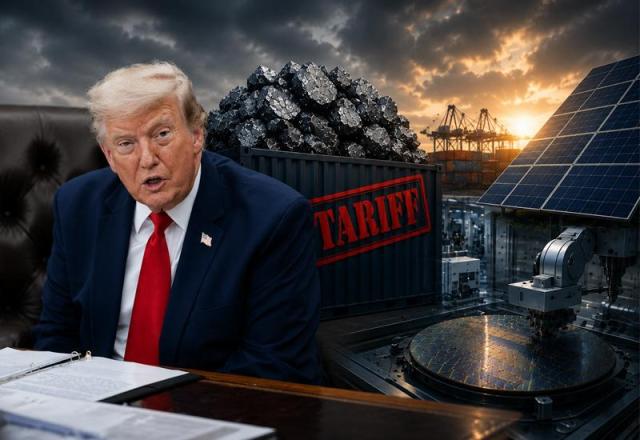
The proclamation, signed Thursday following a Section 232 national security investigation, imposes a 15 percent tariff on polysilicon derivatives and establishes minimum import prices for polysilicon, ingots, wafers and solar products beginning Dec. 4, 2026, giving companies four months to adjust supply chains and contracts.
The move marks Washington's latest effort to localize strategic manufacturing, extending beyond semiconductors and chipmaking equipment to the raw materials underpinning both advanced chips and solar technology.
"Polysilicon is the base material underpinning the security of America's semiconductor and solar-power supply chains," Trump said in the proclamation, arguing that decades of imports had eroded U.S. production and threatened national security.
Under the order, imports of raw polysilicon will be subject to a minimum price of $21 per kilogram, while polysilicon ingots and wafers face a $100-per-kilogram floor.
Solar cells and modules will carry minimum prices of $0.22 per watt and $0.38 per watt, respectively. Importers unable to certify that products meet those price thresholds will instead pay duties equivalent to the applicable minimum price.
The Commerce Department concluded that polysilicon imports threaten U.S. national security, noting America's share of global polysilicon production capacity has plunged from about 50 percent in 2005 to less than 2 percent in 2024, while domestic semiconductor manufacturing has also steadily lost ground.
South Korea nevertheless secured more favorable treatment under the proclamation.
Products from South Korea, Japan, Taiwan, Switzerland, Liechtenstein and European Union member states will face a combined tariff burden capped at 15 percent, meaning the new Section 232 duty will not stack on top of existing tariffs beyond that level. The United Kingdom will receive a 10 percent rate.
South Korea is also designated a "Trade Agreement Partner," allowing qualifying products using partner-country polysilicon to claim manufacturing duty drawbacks under specified conditions.
While South Korea is not a major supplier of raw polysilicon to the United States, the latest action broadens Washington's industrial policy further into the semiconductor value chain, affecting companies from materials producers to wafer and solar manufacturers.
OCI Holdings, South Korea's largest polysilicon producer, could benefit as the measures are designed to counter lower-priced overseas supply, particularly from China.
Hanwha Qcells, which operates one of the largest solar manufacturing complexes in the United States in Georgia, also stands to gain if the price floors reduce competition from cheaper imported cells and modules.
More broadly, the proclamation reinforces a trend already reshaping Korea's semiconductor industry.
Samsung Electronics and SK hynix have committed billions of dollars to expand manufacturing in the United States, while suppliers across the chip ecosystem have increasingly followed customers into North America.
Companies that commit to building, expanding or refurbishing U.S. facilities producing polysilicon, ingots, wafers or solar cells — with construction beginning by Jan. 20, 2029 — will be eligible to import production equipment and covered products without paying the new Section 232 duties during construction.
For Korean materials and solar companies with existing or planned U.S. operations, the provision offers a direct financial incentive to manufacture inside the United States rather than export from Korea.
Copyright ⓒ Aju Press All rights reserved.
