
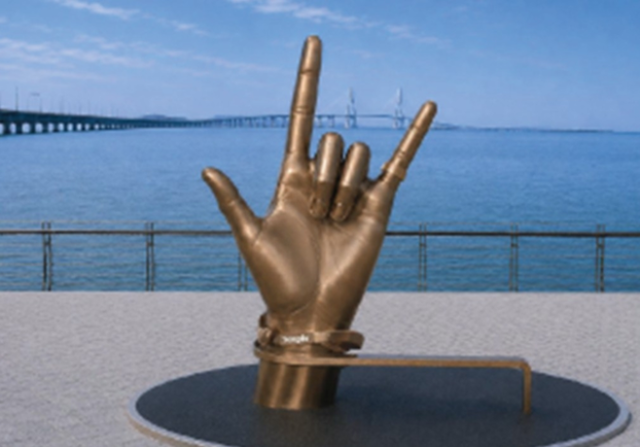
His immediate reaction was "Rock and roll," she said, copying the hand gesture. Her son also thought it looked like Spider-Man's hand.
"There was a lot of discussion because we simply couldn't make it out," Lee told AJP.
She could only laugh when she read the explanation at the base. The giant hand was meant to express "I love you" in sign language.
Her amusement turned to disbelief when she learned the sculpture had cost 200 million won ($144,000) from the public budget.
"I don't know art, but it can hardly be worth 200 million won," Lee said.
The sculpture stands about 4 to 5 meters high and 3 meters wide at Long Beach Park on the northern edge of Songdo International City. The Incheon Free Economic Zone Authority, or IFEZ, developed the concept with a design firm and commissioned an outside company to produce it.
Officials said the gesture was chosen partly because the waterfront park is popular with couples. The hand was envisioned as a photo spot overlooking the Incheon Bridge.
Residents were hardly as warm.
Complaints poured into IFEZ after some residents said the hand resembled an insulting gesture and others questioned why so much public money had been spent on it. The sculpture was subsequently covered while authorities prepared explanatory signage and considered other measures.
Lee sees little point in removing it now.
"They already spent 200 million won making it, and removing it would cost money again," she said.
The controversy has at least given residents something to talk about, she added.
"Maybe at night they could use digital art and make it look like Spider-Man, and then explain, 'Actually, this means I love you in sign language,'" Lee said. "I think finding a way to use it would be better."
The Yeonsu branch of the Incheon Association of the Deaf has taken a similar position, urging authorities to preserve the sculpture and use clearer explanations to introduce visitors to the meaning of the gesture.
The episode touches on a recurring problem in publicly funded cultural projects. The meaning intended by planners does not always survive contact with the people expected to live with the finished product.
Research on public art in South Korea has documented similar gaps between a project's stated purpose and its local reception.
A 2023 study of a public-art project in a former mining village in Boryeong found that longtime residents could regard its intentions favorably while remaining dissatisfied with the results. Their responses depended partly on whether they felt the project reflected the needs and circumstances of their community.
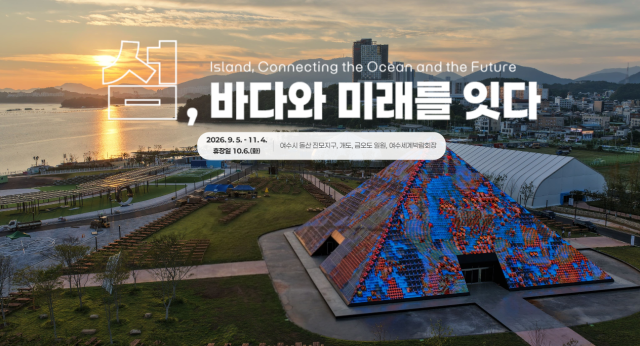
The scale becomes dramatically larger about 300 kilometers south in Yeosu.
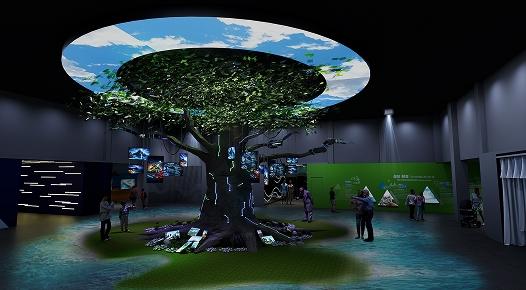
The southern coastal city is hosting the 2026 World Island Fair, a 61-day international event that opened Sept. 5 and runs through Nov. 4 at sites including Dolsan, Gaedo and Geumodo. Organizers have set a target of 3 million visitors.
The fair's direct project cost has risen to about 71.3 billion won, including 6.4 billion won in central government funding,
according to the organizing committee and procurement data.
The money covers exhibition facilities, content, performances, promotion and other programs.
The ambition is far greater than Songdo's solitary hand.
Organizers have promoted the fair as a showcase for the ecological and cultural value of islands and as a vehicle for tourism and regional development.
"I saw the expo being advertised a lot, so I thought it would have some scale to it and be pretty well put together," Seo told AJP.
One scene stayed with him.
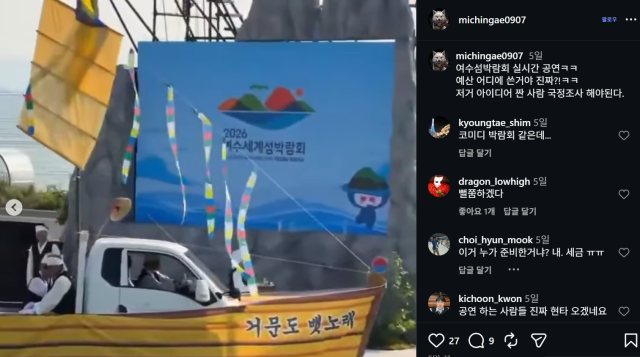
Performers reenacting the traditional Geomundo Boat Song rode on the back of a one-ton pickup truck wrapped in cloth and fitted with a sail to resemble a boat.
Seo was caught off guard.
"We came all the way down there, and what we saw was this Porter truck going around covered in cloth," he said, referring to Hyundai's light pickup truck. "I was honestly speechless. More than anything, I was confused."
Seo's disappointment was with the execution rather than the tradition itself.
Afterward, he and his girlfriend headed to the food court.
"We basically said, 'Let's just go eat,'" he said.
The meal did little to improve his impression.
"The food felt like something from a highway rest stop," Seo said. "I had been excited about eating in Yeosu, but it felt a bit like a military cafeteria. Everything seemed a little rough around the edges."
Food and programming have become part of the wider criticism surrounding the event. Images of a 14,900-won soy-marinated crab meal and footage of the truck performance spread widely online, prompting questions over value and production quality.
Seo represents only one visitor to a fair scheduled to run for two months, and his experience cannot establish how the broader audience views the event.
Organizers themselves, however, acknowledged complaints soon after opening.
Ten days into the fair, the organizing committee announced additional performances and content after visitors complained of insufficient attractions and activities. The measures were intended partly to give visitors more to do and encourage them to stay longer.
The fair had drawn 35,668 visitors during its opening weekend, a small fraction of its eventual 3 million target, although the figure covered only the first two days of a 61-day event.
Local governments across South Korea have increasingly turned to festivals, exhibitions and cultural projects as tools for tourism and regional development.
A study published this year in The Korea Journal of Local Public Finance found significant positive relationships between local-government spending on events and festivals and expenditures in culture and tourism, industry and small businesses, and land and regional development.
The research said such spending has become closely connected with strategies to attract visitors and stimulate local economies, while fiscal efficiency remains a subject of continuing debate.
The Songdo sculpture and Yeosu fair are not directly comparable.
One is a permanent public artwork costing 200 million won. The other is a sprawling international event costing more than 70 billion won across exhibitions, facilities, performances, marketing and related programs.
Their controversies, however, converge on a simpler question facing local governments spending public money on culture.
Grand ambitions and large budgets may be easy to put on paper. Residents and visitors ultimately judge what appears in front of them.
In Songdo, it was a giant hand few people initially understood.
In Yeosu, for Seo, it was a pickup truck pretending to be a boat.
AJP Takeaways
- A 200 million won public sculpture in Songdo sparked controversy after residents struggled to understand its intended meaning and questioned its cost.
- Yeosu’s 71.3 billion won World Island Fair also faced criticism over the quality of some performances, food and visitor experiences, despite its goal of promoting island tourism and regional development.
- The two cases highlight a broader gap between local governments’ cultural ambitions and how residents and visitors actually experience publicly funded projects.

Copyright ⓒ Aju Press All rights reserved.
