A sharp slowdown in U.S. hiring would weaken the case for another Federal Reserve rate increase, take pressure off the dollar and give the BOK more room to stay put. Resilient employment and wages could do the opposite, reviving expectations for back-to-back rate increases in Korea.
The U.S. Labor Department is due to release its July employment report at 9:30 p.m. Korea time, with economists polled by Reuters expecting nonfarm payrolls to rise by 80,000 after a 57,000 increase in June.
Unemployment is forecast to remain at 4.2 percent and annual wage growth at 3.5 percent. Estimates for payroll gains range widely from 10,000 to 140,000, while revisions to May and June could prove nearly as important as the July headline.
Recent indicators have pointed to softer hiring without offering the Federal Reserve much relief on inflation.
ADP reported a weaker-than-expected 44,000 increase in private payrolls in July, while the Institute for Supply Management's services employment index slipped into contraction. Its prices gauge, however, climbed sharply, confronting policymakers with slower hiring but little corresponding easing in price pressures.
The Fed held its benchmark rate at 3.50 percent to 3.75 percent on July 29, but three of its 12 voting members favored a quarter-point increase. Markets on Friday were pricing roughly a 54 percent chance of a September hike.
Higher oil prices and U.S. Treasury yields have further complicated the outlook. That means a modest payroll slowdown alone may not kill expectations for further tightening if unemployment stays low and wages remain firm.
For Korea, the U.S. jobs report matters chiefly through what it does to interest rates and the won.
A stronger-than-expected U.S. employment report in June quickly lifted expectations for Fed tightening, pressured the Korean currency and pushed up domestic long-term yields, illustrating how rapidly an American labor-market surprise can spill into Seoul.
The BOK now faces a finer balance after raising its base rate by 25 basis points to 2.75 percent on July 16, its first increase in more than three years.
Korean government bond yields nevertheless fell on the day of the decision, with the three-year yield dropping to 3.848 percent and the 10-year to 4.297 percent, suggesting investors did not expect rate increases to follow automatically at every meeting.
The argument for an August pause gained ground this week after headline consumer inflation slowed to 2.8 percent in July from 3.2 percent in June. But core inflation accelerated to 2.6 percent, keeping the central bank wary of declaring its renewed tightening campaign finished.
Growth gives the BOK room to move again if necessary. Second-quarter gross domestic product expanded 0.6 percent from the previous quarter and 3.7 percent from a year earlier, supported by the semiconductor boom and improving domestic demand.
That leaves Friday's U.S. jobs report as an important external swing factor.
A weak reading would likely pull down expectations for a September Fed hike, U.S. short-term yields and the dollar. A stronger won would in turn ease imported inflation pressure and give the BOK greater latitude to leave its rate at 2.75 percent on Aug. 27.
A strong payroll figure accompanied by resilient wages or lower unemployment could reverse that chain, pushing up the dollar and U.S. yields and renewing pressure on the won just as Korea's core inflation and economic growth remain firm.
For Korean markets, the crucial number is therefore not simply whether payrolls beat or miss the 80,000 consensus. It is whether the combination of hiring, unemployment, wages and revisions materially changes the Fed's September path — and how quickly that repricing reaches the won and Korean government bonds.
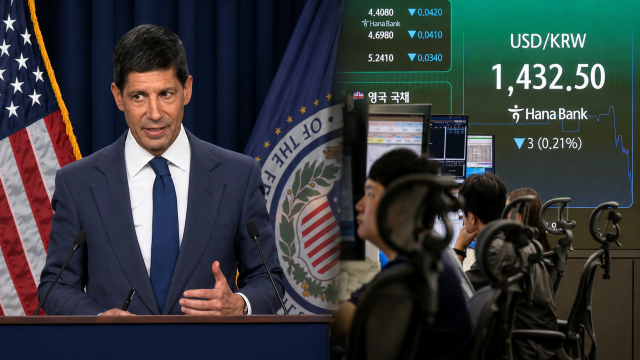
The won closed daytime trading at 1,416.1 per dollar on Friday, strengthening 7.7 won from the previous session to its strongest level in about 10 months as dollar-selling pressure prevailed ahead of the U.S. report.
The three-year Korean government bond yield was trading around 3.76 percent and the 10-year yield near 4.22 percent at around 3:30 p.m., with expectations for an August BOK pause anchoring the short end while higher oil prices and U.S. Treasury yields kept greater pressure on longer maturities.
___________________________________________________________________________________
AJP takeaways
U.S. July jobs data could shape the Bank of Korea's August rate decision by changing expectations for the Federal Reserve's September policy move.
A weaker U.S. employment report would strengthen the case for a BOK pause at 2.75 percent by easing U.S. yields, weakening the dollar and reducing pressure on the Korean won.
A strong U.S. payroll and wage reading could revive expectations for another Korean rate hike as higher U.S. rates and a stronger dollar increase inflation and currency pressure in Seoul.
South Korea's inflation picture remains mixed: headline CPI slowed to 2.8 percent in July, but core inflation accelerated to 2.6 percent.
The won and Korean government bond yields are the key transmission channels linking U.S. employment data and Fed expectations to the BOK's Aug. 27 policy decision.

Copyright ⓒ Aju Press All rights reserved.