
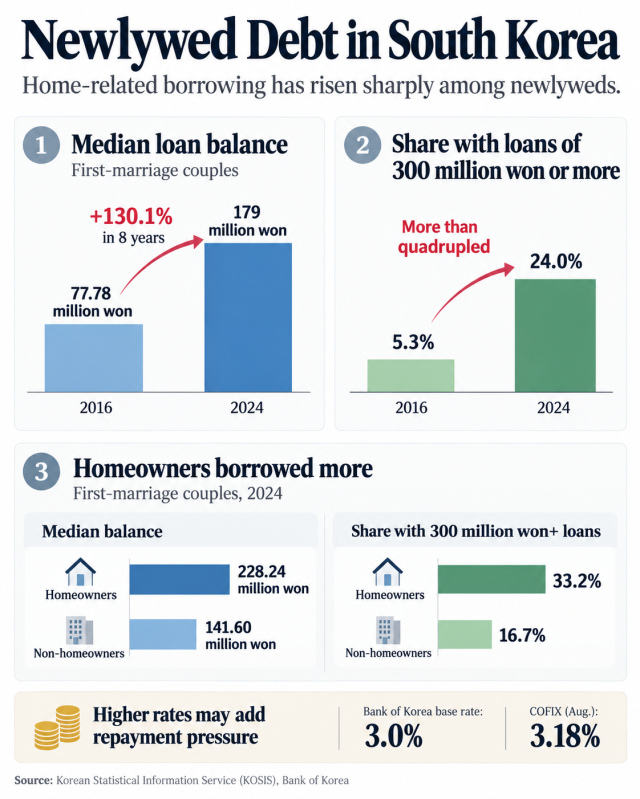
The median balance rose 5.0 percent from a year earlier and was 130.1 percent higher than 77.78 million won in 2016, when comparable data were first compiled, according to data from the Korean Statistical Information Service (KOSIS).
The figures cover couples in their first marriage who had been married for five years or less and had outstanding loans. The balance includes household loans from banks and nonbank lenders, as well as business loans to self-employed borrowers.
Borrowing has climbed steadily alongside housing costs. The median rose to 90 million won in 2017 and 100 million won in 2018 before exceeding 150 million won in 2021. It reached 170.51 million won in 2023.
Borrowing also tended to rise with years of marriage. In the broader KOSIS sample of newlywed couples, the median outstanding balance increased from 160 million won in the first year of marriage to 178.46 million won in the fifth year in 2024.
Large loans became far more common.
The share of newlywed couples with at least 300 million won in loans jumped to 24.0 percent in 2024 from 5.3 percent in 2016, more than quadrupling over eight years.
By contrast, the share of couples with smaller loans declined. The share with less than 10 million won in debt fell to 4.6 percent from 8.8 percent, while the proportion with between 10 million won and 30 million won dropped to 5.7 percent from 14.7 percent.
Homeownership marked a clear divide. Among newlywed couples who owned a home, 33.2 percent had loans of at least 300 million won in 2024, nearly twice the 16.7 percent recorded among those without a home.
Homeowners also carried a median balance of 228.24 million won, compared with 141.60 million won for couples without property.
That burden has grown significantly over time. Among homeowners, the median balance was 112 million won in 2016, about half the 2024 level.
Home values also rose sharply, especially in Seoul. Among newlywed homeowners in the capital, 31.4 percent owned homes officially valued at more than 600 million won in 2024, up from 5.9 percent in 2015.
Income also made a difference. Dual-income couples had a median loan balance of 198 million won in 2024, more than 40 million won above the 157.87 million won recorded for single-income households.
They were also more likely to carry heavy debt. Some 28.0 percent of dual-income newlyweds had loans of at least 300 million won, compared with 18.8 percent of single-income couples.
Couples with children also carried more debt than those without children.
Their median balance stood at 188.26 million won, compared with 169.50 million won for couples without children. The share with at least 300 million won in debt was 26.8 percent among couples with children, versus 21.1 percent among those without.
Those heavier debt loads could become more difficult to manage as borrowing costs rise.
The Bank of Korea raised its benchmark interest rate in both July and August, bringing it to 3.0 percent. The Cost of Funds Index (COFIX), a benchmark used for many variable-rate household loans, stood at 3.18 percent in August, unchanged from July after four consecutive monthly increases. It was the highest level since 3.22 percent in December 2024.
AJP Takeaways
- South Korean first-marriage newlyweds had a median outstanding loan balance of 179 million won in 2024, up 130.1 percent from 2016, according to the Korean Statistical Information Service.
- The share of newlywed couples with loans of at least 300 million won rose to 24.0 percent in 2024 from 5.3 percent in 2016, while smaller-loan shares declined.
- Homeowners, dual-income couples and couples with children carried heavier debt burdens, raising repayment concerns as the Bank of Korea's benchmark rate reached 3.0 percent and COFIX stood at 3.18 percent in August 2026.

Copyright ⓒ Aju Press All rights reserved.
