
The overhaul will also divide early redemptions into a predictable schedule and a more discretionary operation, giving the central bank greater flexibility to manage bank reserves as Korea’s liquidity conditions become less one-sided.
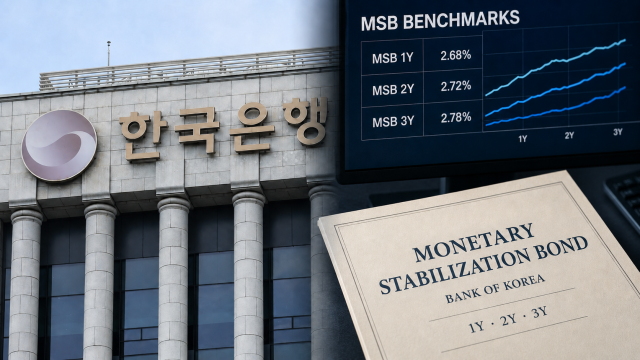
Monetary stabilization bonds, or MSBs, are debt securities issued by the BOK to drain reserves from the financial system. Issuance withdraws liquidity, while maturity payments and early redemptions return funds to the market.
The bonds have historically played an unusually prominent role in Korea because the central bank used them to sterilize liquidity generated by current-account surpluses, capital inflows and the accumulation of foreign-exchange reserves.
That environment has shifted as rising demand for banknotes, larger statutory reserve requirements and the BOK’s foreign-exchange swaps with the National Pension Service have reduced the amount of excess reserves that must be absorbed.
Outstanding MSBs fell from 107.29 trillion won at the end of last year to 95.16 trillion won in March, dropping below the 100 trillion-won mark for the first time since 2003.
The declining stock has added urgency to a longstanding liquidity problem. Research by the Korea Capital Market Institute found that MSBs trade less actively than Korean government bonds and that turnover drops sharply after the first month following issuance.
The BOK will extend the fungible issuance period for one-year MSBs to three months from two, reducing the number of new one-year securities created each year to four from six.
The new securities will be dated March 1, June 1, Sept. 1 and Dec. 1, replacing the current cycle of six issue dates. Concentrating issuance over a longer period should increase the amount outstanding in each security and make it easier to trade without moving prices sharply.
The most recently auctioned coupon bond in each of the one-, two- and three-year maturities will also be designated as the benchmark issue and identified in the BOK’s monthly issuance plan.
The designation is intended to give investors a clearer reference price for each maturity, although it does not by itself guarantee deeper trading.
Unlike primary dealers in the Korean government bond market, MSB participants are not required to provide continuous exchange quotes, and most transactions take place over the counter. The BOK said it would work with relevant institutions on further measures to promote trading in the benchmark issues.
Early redemptions will be separated into two operations. A first-Tuesday operation will cover three securities selected according to a predetermined remaining-maturity schedule, while a third-Tuesday operation will cover about three securities chosen each month according to reserve and market conditions.
The BOK has already conducted two buybacks in some recent months, but the overhaul formalizes the arrangement and separates predictability from discretion. Uneven demand was evident in an Aug. 7 operation, when one one-year security attracted no bids even though total offers exceeded the planned purchase amount.
The approach brings the MSB market closer to the logic underpinning Korea's much larger Treasury market, where liquidity tends to concentrate in benchmark securities.
The contrast between the two markets is becoming more pronounced.
While MSBs are shrinking, Korean government bonds are becoming more deeply integrated into global fixed-income portfolios following Korea's entry into the FTSE World Government Bond Index.
South Korean government bonds began entering the WGBI in April this year, with inclusion being carried out in eight monthly stages through November.
That process is increasing the importance of deep liquidity and reliable benchmark pricing in the Treasury market as index-tracking global investors allocate money to Korean sovereign debt.
Rather than competing with government bonds for scale, the BOK is trying to ensure that its smaller pool of central-bank securities does not become fragmented into increasingly illiquid individual issues.
Unlike primary dealers in the Korean government bond market, MSB participants are not required to provide continuous exchange quotes, and most trading takes place over the counter.
The BOK said it would therefore work with relevant institutions on additional measures to promote transactions in designated benchmark issues.
The overhaul also changes the other side of the MSB market — how the BOK takes its securities back before maturity.Early redemptions will be divided into two operations.
A first-Tuesday operation will cover three securities selected according to a predetermined remaining-maturity schedule, giving investors greater certainty over which bonds are likely to be bought back.
A third-Tuesday operation will cover around three securities selected each month according to reserve conditions and market circumstances, preserving the BOK's ability to inject liquidity where it considers necessary.
The central bank has already conducted two buybacks during some recent months, but the new system formalizes the arrangement and draws a clearer distinction between predictable market operations and discretionary liquidity management.
In an Aug. 7 early-redemption operation, one one-year security received no bids even though aggregate offers across the operation exceeded the BOK's planned purchase amount, illustrating how liquidity and investor demand can vary sharply between individual MSB issues.
The reform also reflects a broader transformation in the way the BOK manages reserves.
A falling MSB balance does not necessarily imply easier monetary policy. The BOK raised its base rate by 25 basis points to 2.75 percent on July 16, even as the amount of structural excess liquidity requiring absorption has declined.
The two developments highlight the distinction between setting the price of money through the policy rate and managing the quantity of reserves through MSBs, repurchase agreements and other open-market operations.
As reserve conditions become more balanced, the BOK increasingly needs the ability to both absorb and supply liquidity rather than operating primarily in one direction.
___________________________________________________________________________________
AJP Takeaways
The BOK will reduce the number of new one-year MSB issues to concentrate liquidity in larger benchmark securities.
Early redemptions will combine a fixed schedule with a flexible monthly operation to improve reserve management.
The reform addresses market liquidity but stops short of replacing MSBs with repurchase agreements.

Copyright ⓒ Aju Press All rights reserved.
