
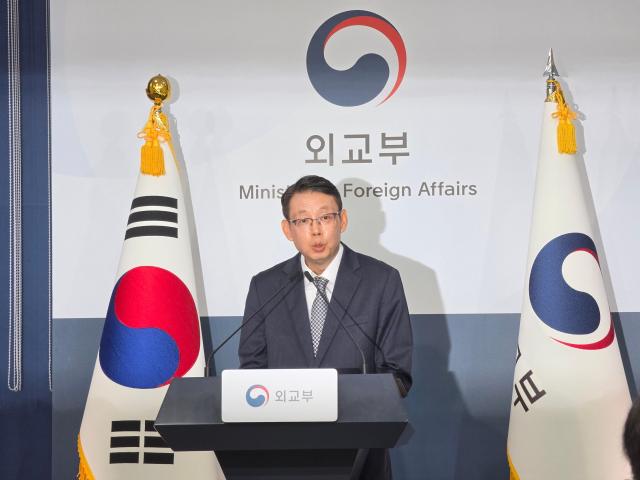
SEOUL, August 13 (AJP) - South Korea's planned nuclear-powered submarines will carry only conventional weapons and sit entirely within the Nuclear Non-Proliferation Treaty, the Ministry of Foreign Affairs said Thursday, rejecting North Korea's warning that the program will set off a nuclear domino across the Asia-Pacific.
The position rests on a document the Ministry of National Defense released on May 26, the first time Seoul set out publicly how it intends to build and operate the boats. Named the Jangbogo-N project, the plan commits the navy to low-enriched uranium fuel, to designing and building the submarines at home, and to launching a first boat in the mid-2030s. It also states that South Korea will hold no nuclear weapons of any kind, and that it will work with the International Atomic Energy Agency to design a safeguards system that can be applied to a submarine reactor.
Park Doo-soon, the ministry's spokesperson, told a regular briefing that the program is a justified and defensive answer to a rapidly changing security environment on the Korean Peninsula, citing North Korea's advancing nuclear and missile capability and its construction of a nuclear-powered submarine of its own. South Korea has met its treaty obligations faithfully, he said, and will stay in close contact with the agency on the basis of transparency as the program moves ahead. He said the government would put the same case to every country with a stake in it. Asked whether it had already explained itself to China or Russia, and whether the subject would come up when Chinese Foreign Minister Wang Yi visits Seoul later this month, he said he had nothing to offer.
North Korean state media carried the statement that prompted the question on Wednesday, under the name of Jang Kum-chol, first vice foreign minister and director of the Workers' Party of Korea's 10th Bureau, which handles South Korean affairs. Jang said the submarine plan had entered its execution phase and was deepening instability in the region. He argued the ambition was not new, claiming Seoul had secretly advanced a nuclear submarine project from 2003, and repeated the North's position that holding unmatched retaliatory power is the responsible choice for deterrence.
The submarines became possible only after Washington agreed to them. President Lee Jae Myung raised the subject with US President Donald Trump at their summit in Gyeongju on Oct. 29 last year, telling him that South Korea's diesel-electric boats have limited endurance underwater, which restricts their ability to track North Korean and Chinese submarines, and that South Korean nuclear boats would lighten the load on US forces in the region. Lee said what he wanted was fuel, not weapons.
Trump announced his approval the following day in a post on Truth Social, writing that South Korea could build a nuclear-powered submarine in place of what he called its old and far less nimble diesel fleet, and adding that the work would be done at a shipyard in Philadelphia. A joint fact sheet the two governments released on Nov. 14 confirmed approval for a nuclear-powered attack submarine, along with US support for civil uranium enrichment and spent fuel reprocessing within the terms of the bilateral nuclear cooperation agreement and US law. It named no construction site. National Security Adviser Wi Sung-lac said afterward that the leaders had talked throughout on the premise that the boats would be built in South Korea, and that the request to Washington concerned fuel alone.
What a reactor buys is endurance. A diesel-electric submarine runs on batteries while submerged and has to rise close to the surface to run its engines and recharge, the moment at which it is most easily found. A reactor needs no air and no refueling for years, so a boat can stay down as long as its crew holds out, cross an ocean at speed, and follow a target without ever showing itself. South Korea builds some of the finest conventional submarines in the world and not one of them can do that.
Nothing in the Nuclear Non-Proliferation Treaty (NPT) bars a country without nuclear weapons from using a reactor to drive a warship. The treaty governs weapons, not propulsion. The difficulty lies in the inspection system run by the International Atomic Energy Agency (IAEA), whose safeguards agreements allow a state to withdraw nuclear material from routine inspection when it goes to a military use that is not explosive. That provision was written decades ago and has never been carried through to a completed arrangement. Australia is working the same question with inspectors for its own submarine program. No verification model exists for fuel sealed inside a reactor that spends months at sea, and the May plan commits South Korea to designing one with the IAEA.
The fuel itself remains unsettled. South Korea cannot enrich uranium or reprocess spent fuel under its nuclear cooperation agreement with the United States, and widening those rights requires the consent of the US Congress. Delegations from both governments met in Seoul on June 2 and 3 for the first working session on the submarine, enrichment and reprocessing, with Under Secretary of State for Political Affairs Allison Hooker leading the American side and First Vice Foreign Minister Park Yoon-joo the South Korean side.
North Korea has been building a nuclear submarine of its own. State media reported on Dec. 25 that Kim Jong Un had inspected construction of an 8,700-ton nuclear-powered vessel designed to launch strategic guided missiles, disclosing its displacement and publishing an image of the full hull for the first time. Standing at the site, Kim said South Korea's plan "seriously infringes upon the security and maritime sovereignty of our state," calling it "an aggressive act" and "a security threat that must be answered."
---
AJP Takeaways
● Park Doo-soon, the South Korean foreign ministry spokesperson, said at a regular briefing Thursday that the country's planned nuclear-powered submarines will carry only conventional weapons and comply fully with the Nuclear Non-Proliferation Treaty, and that Seoul will work with the International Atomic Energy Agency on transparency as the program advances.
● Jang Kum-chol, North Korea's first vice foreign minister, said in a statement carried by state media Wednesday that the South Korean program had entered its execution phase and would set off a nuclear domino across the Asia-Pacific, claiming Seoul had secretly pursued nuclear submarines from 2003.
● Donald Trump approved South Korean construction of a nuclear-powered attack submarine in a Truth Social post on Oct. 30 last year, and a joint fact sheet released on Nov. 14 confirmed the approval without naming a build site. Neither the approval nor the May 26 basic plan behind the ministry's position was raised at the briefing, and both were established through separate reporting.
● Kim Jong Un inspected construction of an 8,700-ton nuclear-powered submarine designed to launch strategic guided missiles, North Korean state media reported on Dec. 25, calling the South Korean plan an aggressive act and a security threat that must be answered.
Copyright ⓒ Aju Press All rights reserved.
