SEOUL, September 15 (AJP) - Foreign investors sold Korean shares for a fifth straight session on Tuesday, handing the KOSPI a fourth consecutive loss as worries over a possible U.S. rate hike this week weighed on the main board.
Buyers turned instead to battery makers and the KOSDAQ.
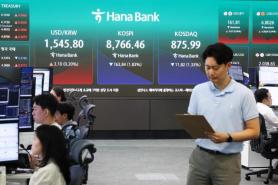
The main index in Seoul shed 57.11 points, or 0.9 percent, to 6,627.26.
Foreigners sold a net 1.57 trillion won ($1.15 billion) of KOSPI shares and institutions 904.9 billion won ($665 million), overwhelming 833.1 billion won ($612 million) of individual buying. The same two groups were net buyers on the KOSDAQ.
Over the five sessions, foreign net selling on the main board has topped 10 trillion won ($7.3 billion), and the KOSPI has lost 6.0 percent since closing above 7,000 last Wednesday.
Hotter than expected U.S. core inflation for August, a 10-year Treasury yield that topped 5 percent and crude above $100 a barrel have revived fears the Federal Reserve could raise rates. Its two-day meeting began Tuesday.
Samsung Electronics and SK hynix barely moved.
Samsung slipped 0.2 percent to 248,500 won ($182.64). SK hynix fell 0.4 percent to 1,690,000 won ($1,242.10).
Financials took heavier hits. Samsung Life Insurance sank 4.2 percent to 285,500 won ($209.83), and KB Financial Group lost 3.2 percent to 175,800 won ($129.21).
Decliners outnumbered gainers 623 to 254.
LG Energy Solution bucked the tide, jumping 4.0 percent to 365,500 won ($268.63). Local media tied the move to expectations for energy storage orders from artificial intelligence data centers.
The KOSDAQ rose 0.7 percent to 812.4, led by battery materials, robotics and some chip names.
Institutions bought a net 110.7 billion won ($81.4 million) on the secondary market and foreigners 24.1 billion won ($17.7 million).
The won weakened to 1,360.6 per dollar.
In Tokyo, the Nikkei 225 finished virtually unchanged at 63,484.1.
SoftBank Group rebounded 7.5 percent to 6,279 yen. The group had slid a day earlier on reports that OpenAI, in which it is a major investor, will not go public this year.
Memory maker Kioxia Holdings added 2.3 percent to 51,750 yen, while chip testing equipment maker Advantest fell 3.0 percent to 30,160 yen.
The composite index in Shanghai slipped. Memory chip designer GigaDevice Semiconductor and PetroChina gained, while fiber optic maker Jiangsu Hengtong Optic-Electric declined.
Lee Kyung-min, an analyst at Daishin Securities, said no fresh negative hit the market on Tuesday. Instead, he said, further gains in rates and oil sapped bargain hunting in a market now more sensitive to bad news than good.
AJP Takeaways
-Hotter than expected U.S. core inflation for August, a 10-year Treasury yield that topped 5 percent and crude above $100 a barrel revived fears the Federal Reserve could raise rates.
-Samsung Electronics and SK hynix barely moved while financials fell harder. LG Energy Solution and the KOSDAQ gained, the Nikkei 225 finished virtually unchanged and Shanghai slipped.
Entity tags: KOSPI, KOSDAQ, Samsung Electronics, SK hynix, LG Energy Solution, Samsung Life Insurance, KB Financial Group, Daishin Securities, Lee Kyung-min, Federal Reserve, U.S. Treasury yield, won/dollar exchange rate, Nikkei 225, SoftBank Group, OpenAI, Kioxia Holdings, Advantest, Shanghai Composite Index, GigaDevice Semiconductor, PetroChina, Jiangsu Hengtong Optic-Electric
Copyright ⓒ Aju Press All rights reserved.