
ASTANA, Kazakhstan, Aug. 23 (AJP) — The Kazakh government presented its constitutional overhaul to foreign correspondents as a way of protecting stability rather than disturbing it, a day before voters choose the country's first single-chamber parliament.
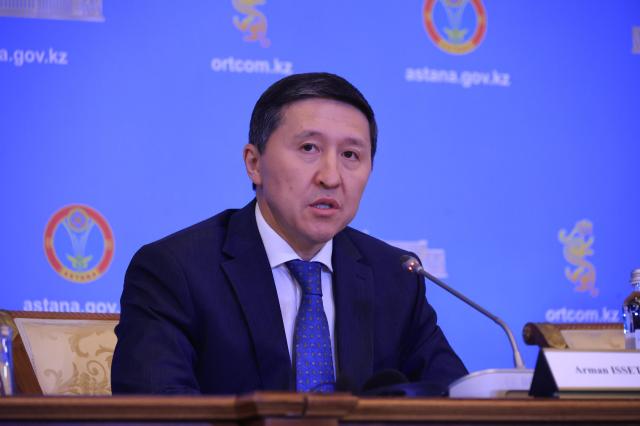
Arman Issetov, deputy minister of foreign affairs, made the argument on Saturday (local time) at a briefing for journalists on a press tour covering the election, held at a hotel in Astana on Saturday afternoon. Polling stations open Sunday at 7 a.m. local time and close at 8 p.m.
"Stability does not mean the absence of change," Issetov said. In today's world, he said, it requires the state to adapt to new circumstances in good time.
He placed the reform against a shifting external picture, describing an international system that is becoming more complex and less predictable. Geopolitical tensions are rising, he said, trade and economic links are changing, and competition is intensifying over investment, technology and transport routes.
Kazakhstan sits at the heart of Eurasia and maintains friendly relations with all countries around the world, he said, and for a country in that position political and economic stability are its most vital national resources.
Most of what he said concerned domestic machinery rather than diplomacy. His central claim was that a growing economy has outpaced the institutions meant to govern it.
The more complex the economy becomes, he said, the more effective state institutions have to be, and the larger the volume of private enterprise and investment, the more legislation has to be predictable and public administration competent.
He cited growth of 6.5 percent at the end of 2025, attributing it to industry, construction, transport and investment activity, alongside government work on industrial production, logistics routes and the digital economy.
That figure has not held. The Bureau of National Statistics, the same agency behind the 2025 result, recorded growth of 3.0 percent in the first quarter of this year and 4.1 percent in the first half.
Issetov said the reform was not change for its own sake, and that its purpose was to bring political institutions into line with modern Kazakhstan.
The goal, he said, is for state institutions to deal more effectively with what touches people directly, among it job creation, income growth, regional development, the quality of education and health care, infrastructure, openings for entrepreneurs and social protection.
Voters choose all 145 seats of the Kurultai, the chamber that replaced the Mazhilis and the Senate when the new constitution took effect July 1. Seven parties are fielding 545 candidates in a single nationwide district, and seats go only to lists that clear five percent of valid votes.
Self-nomination is not allowed. The Central Election Commission has registered 12,605,788 voters.
Adilet holds first place on the ballot with 186 candidates, more than double any rival list. Registered on June 1, it absorbed Amanat, which took 53.9 percent in 2023 and held the largest bloc in the Mazhilis, after congresses of both parties approved the merger in June.
The constitution behind the change was approved in a referendum on March 15, with the Central Election Commission (CEC) putting support at 87.15 percent on turnout of 73.12 percent.
Issetov spoke as a deputy minister rather than for the presidency, and his remarks tracked the case President Kassym-Jomart Tokayev has made in public, that the vote opens a new cycle of reform.
He closed by saying the government wanted to preserve what he called Kazakhstan's greatest achievement, its stability and its capacity for development, while building a political system fitted to what the country needs next.

Copyright ⓒ Aju Press All rights reserved.
