
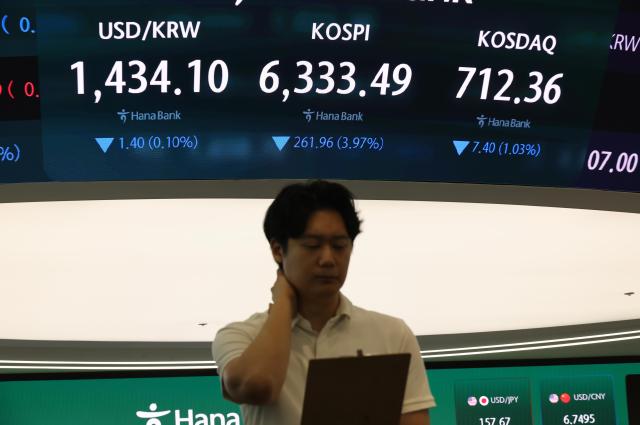
The benchmark KOSPI opened at 6,539.37, down 2.35 percent from Monday's close, and extended its decline to 6,490.65, down 3.08 percent, as of 10:22 a.m. The junior KOSDAQ fell 2.9 percent to 789.48.
Selling was broad, with 247 stocks advancing and 610 declining, while 41 were unchanged. That marked a sharp contrast with Monday, when more stocks rose than fell even as the index retreated about 3 percent.
Foreign investors led the selloff, unloading a net 1.38 trillion won ($998 million) of KOSPI shares. Retail investors bought a net 835.7 billion won, while institutions purchased 316.7 billion won.
Samsung Electronics and SK hynix were among the biggest drags on the index. Samsung, which plunged 8.7 percent Monday after its latest shareholder-return plan fell short of market expectations, extended its losses Tuesday morning, falling 3.5 percent to 248,000 won as of around 9:25 a.m. SK hynix dropped 5.45 percent to 1,580,000 won.
The chipmaker said it would return 50 percent of its free cash flow to shareholders. Investors, however, had hoped for a more aggressive package including a large share buyback and cancellation after rival SK hynix recently pledged to return at least 50 percent of its free cash flow to shareholders.
Analysts nevertheless expect the two chipmakers' large shareholder-return programs to provide some support over the longer term.
Pressure on Korean chip stocks intensified after another weak session for U.S. semiconductor shares overnight. On Wall Street Monday, the Dow Jones Industrial Average rose 0.26 percent, but the S&P 500 fell 0.28 percent and the Nasdaq Composite lost 0.76 percent. The Philadelphia Semiconductor Index dropped 2.70 percent.
Nvidia fell 2.91 percent, extending its decline to a seventh straight session ahead of its earnings report later this week. Micron Technology dropped 5.83 percent, while AMD and Broadcom lost 3.49 percent and 2.63 percent, respectively.
Losses spread across other technology-related stocks in Seoul. SK Square fell 5.58 percent to 1,016,000 won, Samsung Electro-Mechanics dropped 5.92 percent to 1,240,000 won and LG Energy Solution slid 3.87 percent to 348,000 won.
Hyundai Motor bucked the weakness after the automaker and its labor union reached a tentative wage agreement following 111 days of negotiations.
The deal includes a 100,000 won increase in monthly base pay, performance bonuses worth 400 percent of base pay plus 12.7 million won, and 15 Hyundai Motor shares for each worker. The agreement followed a prolonged labor dispute that included the union's first full-scale strike in a decade. Hyundai Motor shares were up 0.24 percent at 415,000 won in morning trading.
Other major blue chips posted more modest declines. Samsung Biologics fell 0.83 percent to 1,560,000 won, Samsung C&T lost 0.82 percent to 361,500 won and Kia slipped 0.61 percent to 130,700 won.
Some financial and industrial shares bucked the broader decline. Shinhan Financial rose 2.42 percent to 105,800 won and KB Financial gained 0.55 percent to 164,000 won, while Samsung Life fell 1.75 percent to 280,500 won. Hanwha Aerospace added 0.72 percent to 1,113,000 won and Doosan Enerbility gained 1.92 percent to 74,400 won.
Selling was also heavy on the KOSDAQ. As of around 9:29 a.m., retail investors bought a net 106.1 billion won of shares, while foreign and institutional investors sold a net 48.7 billion won and 49 billion won, respectively.
Battery-related shares were among the biggest decliners. EcoPro fell 6.14 percent to 82,500 won, while EcoPro BM dropped 5.98 percent to 110,000 won.
Biotech and health care stocks also weakened. Alteogen slid 4.84 percent to 305,000 won, HLB fell 2.77 percent to 36,800 won and PharmaResearch lost 2.04 percent to 407,500 won.
Semiconductor equipment and technology shares also came under pressure. Wonik IPS fell 3.85 percent to 102,300 won, LEENO Industrial dropped 3.56 percent to 62,300 won, Jusung Engineering declined 2.71 percent to 161,500 won and EO Technics fell 2.71 percent to 377,500 won. Rainbow Robotics was down 2.25 percent at 434,500 won.
The Korean won strengthened slightly despite the stock-market selloff, trading at 1,381.90 per dollar as of around 9:42 a.m., compared with 1,382.40 in the previous session.
Some external pressures eased overnight. The U.S. 10-year Treasury yield fell 3.8 basis points to 4.696 percent, while the 30-year yield dropped 4.5 basis points to 5.226 percent. West Texas Intermediate crude fell 2.35 percent to $85.01 a barrel.
Lower bond yields and oil prices could provide some support, but Tuesday's trading showed investors remained focused on the sharp pullback in semiconductor shares.
Analysts said the recent selloff appeared driven more by short-term positioning and profit-taking than by a deterioration in the chip industry's underlying fundamentals.
AJP Takeaways
• The KOSPI fell more than 3 percent as foreign investors sold a net 1.38 trillion won of shares, with Samsung Electronics and SK hynix leading the decline.
• Korean chip stocks extended losses after another weak session for U.S. semiconductors, including declines in Nvidia, Micron, AMD and Broadcom.
• Lower U.S. Treasury yields, weaker oil prices and a firmer won offered some support, while analysts said the selloff still appeared driven more by short-term positioning than weaker chip fundamentals.

Copyright ⓒ Aju Press All rights reserved.
