
Yet the missing activity does not look like a wholesale flight from Korean equities.
Foreign investors still own nearly 40 percent of the KOSPI by market value, only modestly below their share near the June peak. Korean investors, meanwhile, were already deeply invested abroad before the latest slowdown and now hold more than $185 billion in U.S. stocks alone.
An analyst at a South Korean brokerage said the recent increase in overseas investment does not necessarily indicate a structural shift away from the domestic market.
“We have continued to see money move back and forth between Korean and overseas stocks,” he said. “At this point, it looks more like rotation within the market. Retail investors are very sensitive to returns, and recent volatility in the Korean market has also played a role.”
The emerging picture, then, is less one of a party abruptly ending than of the KOSPI moving from a speculative frenzy into a plateau around 7,000, while Korean investors spread more of their money between Seoul and Wall Street.
The change in market velocity is unmistakable.
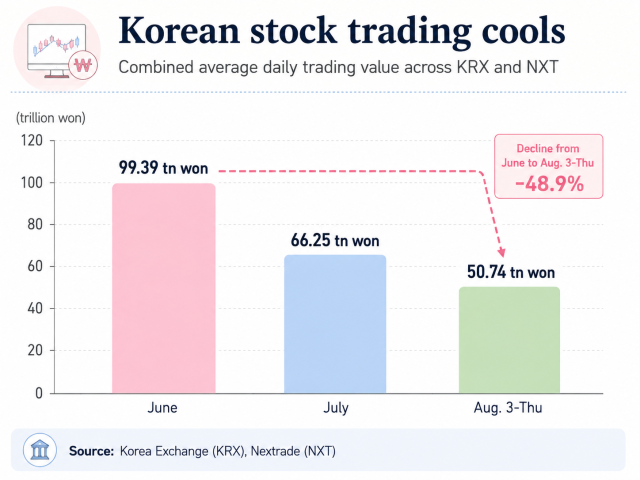
With investors able to trade Korean stocks on both the Korea Exchange (KRX) and alternative trading platform Nextrade (NXT), combined average daily trading value fell from 99.39 trillion won in June to 66.25 trillion won in July and 50.74 trillion won from Aug. 3 through Thursday.
That represents a 48.9 percent decline from red-hot June.
The fall cannot be explained by investors simply shifting trades from the KRX to NXT. Average daily turnover on the KRX dropped 46.5 percent to 32.28 trillion won this month from 60.36 trillion won in June, while NXT turnover fell 52.7 percent to 18.46 trillion won from 39.03 trillion won.
The contrast becomes even starker against individual days near the height of the rally.
The KOSPI closed at 9,052.42 on June 19 after touching an intraday record of 9,385.59. Trading value reached about 67.26 trillion won that day. By Thursday, when the index closed at 6,912.37, KOSPI turnover was just 22.5 trillion won — roughly one-third of the June 19 level.
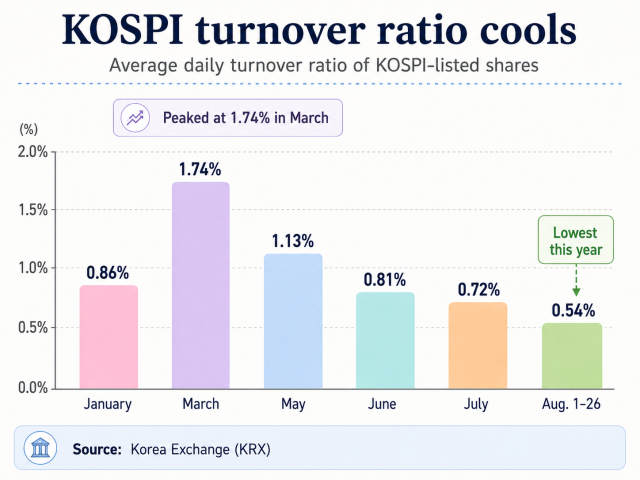
The average daily turnover ratio of KOSPI-listed shares fell to 0.54 percent from Aug. 1 through Aug. 26, the lowest this year. The ratio had risen from 0.86 percent in January to 1.74 percent in March before retreating to 1.13 percent in May, 0.81 percent in June and 0.72 percent in July.
Retail trading has cooled almost as quickly. Average daily trading value by individual investors on KRX markets fell to 24.05 trillion won through Thursday from 46.77 trillion won in June, a 48.6 percent drop.
Cash waiting for the next trade is also disappearing.
Investor deposits at brokerage firms, a widely followed gauge of money available to buy stocks, approached 140 trillion won on June 4 as the KOSPI raced through successive milestones. The balance had fallen to 98.92 trillion won as of Aug. 26, nearly 30 percent below the June peak.
Comparable data put the balance at about 102.5 trillion won on Aug. 25, after dipping into the 97 trillion won range earlier in August.
The shrinking pool of trading cash is important because it suggests the slowdown is broader than investors merely waiting for a better entry point while keeping their money inside securities accounts.
Still, Wall Street cannot account for all the missing money.
Korean investors' U.S. stock holdings reached $185.6 billion as of Aug. 24, up 8.3 percent from $163.6 billion a month earlier, according to Korea Securities Depository (KSD) data.
Net buying has also revived. Korean investors returned to net purchases of U.S. equities worth about $633 million in June after selling in April and May, before purchases surged to $4.64 billion in July.
Recent buying has remained aggressive, particularly in technology and semiconductor-related assets. Leveraged semiconductor exchange-traded funds, memory-chip investments and major U.S. technology companies have ranked among the most heavily purchased securities.
The analyst also pointed to the exchange rate as another factor supporting overseas investment. “Investors who had been concerned about the exchange rate are feeling less burdened about investing overseas as the won has strengthened,” he said.
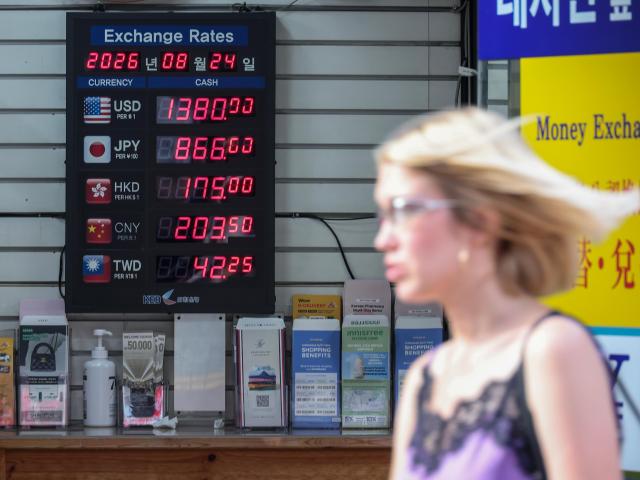
The currency has appreciated into the 1,370-per-dollar range from above 1,400 earlier this month, reducing the amount of won Korean investors need to acquire the dollars required for U.S. investments.
The scale of Korea's overseas portfolio is already far larger than the latest monthly flows suggest.
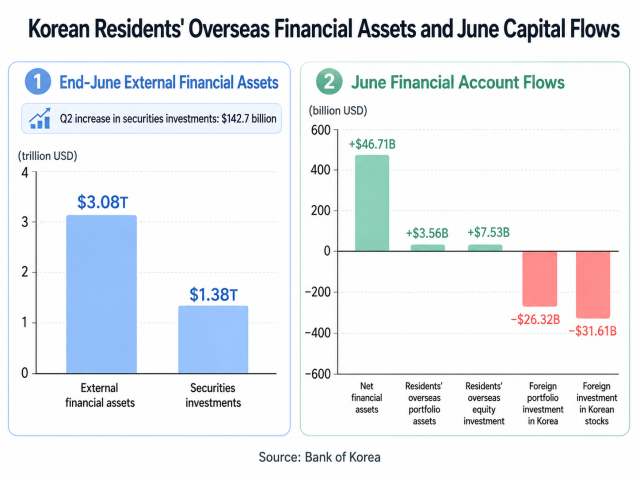
Bank of Korea data show Korean residents held a record $3.08 trillion in external financial assets at the end of June. Securities investments alone amounted to $1.38 trillion, up $142.7 billion during the second quarter as overseas equity markets rallied.
The BOK's June balance-of-payments financial account also captured the two-way movement of capital.
Net financial assets increased by a record $46.71 billion during the month. Korean residents increased overseas portfolio assets by $3.56 billion overall, with overseas equity investment rising $7.53 billion. Foreign portfolio investment in Korea, by contrast, decreased by $26.32 billion, including a record $31.61 billion decline in foreign investment in Korean stocks.
Large foreign selling flows, however, have not translated into anything resembling foreign abandonment of the Korean market.
Foreign investors' share of KOSPI market capitalization stood at about 39.49 percent in the latest reading, compared with a peak of 41.58 percent in late June.
Foreigners therefore remain enormous owners of Korean stocks even after months of net selling. Earlier in August, their market-cap share was still around 39 percent despite cumulative selling that had exceeded 160 trillion won during the year.
The distinction between flow and stock helps explain what is happening.
Foreign investors have taken profits and reduced positions, but they have not deserted the KOSPI. Korean retail investors are trading far less at home and buying more U.S. stocks, but the increase in Wall Street purchases is nowhere near large enough to explain the entire collapse in Seoul turnover or brokerage deposits.
The investor who appears to be leaving fastest is therefore the marginal trader — the investor who chased momentum, traded frequently or kept large sums immediately available during the extraordinary climb toward 9,000.
The underlying pool of capital remains much larger and more patient.
The KOSPI itself reflects the transition. Thursday's 6,912.37 close was 23.6 percent below its June 19 close and more than 26 percent below the record intraday high, but it was also about 22 percent above the July 29 close of 5,663.24.
Instead of continuing either the June melt-up or July collapse, the index has increasingly gravitated toward the high-6,000 range, repeatedly approaching 7,000 without decisively breaking through it.
The next test may therefore be less about whether Korean investors have fallen out of love with stocks than whether the KOSPI can attract enough fresh money to escape its new plateau.
A sustained move above 7,000 accompanied by recovering turnover, rising investor deposits and broader foreign buying would suggest the party has merely taken an intermission.
Another run at 7,000 on thin volume would tell a different story.
The music may still be playing in Seoul, but many of the partygoers are no longer dancing — and a growing number are keeping Wall Street within walking distance.
AJP Takeaways
• KOSPI trading activity has nearly halved from June, with combined average daily turnover on the KRX and Nextrade falling 48.9 percent as South Korea's stock-market frenzy cools.
• Korean investors are increasing U.S. equity exposure, with U.S. stock holdings reaching $185.6 billion in August and July net purchases surging to $4.64 billion.
• Foreign investors have sold heavily but have not abandoned South Korea, retaining about 39.5 percent of KOSPI market capitalization compared with roughly 41.6 percent near the June peak.
• The KOSPI increasingly looks to be forming a plateau around 7,000, leaving trading volume, brokerage deposits and foreign inflows as key signals for whether Seoul's rally can restart.

Copyright ⓒ Aju Press All rights reserved.
