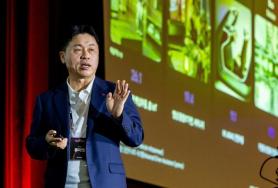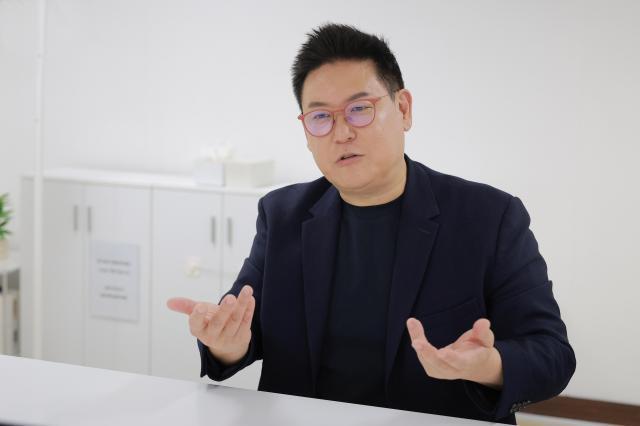
Dennis Hong, a professor of mechanical and aerospace engineering at the University of California, Los Angeles, and director of its Robotics & Mechanisms Laboratory, told Aju Business Daily on Aug. 29 that Korea would lose if it mimicked the two powers.
"Going forward, it will become harder to neatly divide this into American AI and Chinese hardware," Hong said.
He argued that success in physical AI hinges on the speed at which companies build robots, deploy them, gather data and train the next, better generation.
Korea's edge lies in its industrial base spanning semiconductors, automobiles, batteries, electronics and precision manufacturing, Hong said, warning against a numbers race to churn out the same humanoids as rivals.
The country should instead link physical AI to industries where it already leads.
The professor pointed to the field data held by conglomerates such as Samsung Electronics, Hyundai Motor Company and LG Electronics, arguing that the decisive resource in the physical AI era sits on factory floors rather than on the internet that fed the generative AI boom.
Firms with products, plants and supply chains, he said, should deploy robots where work is needed and build a cycle of gathering, learning and refining.
Fusing that data with physical AI will demand social trust, Hong cautioned, citing workers' fears of losing jobs after teaching their skills to machines and looming disputes over who owns the data.
Rules on consent and on sharing the value the data creates are needed, he said.
Hong, sometimes called robotics' Leonardo da Vinci, dismissed inflated hype around the technology and said a robot's worth lies not in working cheaper than a person but in taking on danger.
"What must be warm is not the robot's chest but the heart of the person who builds it," he said.
AJP Takeaways
• Dennis Hong, a UCLA professor and director of its Robotics and Mechanisms Laboratory, urged South Korea in an Aug. 29 interview with Aju Business Daily to avoid imitating the United States and China in physical AI and to build a strategy around its own manufacturing strengths.
• Hong identified South Korea's base in semiconductors, automobiles, batteries, electronics and precision manufacturing, along with the factory-floor data held by conglomerates such as Samsung, Hyundai Motor and LG, as the country's decisive advantage over rivals racing to mass-produce humanoids.
• Hong warned that combining industrial data with physical AI will require resolving workers' job-loss fears and data-ownership disputes, and cautioned that hype obscures the gap between one-off demonstrations and reliable, daily deployment.

Copyright ⓒ Aju Press All rights reserved.