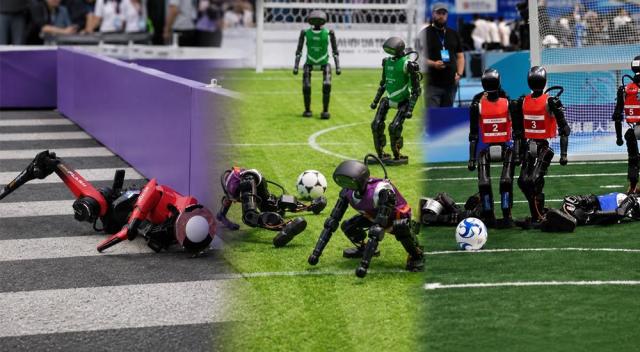
Except that it kept going. Tiangong Ultra hurtled past the finish line, slammed into a padded barrier and crashed to the floor in a shower of sparks, leaving staff to rush in with fire extinguishers before the machine was carried away.
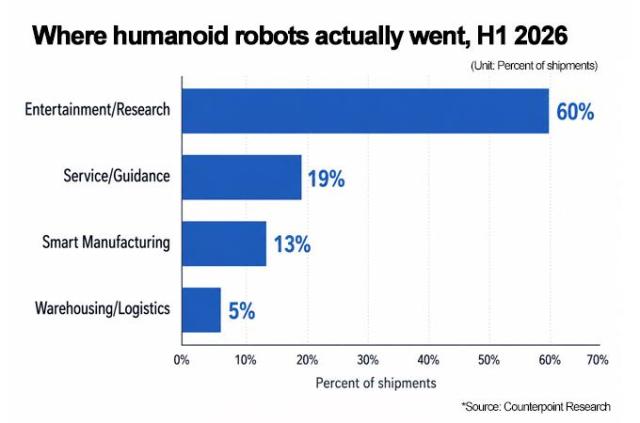
Impressive as the machines are, much of humanoid robotics still ends where the crowd begins - in spectacle.
The crashes are beside the point, said Park Dong-il, director of the Advanced Robotics Research Center at the Korea Institute of Machinery & Materials.
"What China is showing is a process, not a result," Park said. "That is exactly why the games matter."
China's lead in the hardware is already difficult to dispute. Of 666 teams competing in Beijing this year, 641 were Chinese.
"In football terms, China is Messi, and there is no second place," Park said. "No other country can imitate this, which makes the whole thing very hard to measure against anything."
Yet one of the industry's most candid assessments came from a company with every reason to sell optimism.
His benchmark is not running, boxing or backflips. It is a robot dropped into an unfamiliar environment and able to carry out about 80 percent of instructions across 80 percent of situations using little more than spoken or written commands.
Today's machines can approach perfect success rates after extensive training in controlled environments, Wang said. Shift an object or alter the surroundings slightly and those rates can fall sharply.
Zhao Tongyang, founder of EngineAI, put the industrial threshold much higher at the same conference: 99.99 percent.
Factories already have machines that clear it, but the difference lies in specialization.
Humanoids are being built as generalists, while industrial robots have spent decades mastering tightly defined tasks, Park said. On a production line, 99.99 percent is not an aspiration but a baseline because a machine that repeatedly stops the line can be worse than having no machine at all.
A general-purpose robot that succeeds 60 or 70 percent of the time can draw applause at a demonstration. It cannot run a factory.
Industrial robots spent 30 or 40 years grinding their reliability upward, Park said, often one percentage point at a time.
"A lot of what we see is dancing disguised as working," Tang Wenbin, co-founder and chief executive of AI robotics venture Yuanli Lingji, said in remarks reported by Reuters. Chinese humanoid makers have made striking advances in movement and hardware, but conventional industrial robots still outperform them on many of the precise, repetitive tasks factories require.
The industry's answer is increasingly to buy a better brain.
Nvidia in June unveiled an open humanoid reference design aimed primarily at researchers, combining China's Unitree H2 Plus body, five-fingered hands from Singapore's Sharpa and a Jetson AGX Thor computing module capable of 2,070 FP4 teraflops.
The design runs on Nvidia's Isaac GR00T robotics platform, putting the U.S. chipmaker at the center of another emerging computing ecosystem.
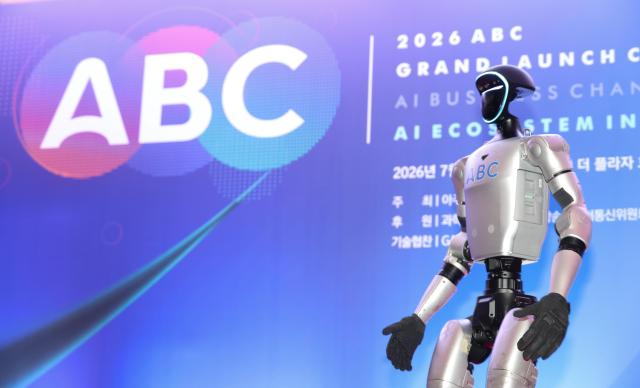
South Korea is joining the race with 2.3 trillion won ($1.66 billion) in planned government spending on humanoids through 2030.
LG Group signed an agreement with Nvidia at the chipmaker's Santa Clara headquarters on Aug. 13 to develop a bipedal humanoid built around Nvidia's Jetson Thor and Isaac GR00T technologies, with an unveiling scheduled for the first quarter of 2027.
Before the humanoid arrives, LG plans to put its wheeled CLOiD robot onto a washing-machine production line at its Tennessee factory this year, testing what happens when a robot leaves the demonstration floor for an actual plant.
Hyundai Motor Group is taking a similarly gradual route.
Its Robot Metaplant Application Center in the United States is scheduled to open this year, preparing Boston Dynamics' Atlas humanoids first for repetitive sequencing work in 2028 and then more complicated assembly tasks from 2030.
Behind them will be an Nvidia-powered AI factory using 50,000 Blackwell GPUs under a wider physical-AI partnership involving Hyundai, Nvidia and South Korea's Ministry of Science and ICT.
Seoul wants more of the machine itself to be Korean.
The Ministry of Planning and Budget said Aug. 27 that the government will buy 250 domestically made humanoids next year and 1,080 by 2030, while seeking to raise localization of key components including actuators, robotic hands and sensors to 80 percent from about 45 percent now.
The scale of China's hardware lead can already be seen at international competitions.
Teams competing at RoboCup 2026 in Incheon in July once arrived with machines they had built themselves, said Kim Ho-joung, a manager at Korean robot maker Aei Robot.
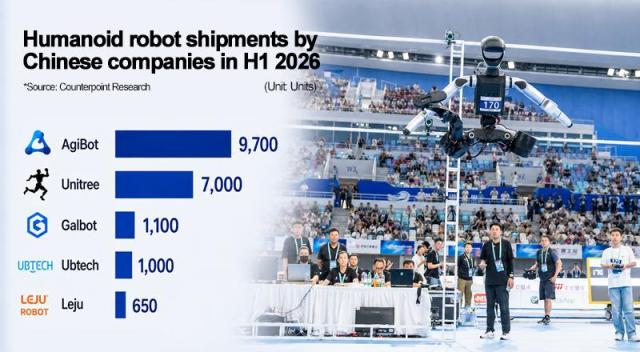
AgiBot topped the Beijing Games with 46 medals — 18 gold, 16 silver and 12 bronze — across dexterous manipulation, scenario-based tasks, martial arts, dance and obstacle events. Many of the tasks being performed would have been difficult to stage convincingly only a year ago.
Galbot is already using robots to pick stock in pharmacies across more than two dozen Chinese cities, filling orders in roughly a minute with a success rate the company puts above 95 percent.
Carrying objects demands relatively little precision compared with assembly, Park said, making logistics one of the most likely areas for early commercialization.
Wheels are faster, cheaper and more stable for much of that work.
Humanoid legs solve a real problem where machines must operate in spaces designed entirely around the human body.
Those places, Park said, may simply be fewer than the industry assumes.
AJP Takeaways
• China dominates humanoid robot hardware, supplying 641 of the 666 teams at the 2026 World Humanoid Robot Games in Beijing as machines set new speed and dexterity records.
• Reliability remains the biggest barrier to humanoid commercialization, with factory applications demanding success rates near 99.99 percent while general-purpose robots can still struggle when objects or environments change.
• Nvidia is emerging as a key supplier of the AI "brain" for humanoid robots, powering reference platforms as well as new projects from South Korea's LG and Hyundai Motor Group.
• South Korea plans to invest 2.3 trillion won in humanoids through 2030, buy 1,080 domestic machines and raise localization of critical robot components to 80 percent.

Copyright ⓒ Aju Press All rights reserved.