The benchmark KOSPI closed at 6,835.80, up 0.23 percent from the previous session. The index fell as low as 6,732.47 in early trading before recovering to an intraday high of 6,857.35.
The rebound came even as all three major investor groups sold shares.
Foreign investors sold a net 491.9 billion won ($359 million) of KOSPI shares, institutions unloaded 634.0 billion won and retail investors sold 539.8 billion won.
Other corporations emerged as the major counterweight, buying about 1.69 trillion won as Samsung Electronics and SK hynix continued their large-scale share repurchases.
The two chipmakers bought a combined 10.3 trillion won worth of shares from Aug. 20 through Aug. 28, according to Shinhan Securities. Their purchases totaled 8.05 trillion won from Aug. 24 through Aug. 28, nearly matching the 8.32 trillion won of KOSPI shares sold by foreign investors over the same period.
The buying helped pull both chip heavyweights and the broader index back from their morning lows.
Strong August export data provided another cushion.
South Korea's exports surged 68.7 percent from a year earlier to $98.25 billion, the third-highest monthly total on record. Semiconductor exports soared 209 percent to a record $46.65 billion as AI-related demand continued to drive chip shipments.
The government's record spending plan for next year presented a more mixed signal for markets.
Seoul proposed an 820.9 trillion won ($597 billion) budget for 2027, up 12.8 percent from this year in the biggest annual increase on record, drawing heavily on a tax windfall generated by booming semiconductor profits.
While the fiscal expansion raised expectations for stronger government-led investment, concerns over public finances and future debt issuance hit the bond market.
The 30-year government bond yield jumped 10 basis points to 4.627 percent, while the 20-year yield climbed 6.9 basis points to 4.559 percent. The 10-year yield rose 5.8 basis points to 4.371 percent.
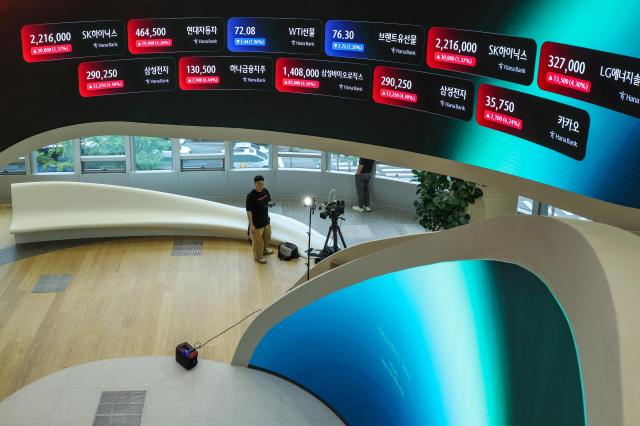
Semiconductor heavyweights recovered alongside the broader market after falling early in the session. Samsung Electronics rose 0.38 percent to 261,000 won, while SK hynix gained 1.14 percent to 1,693,000 won.
Gains extended to several other large-cap shares. Samsung C&T climbed 3.72 percent to 390,500 won, while SK Square rose 2.89 percent to 1,067,000 won. Samsung Life gained 1.14 percent to 309,500 won and Shinhan Financial advanced 2.02 percent to 111,100 won.
Samsung Biologics edged up 0.13 percent to 1,520,000 won, while Kia added 0.15 percent to 131,200 won.
On the downside, Hanwha Aerospace dropped 3.99 percent to 1,058,000 won, while LG Energy Solution fell 2.91 percent to 367,000 won. Samsung Electro-Mechanics lost 1.92 percent to 1,430,000 won and Doosan Enerbility declined 1.33 percent to 81,400 won.
KB Financial fell 1.21 percent to 171,200 won, while Hyundai Motor slipped 0.74 percent to 400,500 won.
The junior KOSDAQ moved in the opposite direction, closing 1.56 percent lower at 821.25 as foreign and institutional selling outweighed retail buying. The index fell as low as 815.52 after reaching an intraday high of 833.52.
Retail investors bought a net 433.7 billion won, while foreign investors sold 151.4 billion won and institutions unloaded 275.1 billion won.
Losses were widespread, with 950 stocks falling, 686 advancing and 98 finishing unchanged. Biotechnology, battery and semiconductor-related shares were among the main decliners.
Alteogen, a biotechnology company developing drug-delivery and biologics platform technologies, fell 2.11 percent to 301,000 won. HLB dropped 4.35 percent to 34,050 won.
Battery-material shares were also under pressure. EcoPro, the holding company at the center of the group's battery-material business, slid 4.49 percent to 87,200 won. EcoPro BM, which produces cathode materials for electric vehicles and energy storage systems, lost 3.81 percent to 116,200 won.
Rainbow Robotics, which develops collaborative, mobile and humanoid robots, declined 2.39 percent to 449,500 won.
Semiconductor equipment and component makers were broadly lower.
Jusung Engineering, which makes semiconductor deposition equipment, fell 2.26 percent to 173,000 won, while Wonik IPS, a semiconductor and display equipment maker, slipped 1.35 percent to 110,000 won. LEENO Industrial, which makes semiconductor test pins and sockets, declined 1.65 percent to 65,500 won.
EO Technics, a maker of laser-based semiconductor equipment, dropped 2.48 percent to 394,000 won, while Simmtech, which produces semiconductor package substrates, lost 2.86 percent to 125,600 won.
In the currency market, the Korean won weakened 1.8 won to close at 1,370.4 per dollar.
The broader market has become less volatile but also markedly less active after the sharp swings earlier in the summer.
The VKOSPI, a gauge of expected volatility in KOSPI 200 shares, closed at 44.03 Tuesday, less than half its June 29 level of 96.94, according to the Korea Exchange.
The calmer market has been accompanied by a sharp drop in turnover. Average daily KOSPI trading value fell to 25.77 trillion won in August, nearly half June's 50.35 trillion won and the lowest level this year. The share turnover ratio declined to 0.54 percent.
Retail participation has also remained subdued.
Investor deposits stood at 98.70 trillion won as of Aug. 28, down nearly 30 percent from a record 139.69 trillion won on June 4, as investors remained cautious following losses during July's selloff.
Investors have also remained wary ahead of the September Federal Open Market Committee meeting as uncertainty over the direction of U.S. interest rates persists.
Korean investors nevertheless continued buying U.S. equities, with net purchases reaching $1.96 billion in August for a third straight month.
Foreign investors, meanwhile, remained net sellers of Korean shares, unloading 10.18 trillion won of KOSPI stocks in August. They nevertheless bought a net 14,246 KOSPI 200 futures contracts in the final week of the month, suggesting some easing in bearish positioning.
Across the region, stocks were mostly lower.
Japan's Nikkei 225 slipped 0.15 percent to 66,215.34 as rising Japanese and U.S. yields weighed on the market. China's Shanghai Composite edged down 0.16 percent to 3,979.89 as weakness in technology shares offset gains in defensive sectors. Hong Kong's Hang Seng Index fell 0.93 percent to 25,329.73.
AJP Takeaways
• South Korea's KOSPI closed 0.23 percent higher at 6,835.80 on Sept. 1, 2026, after falling more than 1 percent intraday, as corporate share purchases and strong August exports offset selling by foreign, institutional and retail investors.
• Samsung Electronics and SK hynix helped support the market through recent share purchases, while South Korea's August exports rose 68.7 percent from a year earlier to $98.25 billion and semiconductor exports surged 209 percent to a record $46.65 billion.
• The broader market remained calmer but less active, with the VKOSPI ending at 44.03 on Sept. 1 and August KOSPI trading value falling to about half its June level, while foreign investors stayed net sellers of Korean shares and domestic investors continued buying U.S. equities.

Copyright ⓒ Aju Press All rights reserved.