Whether spending more alone can prevent another deadly accident is far less certain, experts say.
The Ministry of Land, Infrastructure and Transport said Wednesday that 17 domestic airlines, Incheon International Airport Corp. and Korea Airports Corp. invested a combined 13.31 trillion won ($9.83 billion) in aviation safety in 2025.
The figure rises to 17.45 trillion won in 2026, up 31.1 percent.
The bulk went to aircraft purchases. Operators plan to spend 7.07 trillion won introducing 60 new aircraft this year, compared with 3.88 trillion won for 43 aircraft in 2025.
The number means roughly three-quarters of the increase in overall safety investment between the two years can be explained by higher spending on new aircraft alone.
The timing makes the 2026 figures particularly significant in assessing how the industry responded to the Muan disaster.
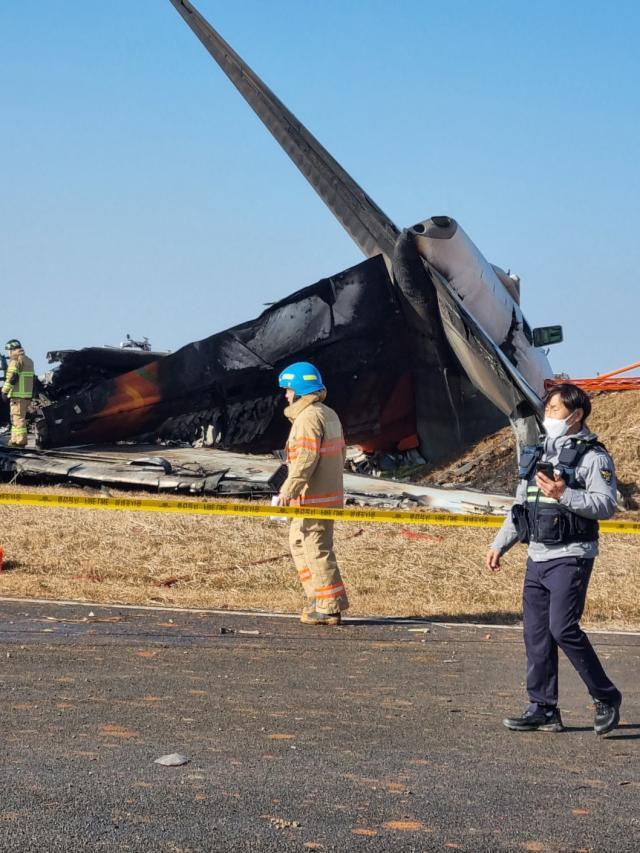
Jeju Air Flight 7C2216 crashed at Muan International Airport on Dec. 29, 2024, killing 179 of the 181 people aboard after the aircraft belly-landed, overran the runway and struck a structure supporting the airport's localizer antenna.
Much of the industry's 2025 spending, particularly aircraft purchases, maintenance programs and infrastructure projects, would have been planned before or around the time of the accident.
The 2026 plans therefore offer a clearer indication of how operators adjusted investment priorities after the disaster, although the headline figure alone says little about how much additional money is being directed at specific safety weaknesses.
Hwang Ho-won, president of the Korea Institute of Aviation Safety Technology, or KIAST, cautioned against treating the disclosure system itself as a response to the crash.
"The safety investment disclosure system is not directly related to the Muan accident," Hwang told AJP. "Its purpose is to encourage airlines and other operators to invest more in safety by making public how much they are spending."
The system was designed to make safety spending visible to passengers and encourage aviation businesses to maintain or increase investment.
But what qualifies as "safety investment" is broad enough to complicate comparisons.
"There is debate over whether everything included under the disclosure system represents pure safety investment or whether it also includes related expenditures," Hwang said.
"If you define safety too broadly, the numbers can become inflated," he said. "We need to look at spending that actually and directly contributes to safety in order to determine whether real safety investment has increased."
Hwang said the indicators are being reviewed to better distinguish expenditures with a direct impact on aviation safety.
That distinction has become more important because the government expanded the categories included in the figures.
The 13.31 trillion won reported for 2025 was 115.5 percent higher than the 6.18 trillion won recorded in 2024.
Much of that apparent surge, however, reflected changes in accounting. The disclosure was expanded to include the cost of introducing new aircraft as well as broader personnel expenses covering pilots, cabin crew and other safety-related employees.
Of the 2025 total, 3.88 trillion won went toward 43 new aircraft and 3.38 trillion won was attributed to safety-related personnel.
Another 3.38 trillion won went toward aircraft maintenance, repair and modification, including preventive maintenance, while 1.88 trillion won was spent on engines and parts and 225 billion won on maintenance facilities and equipment.
Preventive maintenance accounted for 92.7 percent of maintenance, repair and modification spending.
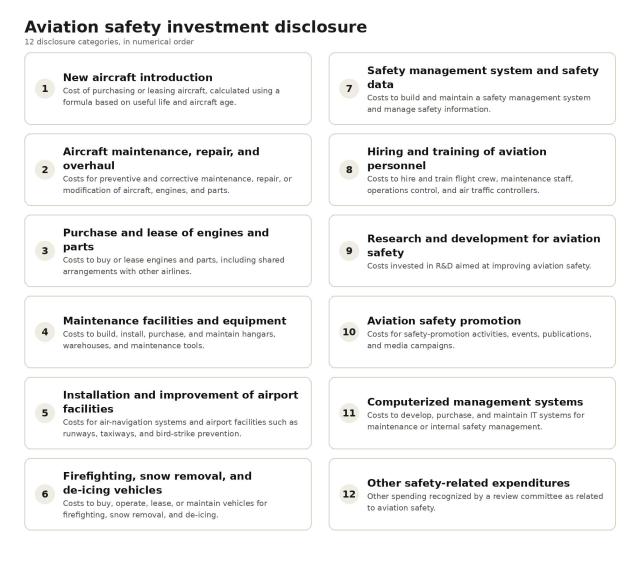
It covers aircraft purchases, preventive maintenance, engines and spare parts, maintenance hangars and equipment, safety management systems and employee training.
For airport operators, it also includes runways and taxiways, navigation systems, bird-strike prevention facilities and firefighting, rescue and snow-removal equipment.
Several of those categories have drawn heightened scrutiny since the Muan disaster, particularly bird-strike risks, emergency response, airport infrastructure and the design of the localizer structure beyond the runway.
Yet more than a year and a half after the crash, investigators have still not published a final report establishing its cause.
The Aviation and Railway Accident Investigation Board's publicly available findings remain limited to its preliminary report issued in January 2025.
Without a final determination, it remains difficult to say what additional investment could have prevented Flight 7C2216 or which measures would be most effective in preventing a similar disaster.
Researchers at KIAST and Korea Aerospace University have also cautioned against judging airlines simply by the size of their safety budgets.
"It is necessary to consider the characteristics of each operator as well as the scale when comparing safety investments," they said.
Greater investment is generally expected to improve safety, but the relationship is not necessarily proportional, they noted.
That makes measures such as safety investment per 10,000 flights and spending per aircraft potentially more revealing than the headline total.
Among low-cost carriers, Trinity Air recorded the largest investment at 990.62 billion won, followed by Jeju Air at 977.57 billion won, Eastar Jet at 559.02 billion won and Jin Air at 407.99 billion won.
Measured by safety investment per 10,000 flights, Parata Air ranked highest at 793.22 billion won, followed by Air Premia at 553.21 billion won and Korean Air at 490.73 billion won.
On a per-aircraft basis, Korean Air led with 43.26 billion won, followed by Eastar Jet at 27.95 billion won and Asiana Airlines at 27.58 billion won.
More detailed 2026 and 2027 investment plans for individual airlines and airport operators are scheduled to be disclosed Thursday.
Those figures should provide a clearer picture of whether the industry's higher spending is concentrated mainly on fleet expansion and operating costs or whether more money is being directed toward maintenance, training, bird-strike prevention and airport infrastructure after the Muan disaster.
For passengers and regulators, the more important question may ultimately be not how much the aviation industry labels as safety spending, but where the money goes — and whether it actually reduces the risks that lead to accidents.
AJP Takeaways
· South Korea’s aviation industry plans to raise safety spending by 31.1% to 17.45 trillion won in 2026.
· Much of the increase comes from new aircraft purchases and broader accounting, making the direct link to the Muan Jeju Air crash unclear.
· Detailed 2026 plans will show whether more money is going to maintenance, training, bird-strike prevention and airport infrastructure.

Copyright ⓒ Aju Press All rights reserved.