
SEOUL, October 14 (AJP) - The Russia-Ukraine war is nearing the five-year mark with little sign of an exit, with both sides expanding attacks on energy infrastructure and extending the war’s repercussions to draw East Asian countries closer to the epicenter.
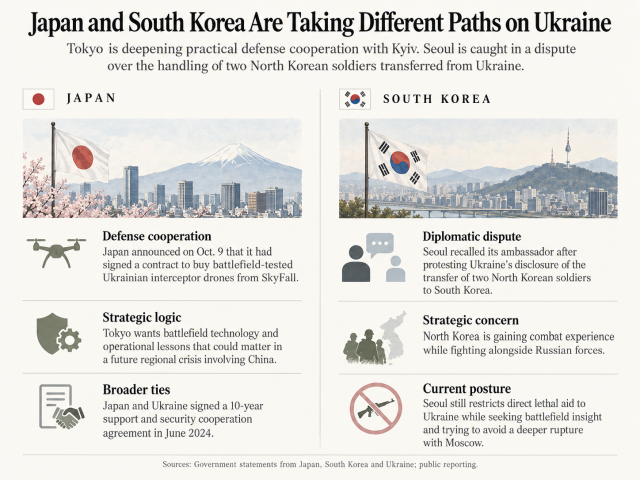
Japan has entered a defense deal with war-engaged Ukraine to purchase battlefield-tested Ukrainian interceptor drones. South Korea is equally engaged with Kyiv but in the opposite direction — a diplomatic spat triggered by Ukraine’s disclosure of the transfer of two North Korean prisoners of war to Seoul.
The contrast reflects different calculations about what the war means for security at home. Tokyo sees Ukraine as a source of technology and operational experience for a possible confrontation involving China. Seoul faces a more immediate concern as its principal threat is gaining combat experience alongside Russian forces.
Seoul has recalled its ambassador in protest at Kyiv’s muted response to its complaints of diplomatic disrespect and the widening dispute with Kyiv risks complicating South Korea’s access to precisely the battlefield knowledge it needs.
Ukrainian Foreign Minister Andrii Sybiha offered dialogue but said Ukraine considered the matter closed, attributing the disagreement to differing interpretations of confidentiality arrangements during the transfer process.
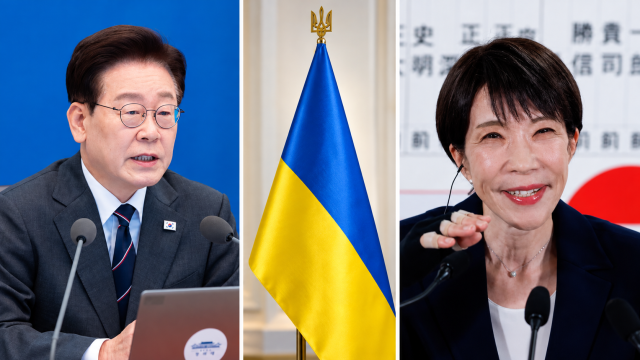
President Lee Jae Myung has framed the dispute as a matter of national standing.
“When the president of the Republic of Korea expressed regret with the utmost courtesy, they denied that an agreement existed, making the head of state of another country out to be a liar,” Lee wrote on social media on Oct. 2.
“When asked to acknowledge the agreement and apologize, Ukraine instead spoke of an imminent military clash between the two Koreas, as if hoping for war on the Korean Peninsula. I express serious regret.
“If they continue to refuse to acknowledge the facts and apologize publicly, we will take further measures. This concerns the dignity of the Republic of Korea and its people, and cannot be overlooked.”
While Seoul presses for an apology, Tokyo is pursuing practical gains from cooperation with Kyiv.
Japan looks to the battlefield
Japanese Defense Minister Shinjiro Koizumi confirmed on Oct. 9 that his ministry had signed a contract to acquire interceptor drones from Ukrainian manufacturer SkyFall. He sought rapid delivery but did not disclose the quantity, value, model or delivery schedule.
The purchase gives concrete form to a strategic argument Japan has made since the invasion.
“The big strategic picture for Japan, as Prime Minister Kishida argued as early as 2022, is that the European and Asian theatres have now become conjoined with Russia’s invasion of Ukraine, and this has only been further confirmed by North Korea’s enhanced cooperation with Russia in Ukraine and in Northeast Asia,” Chris Hughes, professor of international politics and Japanese studies at the University of Warwick, told AJP.
Former Prime Minister Fumio Kishida distilled that concern into a warning: “Ukraine today may be East Asia tomorrow.”
“Japan calculates, most crucially, that if Russia were to prevail in Ukraine that this would only embolden China in its territorial ambitions vis-à-vis Taiwan and Japan itself,” Hughes said.
Yoshihiko Okabe, a professor at Kobe Gakuin University and director of its Matsuguchi Tadashi Anniversary Ukraine Research Center, traced the relationship to shared concerns about Russia.
“Looking at Russia from a central perspective, its western neighbor is Ukraine and its eastern neighbor is Japan; this geopolitical similarity lies in the background,” Okabe told AJP.
Japan’s engagement has expanded from economic and governance assistance after Russia’s initial intervention in 2014 to a 10-year support and security cooperation agreement signed in June 2024. At a Sept. 22 meeting in New York, Prime Minister Sanae Takaichi reaffirmed support for Ukraine, while President Volodymyr Zelenskyy offered to share wartime experience and technology.
Ukraine’s appeal lies partly in its ability to counter expensive threats with relatively inexpensive systems — and improve them quickly.
SkyFall manufactures the P1-SUN family of interceptors, designed to destroy incoming Russian attack drones at a fraction of the cost of conventional air-defense missiles. The company says its original model has destroyed more than 5,500 Shahed-type drones since entering service in November 2025. Reuters said it could not independently verify the claims.
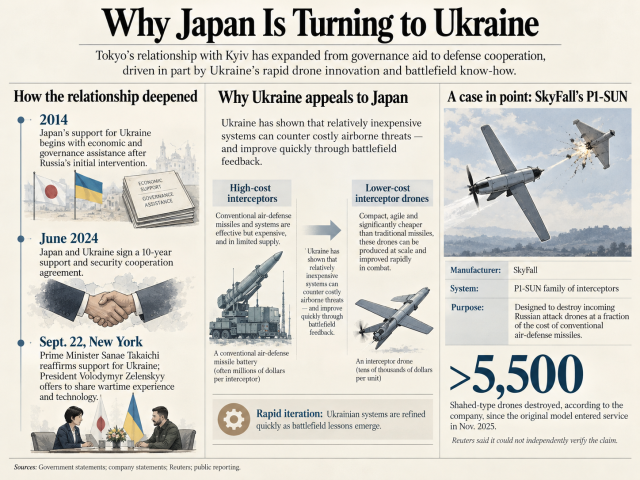
Koizumi highlighted Ukraine’s rapid battlefield feedback, with new capabilities emerging every two or three weeks, as a lesson for Japan’s defense industry and production base.
“Ukraine’s mastery of drones operationally, and its ability to rapidly innovate and manufacture drones is of vital importance to Japan’s own defense strategy,” Hughes said.
Japan remains constrained in supplying weapons directly to Ukraine. Koizumi said Tokyo was not currently considering transfers classified as weapons under Japanese law.
Buying Ukrainian technology, however, opens another avenue for cooperation.
From aid recipient to technology supplier
Early in the invasion, Ukrainian troops improvised weapons from commercially available drones. That effort has grown into a network of manufacturers, software developers and military technology startups.
“An incredibly rapid, civil-military collaborative ecosystem is currently being built in Ukraine, driven primarily by AI, robotics, cybersecurity, and drones,” Okabe said.
Brave1, a government-backed defense innovation platform established in 2023, connects developers with military requirements, battlefield testing and financing. Its ecosystem encompasses about 2,500 companies and more than 5,000 products and technological solutions.
The platform said in September that it had awarded more than 1,000 grants totaling 6.2 billion hryvnias. Developers can test prototypes with military units, incorporate feedback and move successful products toward mass production.
European governments are pursuing joint production and innovation programs with Kyiv. Ukraine is increasingly becoming a supplier of military equipment and knowledge as well as a recipient of assistance.
Battlefield success does not guarantee a ready fit elsewhere. Japan must assess Ukrainian systems against its own operational needs, maintenance standards and procurement rules. The innovation process may prove as valuable as the equipment itself.
Seoul’s immediate stakes
South Korea has reasons for caution that Japan does not share to the same degree.
North Korea has deployed thousands of troops to support Russia since late 2024, alongside artillery ammunition and ballistic missiles. Seoul must assess both what those forces are learning and what military technology Moscow could provide in return.
Japan also faces North Korean missiles and shares concerns about Russia and China. But it does not confront North Korean ground forces across an armistice line or bear primary responsibility for responding to another Korean war.
Seoul has maintained restrictions on supplying lethal weapons directly to Ukraine while providing humanitarian assistance and developing extensive defense-industrial ties with European countries, including Poland. A deeper rupture with Moscow could further complicate efforts to discourage Russian technology transfers to Pyongyang.
The prisoners’ transfer brought those sensitivities into sharp relief.
Ukrainian forces captured the two North Korean soldiers in Russia’s Kursk region in January 2025. Both expressed a wish to resettle in South Korea rather than return to the North, where they could face persecution.
They arrived in South Korea in September after months of consultations. Seoul withheld an announcement, citing their safety and the vulnerability of relatives remaining in North Korea.
Zelenskyy disclosed the transfer in his Sept. 23 address to the United Nations General Assembly. Lee expressed regret the following day, saying Ukraine had breached a confidentiality agreement. Ukrainian officials disputed that account, prompting Seoul to demand an explanation and apology.
Foreign Minister Cho Hyun subsequently said a message from Sybiha contained an apology but fell short of Seoul’s expectations.
For Kyiv, the soldiers provided evidence of North Korea’s involvement in Russia’s war. For Seoul, their resettlement was a sensitive humanitarian and national security operation with consequences extending to their families.
Those concerns help explain Seoul’s response. They do not diminish the strategic value of continued cooperation.
Ukraine has firsthand information about North Korean units, their battlefield performance and their interaction with Russian forces. Such observations could help Seoul assess how combat experience and possible technology transfers are changing the threat on the peninsula.
Restoring a reliable diplomatic channel would require clearer arrangements for handling sensitive information, including advance consultation over disclosures involving North Korean personnel.
Beyond intelligence exchanges, South Korea’s defense manufacturers and electronics companies could explore cooperation in counter-drone detection, electronic warfare, unmanned systems and infrastructure protection. Technical exchanges with Japanese and Ukrainian specialists could also help determine which battlefield lessons apply to East Asian conditions.
These remain possibilities. Export controls, intelligence safeguards and political differences would have to be addressed.
“If Japan and South Korea can support Ukraine by leveraging their respective areas of expertise, it would serve as an excellent precedent for a global challenge that South Korea and Japan can collaborate to resolve,” Okabe said.
For Japan, the question is how quickly Ukraine’s battlefield lessons can become usable defense capabilities. For South Korea, it is whether the dispute with Kyiv can be resolved before it obstructs cooperation on a threat already taking shape.
Copyright ⓒ Aju Press All rights reserved.
