
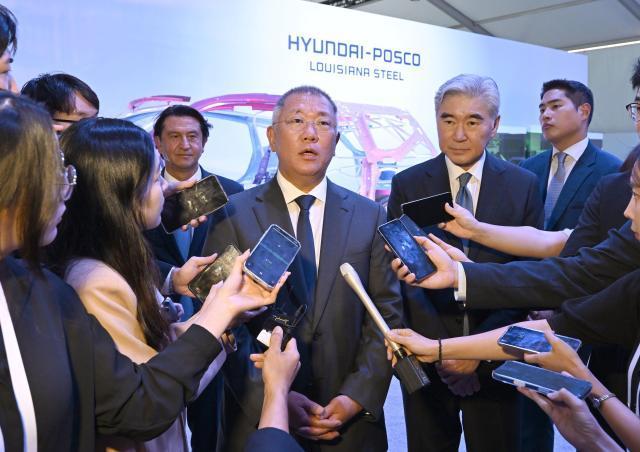
DONALDSONVILLE, Louisiana, September 05 (AJP) - Hyundai Motor Group is envisioning a U.S.-based steel supply chain stretching from cars to humanoid robots and even rockets, with its Chairman Chung Euisun saying steel from its new Louisiana mill could eventually be used in Boston Dynamics' Atlas and supplied to companies such as SpaceX.
Speaking to reporters after the groundbreaking ceremony for Hyundai-POSCO Louisiana Steel (HPLS) in Donaldsonville, Louisiana, on Friday, Chung said steel produced at the plant should "of course" be used in Atlas, the humanoid robot being developed by Hyundai-owned Boston Dynamics.
"I think we naturally should apply it," Chung said when asked whether steel produced at HPLS could be used in Atlas. "If we work harder going forward, I hope we can supply this steel even for rockets made by companies such as SpaceX."
The comments point to ambitions beyond securing a local source of automotive steel for Hyundai Motor and Kia, extending potential demand for the Louisiana plant into robotics, aerospace and other advanced industries.
HPLS will be Hyundai Steel's first steel mill in the United States and the country's first electric-arc-furnace-based mill specializing in automotive steel.
The project carries a total investment of $5.8 billion, or roughly 8 trillion won, and is scheduled to begin commercial production in 2029.
The plant will have annual production capacity of 2.7 million tons, including 1.8 million tons of automotive steel sheets and 900,000 tons of general-purpose steel products.
Hyundai Steel holds a 50 percent stake in HPLS, while POSCO owns 20 percent. Hyundai Motor and Kia each hold 15 percent.
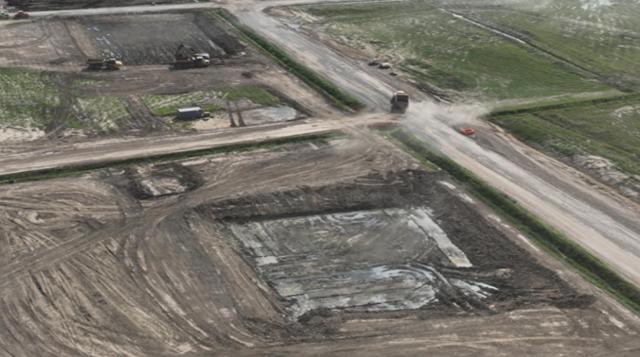
The facility covers about 7.37 million square meters. Once operational, it is expected to supply Hyundai Motor's Alabama plant, Kia's Georgia plant and Hyundai Motor Group Metaplant America, while also targeting other automakers in the U.S. market.
Hyundai Steel expects the mill to help address chronic shortages of higher-value automotive steel in the United States while building a more localized supply chain for the group's rapidly expanding U.S. manufacturing operations.
Still, Chung stressed that avoiding U.S. steel tariffs was not the main reason for the investment.
"Tariffs were not the objective," he said. "We are in a situation where we need to produce and use low-carbon and higher-value steel here in order to improve the quality of the vehicles we manufacture." "I think the advantages on both sides can create synergy."
Asked how much the local production could save in tariff costs, Chung said the impact was difficult to quantify because U.S. trade policy continued to change.
"Tariffs keep changing, so rather than being preoccupied with tariffs, it is more important to produce better products here and improve vehicle quality," he said. "That is where we intend to place more emphasis."
The project nevertheless comes as U.S. trade barriers have reshaped the economics of exporting steel into the world's second-largest automobile market.
The United States has historically imported more than 20 million tons of steel annually as domestic production falls short of demand, while locally produced hot-rolled steel commands some of the highest prices among major markets.
Chung said local production of specialized and lower-carbon products could eventually replace a significant portion of those imports.
"The United States currently imports about 20 million tons of steel," Chung said. "If high-value specialty steel and low-carbon steel are produced here, as much as 10 million tons of that demand could be covered, which would also benefit the United States."
The chairman also emphasized the significance of bringing POSCO into the project, describing the Korean steelmaker as one of the world's leading producers and a long-time partner of Hyundai Motor Group.
"We have worked with POSCO in many areas and have held in-depth discussions on future steel and next-generation batteries," Chung said. "I am pleased that we are investing together. If we conduct research in better ways and produce materials with higher quality and more advanced technology, I think it can be a win-win."
HPLS will combine direct-reduced iron, or DRI, technology with electric-arc furnaces in an integrated production system running from raw materials to finished steel.
In the first stage, iron ore and natural gas will be used to produce DRI. The material will then be fed into electric-arc furnaces together with scrap steel to produce molten steel.
Continuous casting facilities will convert the molten metal into slabs, which will then move through hot-rolling and cold-rolling lines to become products including cold-rolled and coated automotive steel.
Hyundai Steel says the process can cut carbon emissions by about 70 percent compared with conventional blast-furnace steelmaking, which relies heavily on coal.
Chung described the combination of DRI and electric-arc furnaces as another technological challenge for the group.
"Using electric furnaces allows us to produce low-carbon steel and reduce carbon emissions by about 70 percent," he said. "Combining that with DRI is a challenge involving new technology, and if it succeeds, it could be applied elsewhere."
Hyundai Steel ultimately plans to replace natural gas used in the DRI process with hydrogen as part of a longer-term transition away from coal-based steelmaking. The company aims to convert its steel production toward hydrogen-based processes by 2050.
The Louisiana investment has moved quickly since Chung announced Hyundai Motor Group's broader U.S. investment plans at the White House in March last year.
Hyundai Steel established a dedicated North American steel business unit two months later and formed its Louisiana subsidiary in June. Hyundai Motor, Kia and POSCO began making equity investments in the project in January this year.
The company has also signed major equipment contracts with Italy's Danieli and Germany's SMS, as well as agreements related to electricity supply and cold-rolling facilities.
A specialized training center is being developed with River Parishes Community College and local institutions to prepare workers for the plant.
The site near the Mississippi River offers access to rail lines and waterways capable of accommodating Panamax-class vessels. It also sits within reach of major auto plants across the U.S. South, including Hyundai and Kia facilities as well as factories operated by General Motors, Volkswagen and Honda.
Chung was more cautious about another potential use for Atlas — deploying humanoid robots inside the steel mill itself.
"We first need to conduct a lot of testing and see whether it is feasible," he said. "Atlas is intended to do work that is difficult for people, so we want to use robots for jobs that are hard for humans and supplement safety in those areas."
Hyundai Motor Group has been accelerating efforts to incorporate robotics and other advanced technologies into manufacturing as it reorganizes operations around automation and artificial intelligence.
Chung said the group is experimenting with organizational changes as well as new technology.
Asked whether Hyundai Steel could build additional U.S. mills, Chung said the immediate priority was making the Louisiana project a success. "We are only just starting, so succeeding here is the most important thing," he said. "At this point, we are not yet considering other locations."
AJP Takeaways
- Hyundai Motor Group is building a U.S.-based steel supply chain that could extend beyond cars to Boston Dynamics’ Atlas humanoid robot and potentially SpaceX rockets.
- The $5.8 billion Hyundai-POSCO Louisiana Steel mill is scheduled to begin production in 2029 with annual capacity of 2.7 million tons.
-HPLS will combine direct-reduced iron and electric-arc furnaces, which Hyundai says could cut carbon emissions by about 70 percent versus conventional blast-furnace production.
Copyright ⓒ Aju Press All rights reserved.
