SEOUL, September 04 (AJP) - The South Korean won is looking entirely different from the first half, closing at its strongest level in 14 months Friday as a swelling current-account surplus increasingly offsets heavy overseas equity investment and other capital outflows, giving authorities room to absorb a reported $20 billion in dollars from SK hynix's landmark U.S. share sale without reversing the currency's rally.
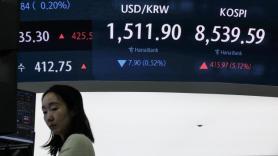
The dollar fell 8.9 won to close Friday's daytime trading at 1,350.4 won at 3:30 p.m., after briefly entering the 1,340 range for the first time since early July 2025.
The greenback has fallen about 13 percent from its July 1 close of 1,559.2 won, a sharp reversal from June, when it traded as high as 1,561 won.
The won's strength also stands out against other major currencies. Over the period, the dollar index rose about 1.3 percent and the dollar gained 0.3 percent against the Japanese yen, suggesting Korea-specific forces have driven the won's rebound rather than a broad retreat in the U.S. currency.
The turnaround is increasingly backed by Korea's external accounts.
The country accumulated a current-account surplus of $233.09 billion in the first seven months of this year, nearly four times the $59.82 billion recorded in the same period of 2025, according to preliminary Bank of Korea data released Friday.
The goods surplus alone widened to $234.28 billion from $69.35 billion a year earlier as booming semiconductor exports generated a growing stream of foreign-currency earnings.
The scale is striking because the improvement has come despite powerful financial-account flows working in the opposite direction.
Korean residents increased their holdings of overseas equities by $60.89 billion from January through July. At the same time, foreign investors reduced their holdings of Korean equities by a net $100.30 billion, according to the BOK.
Taken together, the two equity flows represented roughly $161.2 billion of outward financial pressure — residents sending money into foreign stocks while overseas investors pulled money out of Korean shares.
The figures do not translate mechanically into spot foreign-exchange demand because investments can be hedged and corporate export proceeds do not necessarily return immediately to Seoul.
But they help illustrate how dramatically Korea's underlying foreign-currency balance has shifted. A current-account surplus approaching a quarter-trillion dollars has been large enough to coexist with exceptional portfolio outflows while the won has still appreciated sharply.
Seoul policymakers spent much of the first half tapping foreign-exchange swaps with the National Pension Service and selling dollars to contain won weakness.
The tide changed sharply in the second half.
Exporter dollar selling remained heavy, while a softer U.S. currency and stronger Japanese yen provided additional support for the Korean currency.
Rather than needing to supply dollars, authorities apparently gained room to absorb them.
The Foreign Exchange Stabilization Fund, or FESF, bought about $20 billion of the $26.5 billion in dollar proceeds raised through SK hynix's American depositary receipt offering in July, Reuters reported Wednesday, citing a source with direct knowledge of the transaction.
The reported purchases were conducted over the counter as SK hynix repatriated the proceeds, avoiding direct execution through the domestic spot foreign-exchange market.
Neither the Ministry of Economy and Finance nor the Bank of Korea has confirmed the amount, timing, exchange rates or financial institutions involved.
An off-market purchase allows SK hynix to obtain won without placing an equivalent dollar sell order in the Seoul spot market.
The operation therefore removes potential dollar supply from the market and reduces appreciation pressure relative to a direct conversion rather than directly causing the won to weaken.
Seen against Korea's broader external balance, however, the significance may be less about where the won would have traded on a particular day and more about authorities' increased capacity to absorb an unusually large dollar inflow without destabilizing the currency market.
Friday's fall in the dollar-won rate, including its intraday move into the 1,340 range, shows that exporter supply and global currency forces can still dominate even after a transaction of this size.
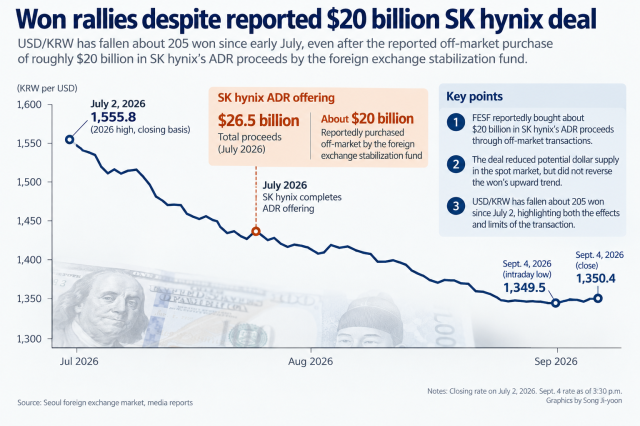
The comparisons demonstrate the transaction's scale but do not establish that the entire amount was added to official reserves on a one-for-one basis.
Foreign-exchange reserves rose by a record $14.33 billion in August to $442.28 billion, with the BOK citing increased foreign-currency deposits at financial institutions, investment income and valuation changes.
Public data do not establish whether the reported SK hynix transaction contributed to the August increase or, if so, by how much.
"The actual dollar-supply effect could continue through August or September," Kwon Ah-min, an FX analyst at NH Investment & Securities, told AJP in July.
Kwon expected conversions to be staggered and said SK hynix would retain part of the proceeds in dollars to pay overseas equipment suppliers, making the flow more likely to cap rebounds in the dollar-won rate than produce a one-way won rally.
"If the report is true, it would be difficult to say the large dollar-supply effect from the ADR has disappeared entirely," Lee Min-hyuk, an economist at KB Kookmin Bank, wrote in a report Friday.
Lee said most of the funds would remain in government foreign-currency assets that could later be released for market stabilization, weakening the case for a dollar-won rebound caused by a supply gap after the ADR proceeds were exhausted.
In short, the SK hynix dollar proceeds could become intervention firepower if the dollar-won rate reverses sharply higher.
A larger stock of liquid dollars increases authorities' capacity to meet demand during renewed won weakness, although it cannot guarantee a particular exchange rate or offset persistent market forces.
The BOK's balance-of-payments data also showed foreign equity investment in Korea increased by $5.98 billion in July, partly reflecting the ADR issuance. Korean residents, meanwhile, added $12.33 billion in overseas equities during the month.
The reported transaction could offer a template for handling unusually large corporate inflows because an over-the-counter block trade can prevent a single conversion from disrupting a comparatively smaller spot market.
The U.S. Treasury has said intervention should address excessive volatility or disorderly exchange-rate movements rather than maintain a preferred currency level.
The exceptional size and one-off nature of the SK hynix proceeds would therefore be central to the policy rationale if authorities confirm the transaction.
The AI chip windfall has become something close to an economic cure-all for Korea, powering growth despite geopolitical headwinds, swelling the country's fiscal buffers and finally giving the won long-delayed traction.
AJP Takeaways
- Korea's January-July current-account surplus surged to $233.09 billion, nearly four times a year earlier, creating a much stronger fundamental dollar buffer behind the won.
- The won strengthened despite substantial equity outflows: residents added $60.89 billion in overseas stocks while foreign investors cut Korean equity holdings by $100.30 billion.
- Authorities reportedly absorbed about $20 billion of SK hynix's ADR proceeds off market, preventing an unusually large corporate dollar sale from directly hitting Seoul's spot market.
- The won's move to a 14-month high suggests Korea's swelling trade surplus, exporter dollar selling and global currency forces are outweighing both outbound investment demand and the removal of SK hynix's potential dollar supply.

Copyright ⓒ Aju Press All rights reserved.